Behind the fence were more cars.
A BMW.
A late-model pickup.
A black Jeep.
A motorcycle.
Two campers.
Most carried plates from outside Texas.
Colorado.
New Mexico.
Arizona.
Oklahoma.
California.
I counted eleven vehicles before the Explorer turned toward the booking entrance.
The deputy caught me looking.
“Eyes front.”
I continued looking.
He stopped correcting me.
Inside, they removed my belt, boots, jacket, wallet, phone, and watch.
The booking room smelled like disinfectant and old coffee.
A camera watched from the ceiling.
I noted its angle.
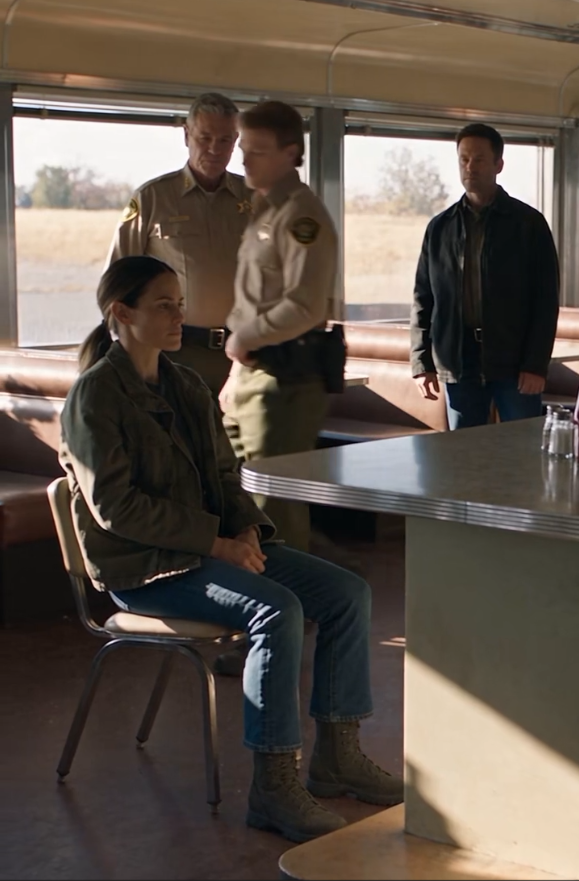
Sheriff Miller leaned against the counter while the young deputy inventoried my property.
“Driver's license. Eighty-three dollars cash. One Visa. One American Express. One hotel key card. Phone.”
He picked up my watch.
It looked ordinary.
It wasn't.
He glanced at the face.
“Watch.”
“Put everything in the bag,” Miller said.
The deputy did.
My military identification wasn't in the wallet.
That was intentional.
I kept it in an inside sleeve of my field jacket when traveling.
Miller picked up the jacket.
For a moment, I thought he'd search it.
Instead he handed it to the deputy.
“Bag it.”
The deputy folded it.
I watched him place it inside a plastic property sack.
Not thorough.
Granger entered carrying the Pelican case.
My attention settled on the handle.
The security seal was broken.
There it was.
The complication I'd been expecting.
Granger set it on the booking counter.
“What exactly are you carrying, Ms. Reese?”
I looked at the case.
The external tamper strip had been peeled away.
“Did you document the seal before you broke it?”
His expression sharpened.
Miller looked between us.
“What seal?”
“The one he removed.”
Granger rested both hands on the case.
“I'm asking the questions.”
“Then ask better ones.”
Miller pushed away from the counter.
“Careful.”
I met his eyes.
He wanted me frightened.
I had been frightened many times in my life.
This wasn't one of them.
That didn't mean I underestimated the situation.
Corrupt men became most dangerous when reality stopped obeying the story they had written for themselves.
Granger turned the case toward me.
“We can't get into it.”
“Yes.”
“Combination?”
“No.”
“Key?”
“No.”
“Then how does it open?”
“Not your concern.”
He smiled again, but the smile had become thin.
“It became my concern when I found narcotics in your vehicle.”
“You didn't find narcotics in my vehicle.”
The room changed.
Not dramatically.
Nobody gasped.
Nobody reached for anything.
But the young deputy stopped writing.
Miller's face went still.
Granger leaned closer.
“Say that again.”
“You heard me.”
Miller walked toward me.
“You accusing my deputies of planting evidence?”
“No.”
He stopped.
I continued.
“I'm telling you the drugs weren't mine.”
“Same thing.”
“Not necessarily.”
That confused him.
Good.
Granger tapped the top of the Pelican case.
“You know what happens if we get a federal warrant and open this?”
“I know what happens if you open it.”
“What?”
“You create a record.”
He stared at me.
Behind him, the young deputy resumed writing.
Very slowly.
My phone sat inside the property bag.
Its screen was dark.
At 1900 hours, I was scheduled to transmit a secure administrative check-in.
It was one of several irritating precautions imposed after the operation that had put me on leave. For three weeks, command wanted a predictable welfare confirmation every evening. Nothing operational. Nothing dramatic.
A simple encrypted acknowledgment.
I had complained about it.
My operations officer had ignored me.
It was now 5:42 p.m.
Sheriff Miller thought he had hours.
In reality, he had seventy-eight minutes.
He just didn't know it.
Neither did Granger.
Yet.
Part II — Pressure
They put me in an interview room instead of a holding cell.
That told me what they wanted.
The room contained a metal table bolted to the floor, three chairs, a wall-mounted camera, and a fluorescent light that buzzed faintly above my head.
My handcuffs were attached to a steel ring on the table.
Someone had scratched initials into the paint.
Miller entered carrying a folder.
Granger followed.
No deputy.
Miller sat across from me.
Granger remained standing.
“Here's where we are,” Miller said.
He opened the folder.
Inside were photographs of my Bronco, the duffel bag, plastic packets of crystalline powder, and a digital scale I had never seen before.
The photographs were poorly framed.
No timestamps visible.
No continuous scene documentation.
No photograph showing the supposedly concealed duffel before removal.
Sloppy.
Or deliberate.
“Possession with intent,” Miller said. “Trafficking across state lines. Firearm enhancement once we get into that case.”
I looked at the photographs.
The duffel was blue nylon.
Cheap.
Brand new.
No dust on it.
The floor of my Bronco had enough West Texas dust to coat anything left there for five minutes.
The bag had supposedly been beneath the back seat.
Yet it was clean.
Miller slid a piece of paper toward me.
“Could be twenty years.”
I looked down.
A waiver.
Not a confession.
A vehicle forfeiture agreement.
There was a blank for my signature and language transferring ownership of my Bronco to the county pending disposition of the criminal case.
I read the first page.
Then the second.
Granger watched me.
“You sign that,” Miller said, “we can start talking about reducing charges.”
“How much cash do you usually take?”
His eyes narrowed.
“What?”
“Vehicle. Cash. Personal property. What's the average?”
Granger leaned over the table.
“You think this is funny?”
“No.”
Miller pulled the agreement back.
“You've got a lot of confidence for somebody in your position.”
“I've been in worse positions.”
“I bet.”
He meant it as sarcasm.
I didn't.
Granger placed both palms on the table.
“Who are you?”
“Alice Reese.”
“You military?”
There it was.
I looked at him.
He had noticed something.
Maybe my posture.
Maybe the boots.
Maybe the calluses.
Maybe the way I had evaluated him.
“Why?”
“You don't move like a tourist.”
“Neither do you.”
He stared at me.
Miller looked annoyed.
“Tom.”
Granger ignored him.
“You active?”
I remained silent.
“Federal?”
No answer.
“Contractor?”
Nothing.
He pulled out the chair beside Miller and sat.
“Here's something you need to understand. Whatever you think you are somewhere else, you're in Okehaven County now.”
“Okehaven is a town.”
His eyes hardened.
“Excuse me?”
“The county has a different name.”
For three seconds, nobody spoke.
I had seen the county name on the courthouse as we drove in.
Granger's mistake was revealing he barely thought of the distinction.
His world ended wherever Miller's authority ended.
Miller slammed the folder shut.
“Enough.”
He stood.
“You get one phone call after booking. Until then, you sit.”
“I want counsel.”
That was my second deliberate escalation.
Miller stopped near the door.
Granger didn't move.
“I am invoking my right to counsel,” I said. “I will not answer further questions.”
Miller looked at Granger.
Granger's jaw shifted.
Legally, the interview was over.
Neither man left.
That told me something else.
Miller returned to the table.
“I'm trying to help you.”
I said nothing.
“You're making that difficult.”
Silence.
Granger leaned toward me.
“What's in the case?”
I looked at the camera mounted on the wall.
Then back at him.
No answer.
Miller followed my glance.
He walked to the wall.
Reached up.