“I heard.”
“Granger isn't.”
“I heard that too.”
“He says everybody's lying.”
“That sounds expensive.”
The former deputy smiled despite himself.
Then he became serious.
“I keep thinking about the diner.”
“What about it?”
“You never looked scared.”
“I was concerned.”
“Didn't look like it.”
“That's different.”
He nodded.
“I thought you were crazy.”
“You said so over the radio.”
His face went blank.
“You heard that?”
“Yes.”
He covered his eyes with one hand.
“Great.”
“You were young.”
“That was two months ago.”
“You've aged.”
He laughed again.
Then he looked at the table.
“Can I ask you something?”
“You can.”
“When did you know?”
“Know what?”
“That Miller and Granger were dirty.”
“When Granger showed me the evidence bag.”
“Because of the tape?”
“That confirmed something was wrong.”
“But before that?”
I thought back.
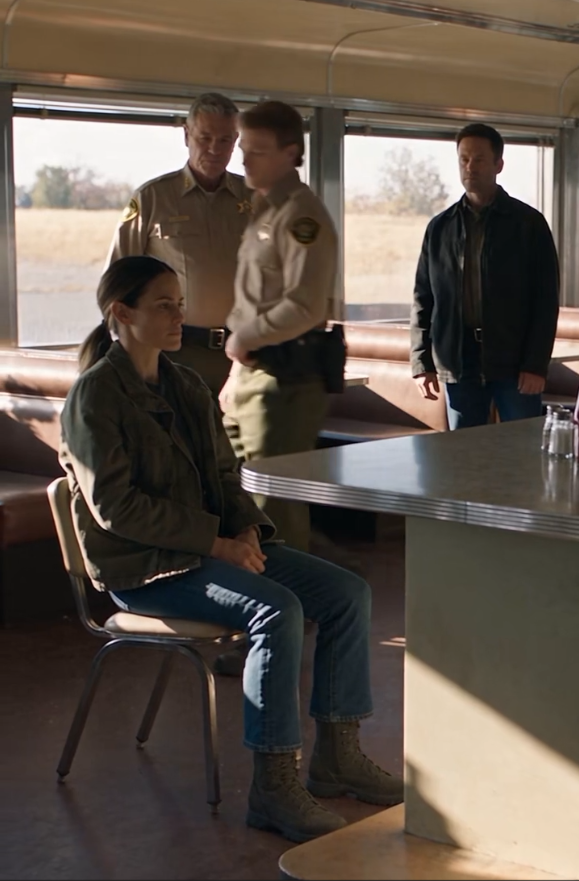
The front door exploding open.
Three deputies.
Granger hanging behind them.
Miller standing outside the doorway.
The clean blue duffel in a dusty Bronco.
The gun barrel against my back.
The waitress frightened before anyone had explained the reason for the raid.
“I didn't know.”
He frowned.
“You suspected.”
“Yes.”
“What's the difference?”
“Suspecting is a reason to pay attention. Knowing is what comes after evidence.”
He sat with that.
Outside, a pickup rolled through the parking lot.
Nobody looked twice at it.
The former deputy said, “Miller always acted like being certain made him strong.”
“It made him careless.”
“And you?”
“What about me?”
“You never seem certain.”
I looked at him over the rim of my coffee cup.
“I'm certain about plenty of things.”
“Like?”
I considered answering.
Then I looked around Higgins Diner.
At the truckers eating breakfast.
At the waitress refilling cups.
At the sunlight warming the worn tables.
At the parking lot where my Bronco sat exactly where it had the first day.
Two months earlier, three men had believed silence meant weakness.
They had believed isolation meant vulnerability.
They had believed a woman traveling alone in an old truck was simply an opportunity with Colorado plates.
They had built their entire operation around one assumption:
That the people they chose would be too frightened, too poor, too distant, or too alone to force anyone important to look closely.
My profession had taught me many things about dangerous people.
The most useful was also the simplest.
Predators rarely fear strength they can see.
They fear uncertainty.
The unknown witness.
The overlooked camera.
The nervous deputy who finally says no.
The evidence label nobody bothered to scrape completely away.
The victim who refuses the convenient exit.
The system that starts asking a second question after years of accepting the first answer.
The waitress brought another slice of cherry pie and placed it between us.
“I didn't order this,” I said.
“On the house.”
I looked at the former deputy.
“You want it?”
“No way.”
“Why?”
“Last time you ate pie here, half the county got indicted.”
The waitress laughed from behind the counter.
I stared at him.
Then, despite myself, I laughed too.
Outside, the morning sun flashed against the Bronco's windshield.
My wrists had healed.
The marks were gone.
The truck was mine again.
The road west waited beyond the cracked parking lot.
For once, nobody was blocking it.
I finished my coffee, left money beneath the cup, and stood.
The former deputy looked up.
“Where you headed?”
I pulled on my faded olive jacket.
“West.”
“Anywhere specific?”
“No.”
He smiled.
“Quiet trip?”
I glanced toward the sheriff's office in the distance.
“That was the original idea.”
The bell rang when I opened the diner door.
Warm Texas air moved across my face.
I crossed the parking lot, climbed into the Bronco, and started the old engine.
For a moment, I remained there with both hands on the steering wheel.
Then I looked once at Higgins Diner in the rearview mirror.
The former deputy was still inside.
The waitress was pouring coffee.
Ordinary people in an ordinary town, going back to an ordinary morning after learning how much damage can hide beneath routine.
I shifted into gear.
Two months earlier, Sheriff Boyd Miller had told me that by midnight I'd surrender my Bronco for the privilege of making a phone call.
He had been wrong about almost everything.
But especially one thing.
Silence had never meant I had nothing to say.
Sometimes silence simply meant I was paying attention.
And once I had seen enough, there was nowhere left for them to hide.