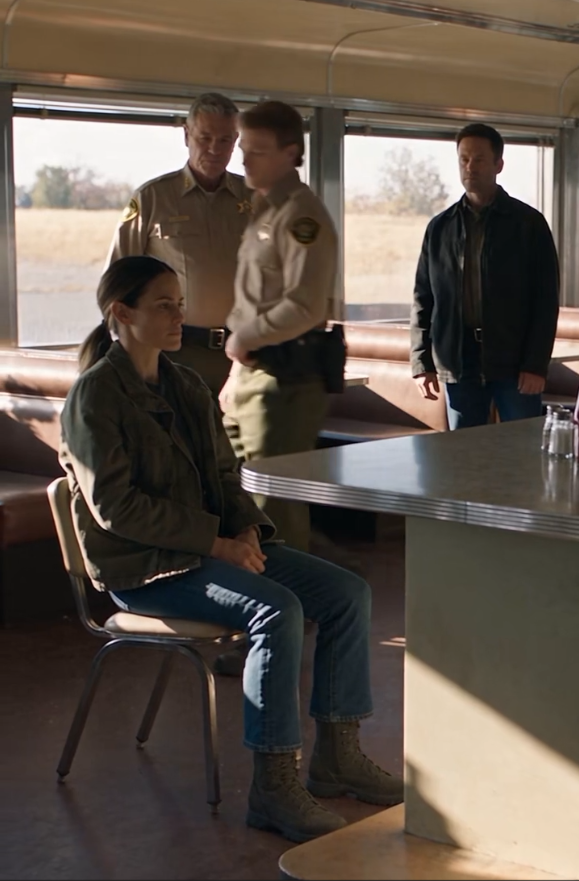
I stopped.
I could have said something satisfying.
Something sharp.
I could have told him prison.
I could have reminded him of his own threat about not seeing sunlight for a decade.
It would have been easy.
Instead I looked back.
“I don't decide that.”
Then I left.
Because that was the difference.
Part VI — Aftermath
The sun rose over Okehaven at 6:18 the next morning.
I knew because I was still awake.
I sat on the hood of my Bronco inside the secured impound lot while investigators finished photographing the interior.
Someone had given me coffee.
It was terrible.
I drank it anyway.
The vehicle looked almost exactly as it had the day before.
The same chipped paint.
The same dust.
The same old dent over the rear wheel well.
But everything inside had been cataloged.
Photographed.
Swabbed.
Tagged.
The blue duffel had been removed.
The Pelican case had been transferred into federal custody until its contents could be reverified.
My SIG remained secured.
My phone was back in my pocket.
My field jacket hung over my shoulders.
Commander Mercer walked through the gate carrying two fresh coffees.
He handed me one.
I smelled it.
“Better?”
“Marginally.”
“High praise.”
He leaned against the Bronco.
For a while we watched investigators work.
“You're not going back on leave today,” he said.
“I assumed.”
“Medical evaluation.”
“I'm fine.”
“Not optional.”
“Administrative debrief?”
“Yes.”
“Legal?”
“Definitely.”
I drank my coffee.
“Wonderful.”
Mercer smiled.
“You know, most people on leave go to beaches.”
“I don't like beaches.”
“Mountains.”
“Too many tourists.”
“Stay home.”
“Boring.”
He nodded toward the sheriff's office.
“This was less boring.”
I looked at him.
He raised both hands.
“Just observing.”
The young deputy came through the gate.
He had a dark bruise forming along his cheek.
He had changed into jeans and a gray T-shirt.
No badge.
He stopped several feet away.
“Ma'am.”
“Deputy.”
He glanced down.
“Not right now.”
I nodded.
He looked toward the Bronco.
“They said you can probably take it once they're finished.”
“Probably.”
He shifted his weight.
“I wanted to say I'm sorry.”
“For what?”
He seemed surprised.
“For arresting you.”
“You believed the arrest was lawful?”
“At first.”
“Then you did your job.”
“Badly.”
“You put the cuffs on too tight.”
His face reddened slightly.
“Yeah.”
“Work on that.”
Mercer hid a smile behind his coffee.
The young man looked toward the sheriff's office.
“They're saying I might keep my certification.”
“I heard.”
“I don't know if I want to.”
“That part's yours.”
He nodded.
“I should've noticed sooner.”
“Maybe.”
He looked at me.
“You're not going to tell me I couldn't have known?”
“No.”
“Why?”
“Because you did notice.”
He frowned.
“You just didn't know what the pieces meant yet.”
That seemed to land differently.
He stared through the fence at the row of seized vehicles.
“I saw all those cars every day.”
“Yes.”
“Never asked why most had out-of-state plates.”
“No.”
He breathed out.
“That's not going to feel good for a while.”
“It shouldn't.”
He looked at me again.
That answer surprised him too.
I continued.
“But feeling bad isn't the same as being useful. Figure out which one you want to be.”
He nodded slowly.
Then he walked away.
Over the next several months, the case widened.
I experienced most of it through secure conference rooms, attorney calls, sealed testimony, and carefully worded reports.
Sheriff Boyd Miller resigned before the county could formally remove him.
Then he was indicted.
Thomas Granger was suspended immediately, then arrested after investigators confirmed he had diverted narcotics from evidence scheduled for destruction.
Deputy Hollis cooperated after his attorney saw the booking video.
The young deputy became one of the government's most important witnesses because he had preserved dispatch records, vehicle logs, and the original camera backup before anyone could alter them.
Forty-seven forfeiture cases were reopened.
Then fifty-three.
Then sixty-one, after investigators compared Granger's federal records with neighboring-county arrests.
Not every case had been fraudulent.
Enough were.
Two convictions were vacated within weeks.
One man walked out of prison after twenty-two months.
Another came home after almost a year.
Dozens of people filed claims to recover vehicles, money, equipment, and property.
Some assets were gone.
Sold.
Transferred.
Impossible to return exactly as they had been.
There are harms the legal system can acknowledge without truly undoing.
My own case disappeared quickly.
The charges were never formally filed.
The supposed narcotics evidence was reclassified as evidence of official misconduct.
My Bronco was released after three days.
The county offered to tow it wherever I wanted.
I declined.
I drove it myself.
Three weeks later, my mandatory leave was extended.
Mercer called it “administrative wisdom.”
I called it punishment.
He told me nobody in command wanted me near an aircraft until I'd proven I could drive across Texas without dismantling a county government.
“That isn't what happened,” I said.
“I'm aware.”
“You keep telling people it is.”
“Morale.”
I hung up on him.
Two months after Okehaven, I was required to return for a federal hearing.
The courthouse had changed.
Miller's name had been removed from a plaque in the lobby.
His photograph was gone from the sheriff's-office wall.
Outside, the impound lot was almost empty.
Higgins Diner remained exactly the same.
I stopped there before leaving town.
The same rusted bell rang above the door.
The same checkered floor.
The same smell of coffee, grease, and pie.
The elderly waitress stood behind the counter.
She recognized me instantly.
Her hand stopped halfway toward a coffee pot.
“Well.”
I removed my sunglasses.
“Morning.”
She looked through the window at the Bronco.
“Thought that was yours.”
I sat in the same corner booth.
She came over with a menu.
“You don't need this.”
“No?”
“Coffee. Black. Cherry pie.”
I looked at her.
“That's concerning.”
“I remember trouble.”
“Fair.”
She poured the coffee.
For a moment she didn't leave.
“I should've said something.”
I looked up.
“About what?”
She glanced around the diner.
There were only three customers.
“People getting stopped.”
I waited.
“I saw it happen before. Travelers. Always somebody alone. Sometimes Miller came in asking questions after. Sometimes cars disappeared into that lot.”
“Did you know they were planting drugs?”
“No.”
She answered immediately.
I believed her.
“But I knew something wasn't right.”
She wrapped both hands around the coffee pot.
“I told myself it wasn't my business.”
I looked toward the window.
Morning light stretched over the parking lot.
“What changed?”
“You came back.”
I looked at her.
She nodded toward the Bronco.
“Most people didn't.”
Then she walked away.
The pie arrived warm.
The coffee was better than I remembered.
Halfway through breakfast, the bell above the door rang.
The young deputy entered.
Former deputy, technically.
He wore work boots, jeans, and a navy button-down shirt.
No uniform.
He saw me and stopped.
“You following me?” I asked.
He smiled.
“Small town.”
He ordered coffee and sat across from me without asking.
“What are you doing now?” I said.
“State academy application.”
I raised an eyebrow.
“Thought you weren't sure.”
“I wasn't.”
“And now?”
“Still not sure.”
“Good.”
He laughed.
“You always answer like that?”
“Usually.”
He stirred cream into his coffee.
“Federal people told me Miller's lawyer is negotiating.”