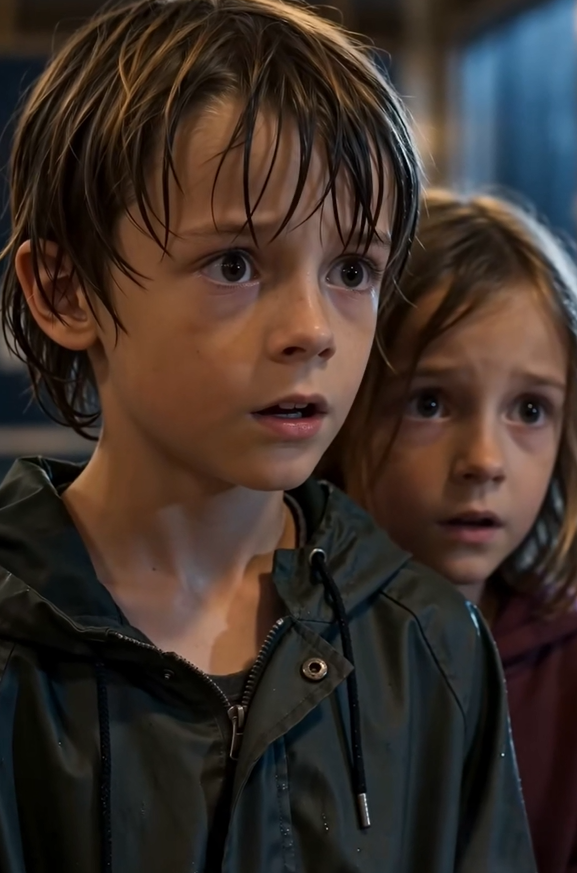
WE ASKED A HELLS ANGELS LEADER FOR HIS LEFTOVERS – HIS ANSWER SILENCED THE DINER
Leftovers were not supposed to change the course of anyone’s life.
They were supposed to be scraped into the kitchen trash at the end of the night, wrapped in foil for a tired waitress, or carried home by someone who could not finish a steak.
But on a cold Friday night outside Kingman, Arizona, a twelve-year-old boy walked into Millie’s Route 66 Diner with rain dripping from his hair, his shoes falling apart, his little sister trembling behind him, and hunger written across both of their faces.
He did not ask for charity from the waitress.
He did not ask the kind-looking retired couple by the window.
He did not ask the trucker at the counter who looked like he could afford another meal without noticing.
He walked straight to the corner booth, where Victor “Grim” Hayes sat alone beneath the yellow diner light with a Hells Angels patch across his back and a second untouched plate across from him.
Everyone in the diner knew that second plate.
Everyone also knew better than to ask about it.
Every Friday for years, Grim ordered two full meals.
One for himself.
One for the empty seat across from him.
A ribeye, mashed potatoes, green beans, coffee black enough to look like a threat.
The second meal always arrived hot, perfect, and untouched.
It sat there through the evening like a dare, like a grave marker, like a place being held for someone who never came.
Millie had asked about it once, years earlier.
Only once.
Grim had lifted those flat gray eyes to her and said, “Just bring it.”
She had brought it ever since.
No questions.
No jokes.
No soft little comments about loneliness.
Men like Grim did not invite sympathy.
They did not accept comfort.
They carried their damage the way other men carried a pocketknife, close enough to reach, hidden enough to deny.
The town had built its own stories around him.
Some said the plate was for a dead brother.
Some said it was a biker ritual.
Some said it was a warning, because in towns built on rumor, people will turn grief into danger if danger makes more sense to them.
Whatever the truth was, nobody touched that plate.
Not waitresses.
Not drunks.
Not teenagers showing off.
Nobody.
Then the boy came in.
The door banged against the wall with a crack that made three people flinch.
Cold desert rain blew in behind him, sharp and dusty and wrong for that part of Arizona.
He was small for twelve, thin in a way that made adults look away because it accused them without saying a word.
His left sneaker had been wrapped in silver duct tape around the toe, but the tape had soaked through and peeled back like dead skin.
His jacket was too large and hung from one shoulder.
Behind him stood a little girl, maybe seven, maybe eight, clutching a cloth bag to her chest and shaking so hard her teeth clicked.
The boy took in the room in one quick sweep.
It was not curiosity.
It was assessment.
Door.
Counter.
Kitchen.
Windows.
Men.
Escape.
That was how frightened children learned to read rooms when the adults in their lives had failed them too many times.
His eyes moved from face to face until they stopped on Grim’s table.
They stopped on the untouched steak.
The diner seemed to tighten around him.
Danielle, the young waitress behind the counter, held a coffee pot frozen in midair.
The trucker lowered his fork.
The college kids in the middle booth stopped whispering.
The retired woman by the window pressed her hand lightly over her husband’s wrist.
Millie stood in the kitchen doorway and felt the old floorboards beneath her shoes.
The boy stepped forward.
Every step left a wet print on the tile.
Every step took him closer to the one man nobody approached without permission.
Grim did not look up at first.
He was cutting into his steak with steady, unhurried movements.
Knife against plate.
Fork through meat.
Nothing in his posture changed, but the air around him seemed to warn the boy back.
The girl behind him slowed.
The boy did not.
He stopped beside the booth.
For three full seconds, he said nothing.
Then Grim looked up.
His eyes were pale and cold, the color of winter sky before a storm closes in.
He looked at the boy, then at the girl, then back to the boy.
He did not ask what they wanted.
He waited.
The boy swallowed hard enough for the movement to show in his throat.
“Sir,” he said, barely louder than the rain against the windows, “can me and my sister eat your leftovers?”
The diner stopped breathing.
It was not just the question.
It was who he had asked.
It was the second plate.
It was the empty seat.
It was the sacred, forbidden thing the whole diner had learned to leave alone.
Danielle’s hand tightened around the coffee pot.
The trucker looked down like he had seen something he had no right to witness.
Millie’s chest ached.
Grim stared at the boy for a long moment.
Then he looked at the little girl.
Her fingers were twisted in the back of her brother’s jacket.
Her eyes were too big for her face.
Her lips had gone blue at the edges from cold.
Something moved behind Grim’s eyes.
Not softness, exactly.
Not yet.
Something older and sharper, like a locked door inside him had heard a key turn somewhere in the distance.
He set down his knife.
He set down his fork.
The sound was small, but it crossed the room like a command.
Then he pushed the untouched plate across the table.
“Leftovers are for dogs,” Grim said.
The boy flinched.
Several people did.
Grim nodded toward the empty side of the booth.
“Sit down and eat like family.”
Nobody moved.
The boy looked at the plate.
He looked at Grim.
He looked back at his sister.
“Both of us?” he asked.
“I said family,” Grim replied.
His voice was low and rough.
“Sit before it gets cold.”
The boy turned to the little girl.
“Rosie,” he whispered, “come on.”
He helped her into the booth first, careful with her like she was made of glass and he was the only one who knew where the cracks were.
Then he slid in beside her, keeping himself between her and the room.
They ate like children who had learned not to believe food would stay available.
Rosie held the fork in one hand and used the other to brace herself against her ribs.
The boy cut the steak for her before he cut his own.
He kept one arm behind her shoulders.
He watched the door every time the bell above it moved.
Grim noticed.
He noticed the way the boy’s left forearm carried yellow-green bruising in the shape of fingers.
He noticed how Rosie avoided stretching one arm too far.
He noticed how neither child asked for salt, ketchup, napkins, or anything that might sound like wanting too much.