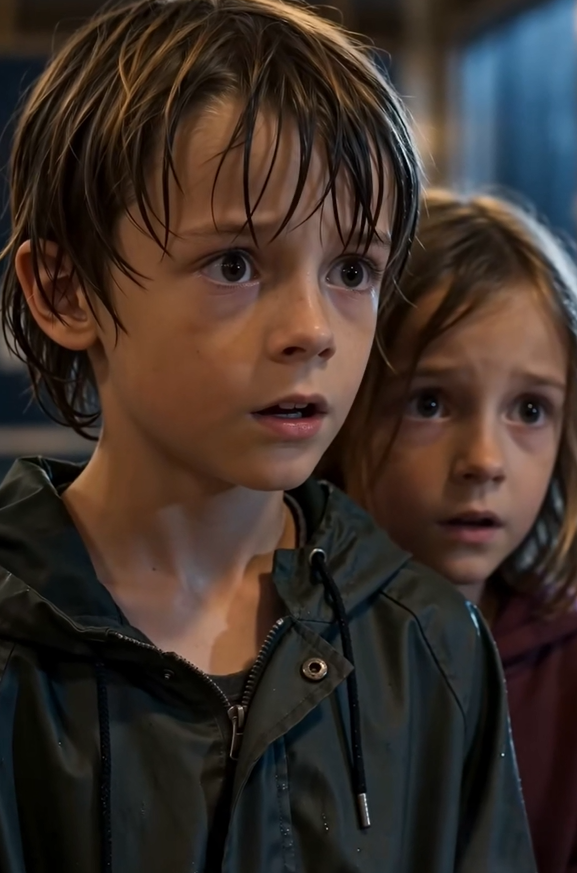
They ate with desperation, but also with manners.
That was what hurt most.
Millie was already moving.
She did not ask Grim for permission.
She did not ask the children what they could pay.
She turned toward the kitchen and called for soup, bread, and hot chocolate.
Then she picked up the phone.
Her fingers hovered over the numbers.
Police, she thought.
Social services.
An ambulance.
Someone official.
Someone with a form and a badge and a way of taking over.
Then she looked back at the corner booth and saw the boy watching the door while his little sister ate mashed potatoes with shaking hands.
She set the receiver down.
Not yet.
In places like Kingman, official did not always mean safe.
She had lived long enough to know the difference between calling for help and inviting the wrong people inside.
Grim leaned back and watched the children eat.
He did not touch his own plate.
The silver skull ring on his right hand caught the diner light.
People said that ring had broken more than one man’s cheekbone.
Maybe it had.
Maybe half the stories about Grim were true.
Maybe the worst ones were.
But at that table, in that moment, he was not looking at the children like prey, trouble, or weakness.
He was looking at them like evidence.
Millie came over with hot chocolate and a bowl of chicken soup.
She set them down gently, as if loud movements might shatter whatever small safety had formed.
“What’s your name, sweetheart?” she asked the boy.
He hesitated.
“Ethan.”
“And your sister?”
“Rosie.”
“Is there someone we can call, Ethan?”
His hand tightened around his fork.
“Our mom’s still there.”
The sentence carried more than a child’s voice should ever have to carry.
Millie lowered herself beside the booth.
“Still where?”
Ethan glanced at Grim.
Maybe he understood already that the man across from him was not kind in the usual way.
Maybe he understood that kindness was sometimes soft and useless, and what he needed was something harder.
“At the trailer,” Ethan said.
“She told us to run.”
Rosie stopped eating.
Her spoon hovered above the bowl.
Grim’s eyes narrowed.
Millie kept her voice calm.
“Why did she tell you to run?”
Ethan looked down at the table.
His wet hair hung over his forehead.
“Because Clay came home drunk,” he said.
His voice stayed even.
That made it worse.
“He found the bag she packed.”
The retired man by the window shifted in his chair.
The trucker slowly turned on his stool.
Millie felt the name before she fully processed it.
Clay Mercer.
There were names people spoke freely, and there were names they lowered their voices around.
Clay Mercer’s name belonged to the second kind.
He lived outside Wikieup, ran dirty business through clean-looking men, and had a way of making problems disappear before they reached anyone who could solve them.
People said he paid men with badges.
People said he paid men without badges.
People said a lot of things they would never sign their names to.
Grim’s face did not change.
“Clay Mercer,” he repeated.
It was not a question.
Ethan looked at him carefully.
“You know him?”
“I know the shape of him.”
The answer made no sense and perfect sense at the same time.
Ethan nodded once, like he understood more than any twelve-year-old should.
“Mom tried to leave before,” he said.
“Three times.”
The room listened now without pretending not to.
The rain made silver lines down the windows.
Danielle stood still with her hand pressed against the counter.
“The first time, he had somebody watching the road.”
Ethan’s voice stayed flat.
“The second time, she called a shelter, but he found out.”
He swallowed.
“The third time, she got as far as Wickenburg.”
Rosie put her spoon down.
Ethan moved his arm around her shoulders.
“He brought her back himself.”
No one needed him to explain what that meant.
The bruises explained enough.
Grim asked, “How long ago did you leave?”
“Before sunup.”
“You walked?”
“Most of the way.”
“From Wikieup?”
Ethan nodded.
“We got a ride for a little while from a lady in a pickup, but she couldn’t take us all the way.”
Millie did the distance in her head and felt anger rise hot beneath her ribs.
Twenty-five miles.
Rain.
Desert.
A boy in broken shoes.
A little girl with hurt ribs.
“Why here?” Grim asked.
Ethan looked at the second plate.
“Because of that.”
Grim did not move.
“The plate,” Ethan said.
“I saw it through the window.”
His voice dropped.
“I thought somebody who orders food for a person who isn’t there probably knows what it means to miss somebody.”
The diner went so quiet that the hum from the soda cooler sounded loud.
“And I thought maybe somebody like that wouldn’t hurt hungry kids.”
Millie turned away because her eyes had filled without warning.
Grim’s jaw tightened.
For a moment, his face was nothing but stone.
Then Rosie looked up at him.
She had not spoken once since entering the diner.
Her voice came out so small it nearly disappeared before it reached him.
“Is our mom going to be okay?”
That was the question that broke something.
Not loudly.
Not visibly enough for most of the room to understand.
But Millie saw it.
She had known Grim for eleven years.
She had seen men leave the diner when he entered.
She had seen him stare down strangers until they forgot what they meant to say.
She had seen rage sit on him like a second jacket.
But she had almost never seen grief.
For half a second, grief crossed his face bare and violent.
Then he buried it.
He looked at Rosie.
“I’m going to find out.”
He did not say it like comfort.
He said it like a decision already made.
He stood.
The booth seemed smaller without him in it.
He pulled on his heavy leather jacket, the Hells Angels patch dark across his back, the road worn into every crease.
He looked at Millie.
“They stay here.”
Millie nodded.
“Nobody knows they’re here.”
“They’re not going anywhere,” she said.
He turned to Ethan.
“What is your mother’s name?”
“Sarah Cole.”
Grim nodded once.
Ethan leaned forward.
“She made us promise not to go back.”
His voice did not beg.
It did not shake.
“But she didn’t say anything about someone else going.”
Grim looked at him a long time.
“Eat,” he said.
“Both of you.”
Then he walked to the pay phone near the restrooms and made three calls.
They were short calls.
A name.
A place.
A sentence.
A silence.
Then, outside in the wet parking lot, three Harley-Davidsons coughed awake under the desert rain.
Grim walked out without looking back.
For the first time in years, the man who always seemed to be riding away from something was riding toward it.
Inside the diner, Rosie fell asleep eleven minutes after he left.
It happened suddenly, the way it happens to children whose bodies have been surviving on fear and fumes.