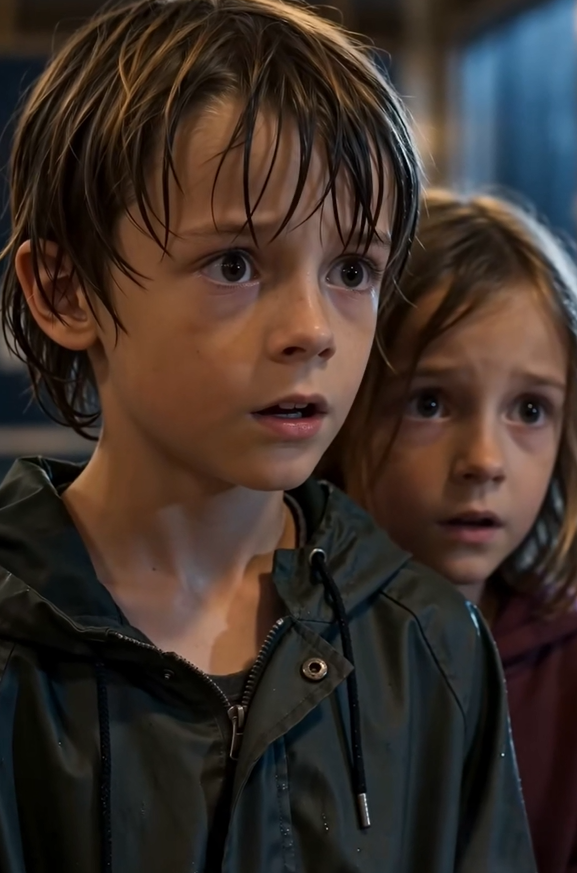
One second she was holding hot chocolate in both hands.
The next, her head slid against Ethan’s shoulder and her eyes closed.
Ethan adjusted at once.
He shifted his arm beneath her so her neck would not bend wrong.
He kept watching the door.
Millie watched him from behind the counter and felt a deep, helpless fury.
Children were not supposed to be guards.
Children were not supposed to count exits.
Children were not supposed to know how far a dangerous man could drive in an hour.
She brought Ethan apple pie without asking.
Warm.
Vanilla ice cream melting on the side.
He stared at it.
“You don’t have to do that.”
“I know,” Millie said.
“Eat it anyway.”
He took the fork slowly this time.
The terrible speed from the steak was gone.
His body had accepted food, but his mind had not accepted safety.
“Is he coming back?” he asked.
“Grim?”
Ethan nodded.
“Yes,” Millie said.
“How do you know?”
“Because he said he would.”
Ethan looked toward the window.
“Lots of people say things.”
Millie sat across from him in the seat Grim had left empty.
“That man has many problems,” she said.
“He has frightened people.”
“He has hurt people.”
“He has made choices I would never defend.”
She paused.
“But in eleven years, I have never heard him say he would do something and then not do it.”
Ethan absorbed that like information he could use.
Not comfort.
Information.
The trucker at the counter had paid his bill thirty minutes earlier and still had not left.
He was on his third cup of coffee.
The retired couple had moved one booth closer to Ethan and Rosie.
The college boys had taken the table near the window facing the parking lot.
No one announced that they were staying.
No one made a speech about protecting children.
They simply rearranged themselves around the danger.
Ethan noticed.
Of course he did.
He noticed everything.
His eyes moved from one person to another and then back to his plate.
Something softened around them for half a second.
Millie pretended not to see it.
“Did your mother know you were coming here?” she asked.
“She woke me at three.”
He looked at Rosie.
“She had Rosie’s bag ready.”
“What did she say?”
Ethan’s hand stopped moving.
“She said she had tried everything she knew how to try.”
His voice remained steady, but the words had weight.
“She said she couldn’t get out anymore.”
He looked up.
“So she had to get us out.”
Millie put one hand flat on the table.
She wanted to curse.
She wanted to pray.
She wanted to drive to that trailer herself with the old shotgun beneath the counter and thirty-one years of diner-owner fury in her hands.
Instead, she said, “You did good.”
Ethan’s face closed at the praise.
He did not know what to do with it.
“Is there more pie?” he asked.
Millie laughed before she could stop herself.
The sound surprised the whole room.
Then the trucker smiled into his coffee.
The retired woman blinked away tears.
“Yes,” Millie said.
“There is absolutely more pie.”
She was cutting the second slice when the pay phone rang.
Every head turned.
The ring sounded too loud.
Too sharp.
Too official for that quiet room.
Millie crossed to it and lifted the receiver.
“Millie’s.”
Grim’s voice came through low and rough.
“They still there?”
“Both of them.”
“Rosie?”
“Asleep.”
A pause.
Then he said her name in a way that made her grip the receiver harder.
“Millie.”
“What?”
“It’s worse than the boy said.”
She closed her eyes for one second.
“How much worse?”
“Sarah’s locked in.”
His voice had gone flat, which Millie knew was the most dangerous kind of calm.
“He’s got people at the road.”
Another pause.
“One of them is wearing a badge.”
Millie turned her back to the room.
“Can you get to her?”
“We’re working on it.”
“Do I call local?”
“No.”
The word came fast.
“No local department.”
“You understand me?”
“I understand.”
“Keep those kids hidden.”
“I will.”
“I’ll call again.”
The line went dead.
Millie stood with the receiver in her hand.
When she turned, Ethan was watching.
“That was him,” he said.
“Yes.”
“Is she alive?”
The directness of it nearly undid her.
“Yes,” Millie said.
“She is alive.”
Ethan nodded.
He looked down at his pie and took a bite.
Then he said so softly she almost missed it, “She’s been alive every other time too.”
Millie sat down in front of him.
“Ethan, look at me.”
He did.
“The man who just called me has started something.”
She leaned closer.
“When Grim starts something, he finishes it.”
Ethan studied her face.
Then he looked at the second plate, still pushed to the side.
“He lost somebody, didn’t he?”
Millie sat back.
There it was.
The thing the whole town had whispered around for years, seen by a hungry child in five minutes.
“Yes,” she said.
“Who?”
“A son.”
Ethan’s expression changed.
“Is he dead?”
Millie looked toward the rain-dark window.
“No.”
“Then where is he?”
“He doesn’t know.”
Ethan looked back at the plate.
“That’s why he keeps the seat.”
Millie said nothing.
There was nothing she could add to the truth once a child had found it.
Sixty miles away, Grim stood in the rain beside two other riders and watched Clay Mercer’s trailer from the dark.
Danny Reyes crouched beside him, rain dripping from the brim of his cap.
Marco stood farther back, studying the land.
At the entrance road, a deputy’s cruiser sat with its lights off.
The cruiser made Grim angrier than the trailer.
Violent men were one kind of problem.
Violent men protected by official silence were another.
Grim knew the difference.
He had spent a lifetime learning which doors opened because of fear, which doors opened because of money, and which doors stayed closed because good people convinced themselves they had no key.
Marco pointed east.
“Dry creek bed.”
“Can we take the bikes?”
“No.”
Grim looked at him.
“Foot only.”
Danny exhaled.
“Slow.”
“Then we go slow.”
Nobody argued.
What happened in the next twenty minutes would later become rumor because Grim never told the story cleanly.
He never described the back door.
He never described Clay.
He never described the moment he found Sarah Cole inside a room where the window had been screwed shut.
He never described the exact condition of the bathroom mirror.
When federal people later asked questions, he gave them one sentence.
“We went in, found her alive, and brought her out.”
That was true.
It was not complete.
Sarah Cole came out under her own power, which was almost impossible given the way she moved.
Her face was bruised.
Her ribs were damaged.
Her breathing was shallow.
But she walked because the thought of her children gave her muscles a kind of borrowed strength.
When she saw Grim, she did not scream.
She did not ask who he was.
She looked at his jacket, his ring, his gray eyes, and said, “My kids?”