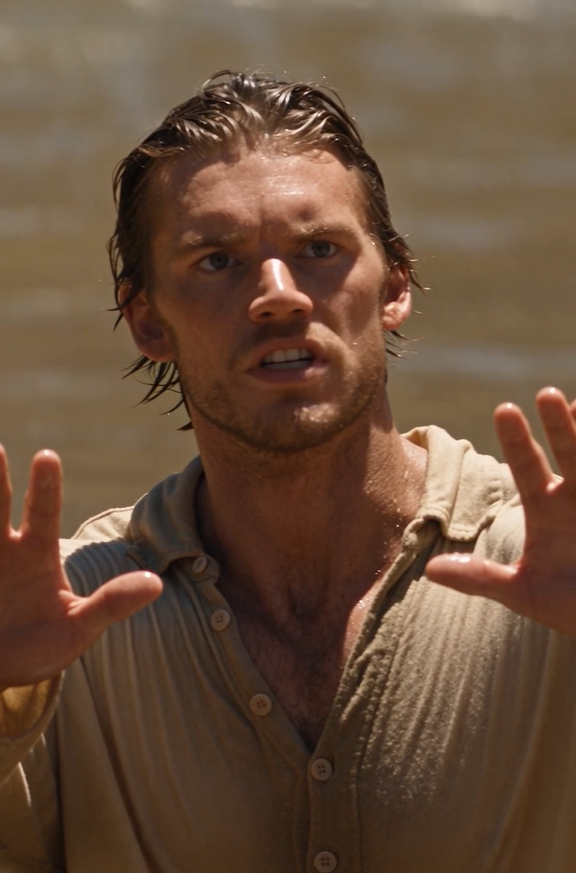
He floated with his eyes closed, his brown hair drifting like weeds around his temples, looking up into the blue heaven when he broke the surface.
Then came the sound.
It was not a loud noise, but it was a sound that every man who had ever lived along the borders of the Comancheria or the Apache passes knew in his very bone marrow.
It was the dry, fibrous thrum of seasoned mulberry and sinew being drawn against tension.
Part II: The Law of the Red Canyon
Cole froze.
His arms remained outstretched on the surface of the stream, his feet planted in the gravel.
He opened his eyes.
They were there.
On the low terraces of red sandstone lining both banks of the creek, half-concealed by willows and the deep purple shadows of the overhangs, a dozen men had materialized as if the rock itself had exhaled them.
They wore deerskin leggings, fringed at the seams, and high moccasins wrapped with hide ties.
Their chests were bare, weathered to the shade of aged walnut, painted with simple, stark lines of white clay and red ochre across the cheekbones.
Every single one of them had an arrow nocked to a short, heavy hunting bow.
The stone and iron points were leveled squarely at Cole’s ribs, his neck, and his throat.
Slowly, carefully, Cole raised his hands until his dripping forearms cleared the surface of the pool.
He kept his palms open and flat.
“I don’t want any trouble,” he said, his voice raw from the days of silence.
Not an arrow wavered.
No one answered.
“I just needed water,” Cole added, his Spanish halting and rough, pieced together from cantinas along the Rio Grande.
“Solo agua. Mi caballo y yo. Just the horse and me.”
A suffocating silence hung over the gorge, broken only by the chuckle of the water against his waist and the distant, dry rattle of a locust in the cottonwood canopy.
Then, from behind a thicket of young willow trees, an older man stepped onto a flat shelf of rock that jutted out three feet above the pool.
His hair was iron-dark, interwoven with coarse strands of gray, braided on the left side and left loose on the right, where two mottled hawk feathers hung tipped with red trade cloth.
His face was a road map of ancient sun-scars and wind-creases, but his eyes were black, clear, and unclouded.
He wore a necklace of bear claws and silver discs, and he held himself with that quiet, terrifying stillness that belongs exclusively to men who have never needed to raise their voices to be obeyed.
He looked down at Cole with an expression that held neither immediate rage nor curiosity—only a grim, immutable finality.
“Sal del agua,” the old man commanded in flawless, archaic northern Spanish. Get out of the water.
Cole didn’t hesitate.
Slowly, moving with deliberate, unhurried care so as not to startle any of the twitching bowstrings, he waded toward the gravel bar.
The water clung to his skin, dragging at him, making him feel clumsy and soft.
Stepping out of a river bare-skinned, shivering in the sudden breeze while a dozen warriors track your naked chest with hunting points, was an exercise in pure humility.
He reached the gravel bank, water streaming down his legs into the mud.
He kept his hands at shoulder level.
The older man stepped down from the ledge with the light, soundless grace of a cougar.
He was shorter than Cole by half a head, but he seemed to occupy twice the space.
He stopped five paces away, his gaze sweeping over Cole’s ribs, his weathered face, and then turning toward the pool.
“Do you know what water this is?” the man asked.
Cole swallowed against the dryness that seemed to return to his mouth out of sheer instinct.
“No, sir.
I don’t.
It wasn’t on my map.”
“A paper drawn by white men cannot hold things that have life,” the old man said, his tone dry and hard.
“If this water belonged to your people, white man, you would have built a fence around it, poisoned it with cattle, and charged travelers a dime a cup.”
“I don’t own a fence in the world,” Cole said quietly.
“And I didn’t mean any disrespect.
If this is your people’s creek, I’m sorry.
I’ll take my horse and be gone before the sun hits the rim.”
The old man’s mouth tightened.
A ghost of a cold, humorless smile flickered at the corners of his lips.
“You will not be gone before the sun hits the rim.
You will not be gone tomorrow.”
He struck his own chest with a flat thumb.
“I am Nantan.
Headman of the red earth people who dwell within these canyon walls.”
Cole gave a shallow nod, keeping his eyes on Nantan’s.
“Cole Ransom.
Just passing through to California.”
“Your name is written on the brass plate of your saddlebags,” Nantan remarked coldly.
“We read it while you were floating like a dead fish in the deep pool.”
Cole winced inward.
He hadn’t even heard them approach Dusty.
“Fair enough.
Look, Chief—Nantan—if there’s a fine for the water, take the silver in my saddle.
Take the carbine.
Just let me have the horse and a canteen.”
Nantan took a slow step forward.
“Silver does not wash out a stain.
Metal cannot mend an unbroken circle.
You have entered the River of Promise.”
“It’s a fine river,” Cole ventured carefully.
“It is a sacred river,” Nantan countered, his voice dropping an octave, carrying the weight of a stone falling into a deep well.
“For seven generations, no man has dipped his flesh into that specific pool unless he was prepared to give up his name, his bloodline, and his freedom to the mountain.”
Before Cole could process that, Nantan raised his chin.
“And you, Cole Ransom, have either brought down a curse upon my house, or you have fulfilled an ancient oath older than my grandfather’s grave.”
Cole’s brow furrowed.
“I don’t understand.”
“Tell him, Father,” a woman’s voice snapped from the terrace above.
“Do not make a mystery of an idiot’s blunder.”
The warriors parted, lowering their bows slightly, though their eyes never left Cole’s torso.
A young woman walked down the slope of red shale.
She moved with an athletic, predatory balance, her deer-hide dress belted with a thick silver concho strap that held a bone-handled skinning knife.
She looked to be perhaps nineteen or twenty years old.
Her hair was the color of raven feathers, gathered into a thick braid that fell past her waist, woven through with beads of raw sky-blue turquoise and polished bone.
Her skin was a rich, warm bronze, her high cheekbones set against a jawline so sharp it looked carved from slate.
Her eyes were dark, burning with a furious, indignant fire that made Cole’s ribs tighten far more than the drawn arrows had.
Nantan didn’t look at her, but he gestured with a leather-clad wrist.
“My daughter.
Ayana.”
Ayana stopped three paces away, crossed her arms over her chest, and looked Cole up and down with unvarnished disgust.
“And apparently,” she spat in clear, cold English that carried only the faintest trace of an accent, “now my husband.”
Cole stopped breathing.
He looked at Ayana.