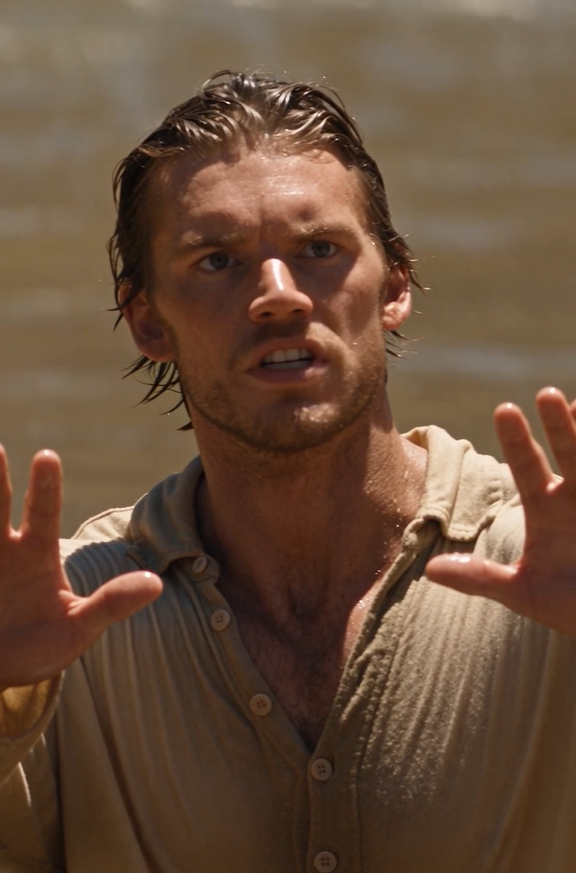
He looked at Nantan.
Then he turned his head slowly to look at the innocent, sun-dappled creek behind him.
“I beg your pardon?”
Cole said.
“You heard her,” Nantan said evenly.
“Tradition dictates that the water of that upper bend is reserved for the ritual of the Daughter of the Sun.
For sixty summers, no man has touched it.
The custom of our clan states clearly: the first man who enters the water of the basin unbidden is either struck down where he stands by the arrows of the clan… or he is bound by blood to the house of the chief to restore the favor of the waters.”
Cole felt the cold gravel bite into his bare feet.
The absurdity of it rushed up his spine like whiskey.
“Now, hold on.
You’re telling me that because I took a bath in an unmarked creek, I either have to take twelve arrows to the liver or marry your daughter?”
“Those are the two choices the tradition permits,” Nantan answered without blinking.
Cole looked back at Ayana.
Her eyes narrowed into two slits of pure venom.
“Father,” she hissed, “look at him.
He smells of sweat and wet wool.
He has no clan.
He has no cattle.
He wanders like a stray dog with one horse and a broken hat.
Let the warriors shoot him and throw his carcass into the grease-flats.”
Cole held up a placating hand, despite the sudden chill that raced across his ribs.
“Now wait a minute, ma’am.
Let’s not be hasty about shooting anybody.
If you don’t want me, that makes two of us with an abundance of good sense.
I was just heading to California!”
Nantan stepped between them, his voice cutting through their voices like an iron wedge.
“The last time our people ignored the signs of the River of Promise—when my grand-uncle allowed a trader who had despoiled the pool to ride away with a laugh—the sky closed its eyes.
Three summers followed without a drop of rain.
The corn dried to dust.
The deer left the canyons.
We buried forty children in the sand before the snows returned.”
The old man’s face went dead, hollowed out by memories that still cast long, terrifying shadows across his soul.
He looked into Cole’s eyes.
“You think this is a jest, white man?
For those who carried the small bundles into the rocks and covered them with stones, it is no jest.
We do not gamble with the water.
You will come to the camp.
The council of elders will look upon you at dawn.
And until they decide if your blood belongs in the earth or in our circle… you are our prisoner.”
Nantan whistled once.
Two burly warriors stepped forward, one holding Cole’s boots and trousers, the other leading Dusty by the bit.
Cole looked at the bows, then at Ayana’s murderous glare, and finally at his boots.
“Well,” Cole muttered, yanking his trousers up over damp legs, “I suppose California can wait a day or two.”
Part III: The Sanctuary of Whispering Ochre
They marched him two miles up the canyon, through a labyrinth of natural stone walls so narrow that Dusty’s pack frames scraped both sides of the rock.
The path wound upward through a concealed crevice in the mesa, completely invisible from the flat desert plains below.
When they crested the final rise, the world opened into an emerald basin.
It was a hidden valley, five miles long and perhaps two wide, enclosed entirely by sheer, unscalable walls of blood-red sandstone.
A tributary of the creek meandered through the center, feeding small, terraced patches of squash, beans, and tall green corn.
Dozens of dome-shaped wickiups made of willow boughs and thatched brush were scattered among groves of live oaks and piñon pines.
Smoke rose lazily from hearths, carrying the sweet smell of roasting pinto beans, parched corn, and burning cedar.
As the party passed through the village perimeter, the everyday life of the tribe ground to a halt.
Women grinding corn on stone metates stopped their rhythmic work, lifting flour-dusted hands to shield their eyes.
Old men smoking wild tobacco on reed mats leaned forward, their rheumy eyes widening.
Children who had been chasing a tame coyote pup halted in their tracks, scrambling behind their mothers’ skirts to point small, brown fingers at the tall, soaking-wet white man walking between their chief and their fiercest huntress.
Whispers passed through the brush shelters like wind through dry reeds.
“The River…”
“He came out of the water…”
Cole felt every single stare like the prick of a needle.
He was accustomed to being an outsider—in Texas, an orphaned boy with no family name was always an outsider—but this was different.
He was not just a trespasser; he was an omen.
A walking, dripping complication of their universe.
Nantan stopped in front of a large, open-sided ramada supported by cedar posts near the center of the village.
He turned to face the gathered people.
“The council will sit when the first light touches the East Wall,” Nantan proclaimed in a voice that reached every ear.
“Until the sun rises, this man is under my roof.
He eats our salt.
He drinks our water.
No hand shall touch him.”
Ayana, who had been walking a few paces behind, muttered something in her native tongue that sounded decidedly uncharitable.
Cole turned his head slightly.
“I’m no linguist, Miss Ayana, but that didn’t sound like a wedding toast.”
“It wasn’t,” she replied in English, her voice tight and low.
“I told my father that if the council decides you must live, I will personally challenge you to a knife match before the moon wanes.”
“Mighty hospitable of you,” Cole drawled, gingerly pulling on his dry boots.
“I can see why you’re still single.”
Ayana’s hand dropped toward the bone hilt at her hip, her eyes flashing with dangerous electricity, but Nantan barked a single, sharp syllable.
She stopped, her jaw working furiously, before turning on her heel and marching toward the cooking fires.
The afternoon wore away with agonizing slowness.
True to Nantan’s word, Cole was not bound.
They gave him back his shirt and his hat, though his weapons remained securely tucked away inside Nantan’s lodge.
A young boy with wide, terrified eyes brought him a clay bowl filled with stewed rabbit, crushed hominy, and wild greens.
Cole ate every scrap; it was the first warm meal he had tasted since he crossed the Pecos River, and it tasted better than anything served in the hotels of San Antonio.
As twilight began to pool in the canyon floor, turning the red rock walls to deep, bruised shades of plum and purple, the temperature dropped.
Cole sat on a cedar log near the edge of the ramada, whittling a small piece of pine with a sharp river stone he had found in the dirt.
A shadow fell over his hands.
He looked up.
Ayana stood there, holding a woven woolen blanket dyed with cochineal red and natural sheep’s wool.
She tossed it onto the bench beside him with an aggressive lack of gentleness.