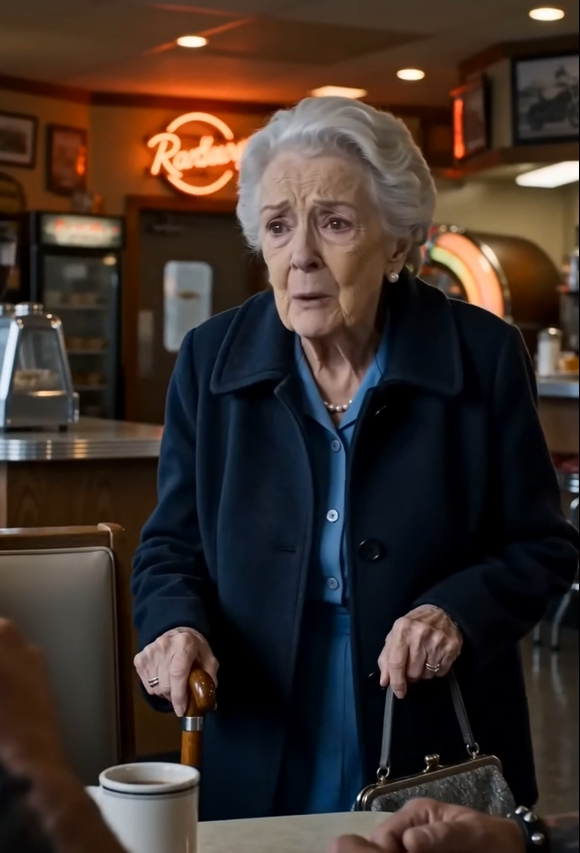
By Friday morning, he called Chief Harmon Wallace.
Harmon had known Jack for fifteen years.
Their history was complicated, as histories between police chiefs and motorcycle clubs usually are in small towns.
But Jack did not call like a man asking permission to cause trouble.
He called like a man preventing it.
Harmon, I need to talk to you about tomorrow.
Already heard chatter about bikes coming through town.
You need to hear it from me.
Jack told him everything.
The diner.
Eleanor.
Thomas.
The guest list.
The message.
Harmon was quiet for a long time.
Then he asked the only question left.
How many?
Jack told him the best estimate.
Harmon went silent again.
Then he said, I am going to need to close Lammer Street from the highway to the church.
I will need every officer I have and probably county backup.
I’ll make sure they behave, Jack said.
I know you will.
That is not what worries me.
What worries you?
Parking.
Jack almost smiled.
Does she know? Harmon asked.
No.
You sure about that?
Jack looked down at the table in front of him.
She asked for someone.
She does not need a number.
She needs to see it.
Harmon understood more than he said.
My people will be in place by eight.
Thomas Arthur Whitmore sounds like he was worth it.
He was, Jack said.
So is she.
Friday evening, Catherine Whitmore landed at the regional airport forty miles away.
She came through arrivals looking tired, grey at the temples, and determined.
Eleanor was waiting.
When Catherine saw her mother, she stopped.
Eleanor looked smaller than she had at Thomas’s funeral six months earlier.
Not weaker.
Not exactly.
Just compressed, as if grief had settled inside her bones.
Catherine crossed the room and wrapped her arms around her.
You came, Eleanor whispered.
Of course I came.
I was not sure.
Catherine pulled back and held her mother’s shoulders.
I will always come.
You understand me?
I will always come.
Eleanor nodded.
She had decided not to cry in the airport, and because she was Eleanor Whitmore, she managed it.
That night, mother and daughter sat at the kitchen table drinking tea.
Catherine made food because the refrigerator contained what she privately considered an alarming amount of nothing.
They talked about Thomas.
They talked about the way he fixed things.
They talked about the stories people had told after his death, stories Thomas never told about himself.
He just did things, Catherine said.
That was your father, Eleanor replied.
Catherine looked at her.
Is that why you went to the diner?
Eleanor held her cup with both hands.
He deserved witnesses.
Catherine reached across the table and took her hand.
He will have them.
Neither woman knew how true that was.
They did not know the motel on Route 9 was already full.
They did not know riders were sleeping in trucks, at campgrounds, and in the parking lot behind a bar whose owner had come outside, seen the crowd, and started another pot of coffee.
They did not know Silver Creek was filling in the dark.
They went to bed after midnight.
Eleanor slept better than she had in six months.
At four Saturday morning, Jack Callahan stood in his kitchen with black coffee and a phone full of messages.
Last count, his road captain Trey said, was three hundred and sixty-two.
More coming in.
Group from Calgary crossed last night.
Group from Spokane arrived.
Group from Boise is thirty miles out.
Best estimate?
Close to four hundred.
Maybe over.
Jack stood very still.
Four hundred people for a woman who had asked for someone.
Formation, he said.
Two columns.
Engines slow into town.
Park both sides of Lammer from the highway to the church.
Helmets off.
Heads bowed.
No noise when she arrives.
She should see it before she hears it.
At five-thirty, Catherine woke in her childhood bedroom.
The sky outside was grey as graphite.
She went downstairs and made coffee.
At the kitchen window, she noticed a man standing across the street.
He was large, quiet, and wearing a dark jacket.
He was not doing anything.
He was simply waiting.
Catherine looked toward the corner.
Another man stood there.
Then another.
She opened the front door.
Cold air swept in.
She stepped onto the porch and looked up and down the street.
People stood on both sides.
Silent.
Still.
Not neighbors.
Not church ladies.
Not anyone she recognized.
Bikers.
Dozens of them already.
More were arriving without sound, as if the morning itself was gathering around the house.
Catherine went back inside.
She stood at the foot of the stairs.
Mom.
Eleanor’s voice came down, rough with sleep.
Is something wrong?
No, Catherine said.
And she meant it.
Come look.
Eleanor came down slowly in her robe, cane tapping each step.
Her hair was still in rollers.
She reached the window.
She looked out.
For a long time, she said nothing.
Then her hand went to her mouth.
Catherine.
Who are all these people?
Catherine put an arm around her shoulders.
I think Jack came through.
Eleanor stared.
The street was filling.
Not with spectacle.
Not with chaos.
With presence.
Men and women in leather stood in the cold morning light as if guarding something sacred.
Eleanor began counting and stopped at thirty because the number no longer belonged to ordinary arithmetic.
I only asked for someone, she whispered.
I know, Mom.
I did not ask for this.
No.
You did not.
Catherine waited.
Then she said the thing she felt in her bones.
But Dad did.
Eleanor turned to her.
Thomas earned this.
Every person out there came because of who he was.
Because of what you told Jack.
Because a life like his does not vanish just because the man is gone.
Eleanor made a sound that was almost a sob and almost a laugh.
He would have hated this.
Catherine smiled through tears.
He would have been mortified.
He would be outside in his slippers apologizing to everyone for the trouble, Eleanor said.
Then he would insist on making coffee for all of them.
Both women laughed because it was true.
Then Eleanor straightened.
Her spine seemed to remember itself.
I need to get dressed.
Mom.
I have a funeral to attend.
My husband’s funeral.
And I will not go to it in my robe with my hair in rollers.
Start the coffee.
Real coffee.
Not that weak business you brew in Oregon.
Thirty minutes later, Eleanor came downstairs in her blue dress.
Thomas had loved that dress.
She wore pearl earrings he had given her on their fortieth anniversary.
His wedding ring hung on a chain beneath the fabric against her heart.
She carried one white rose.
One rose chosen well, Thomas used to say, meant more than a dozen chosen carelessly.
Outside, the crowd had grown to something impossible.
At nine forty-five, the taxi arrived.
Gerald, the driver who had taken Eleanor to appointments for four years, stepped out and froze.
He looked down the street.
He looked back at Eleanor.
For once, the man who was always precisely polite had no words.