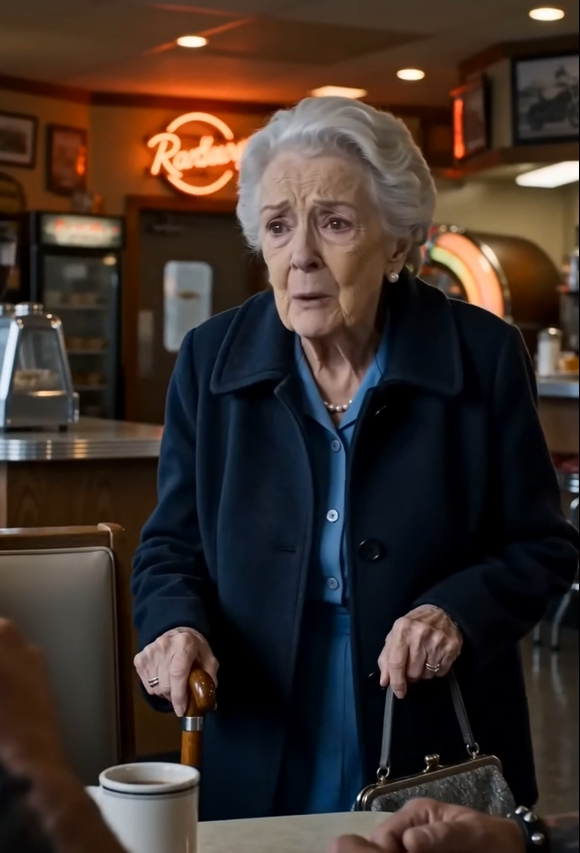
At the foot of the porch stood Jack Callahan.
He held his helmet in both hands.
He had placed himself where Eleanor would see one familiar face first.
She stepped onto the porch.
A breath moved through the crowd.
Not a cheer.
Not a shout.
Just a human sound of recognition.
Jack, Eleanor said.
Mrs. Whitmore.
You did this.
Jack shook his head.
They did this.
I only told them.
You told them about Thomas.
Yes, ma’am.
Eleanor looked at the hundreds of strangers lining her street.
Her voice remained steady, though her hand tightened around the rose.
Thomas would have been furious with me for causing this much trouble.
A low warmth moved through the nearest riders.
He would have apologized to every one of you.
He would have asked if you had breakfast.
He would have tried to invite you all inside, not understanding that four hundred people cannot fit in my living room.
Some of the riders smiled.
Some looked down.
But underneath that, Eleanor said, and her voice changed, he would have known.
He would have known what this meant.
He would have looked at me the way he always did when something good happened, as if it were somehow my fault.
Then he would have squeezed my hand.
She touched the chain at her throat.
Shall we go give Thomas his funeral?
Jack offered his arm.
Eleanor took it.
The taxi moved slowly through Silver Creek.
Lammer Street had been closed from the highway to the church.
On both sides of the road, hundreds of riders stood shoulder to shoulder with helmets in hand.
Their heads were bowed slightly.
Their engines were off.
No one spoke.
The town had never been this quiet with this many people in it.
Eleanor sat in the back seat, Catherine beside her, and looked at every face she could.
Old faces.
Young faces.
Women.
Men.
Scarred faces.
Tired faces.
Faces that had crossed distances in the dark.
They had not known Thomas.
They had come because someone told them he mattered.
That was when Eleanor understood what Jack had truly done.
He had not filled chairs.
He had made visible something she had feared grief had hidden forever.
Thomas had mattered.
Not just to her.
Not just to Catherine.
Not just to the people whose cars he fixed and whose fences he repaired.
He mattered to the idea that a life of service should be witnessed.
He mattered to everyone who believed no one should leave the world unwitnessed.
At the white church, Jack was waiting again.
He had ridden ahead and stood by the steps.
Eleanor took his arm.
Inside, the church was full.
Every pew.
Every wall.
Every corner.
The small white building where Eleanor had married Thomas, baptized Catherine, buried parents, and said a thousand ordinary prayers now held four hundred strangers who had come to say goodbye to her husband.
Eleanor walked down the aisle.
She looked at the casket.
Thomas had chosen it himself.
Simple wood.
No frills.
Practical to the end.
A photograph stood beside it.
Thomas and Eleanor in 1971.
He was tanned from summer work.
She was laughing at something he had said before the shutter clicked.
They looked like people who did not yet know how much good life still owed them.
Eleanor sat in the front pew and placed the white rose on her lap.
I brought people, she whispered toward the casket.
I know you would have something to say about that.
I would like to hear it.
Reverend Mills began.
He was eighty-one, and his voice had thinned, but not his conviction.
He did not list Thomas’s accomplishments like items in a ledger.
He painted him with small truths.
Thomas reading the newspaper from back to front because he said sports steadied a man for the rest of the news.
Thomas shaking hands with both hands when he meant it.
Thomas fixing anything mechanical and refusing anything electrical because he claimed electricity was basically magic and he did not trust magic.
The church listened.
Four hundred strangers met Thomas piece by piece.
Then Catherine stood.
She had not written a formal eulogy.
Formality would have felt wrong for a man who found pretension mildly hilarious.
She looked at her mother.
Then she looked at the room.
My father fixed things.
She paused.
I do not just mean cars, though he fixed a lot of cars.
I mean broken things bothered him.
A fence.
A truck.
A kitchen table.
A bad day.
A family argument.
If something was broken and he could reach it, he could not leave it alone.
A small sound moved through the church.
He fixed our neighbor’s truck for free for fifteen years.
He thought I did not know.
I knew.
I think everyone knew except Dad, who thought he was being discreet.
A few people smiled.
He fixed our kitchen table so many times that by the end it was basically a philosophical concept.
The only original part was the idea of a table.
He refused to replace it because he said he knew that table.
More warmth moved through the pews.
Catherine’s voice softened.
He fixed things between people too.
When families fell out, somehow Thomas Whitmore ended up in the middle.
Not because he pushed in.
Because both sides trusted him.
He never took credit.
He never told the stories.
He just put things back together and moved on.
She looked at the casket.
He cannot fix things anymore.
I have been trying to understand what the world does with that.
Then she looked out at the packed church.
Maybe this is what the world does.
Maybe the things he gave away did not disappear.
Maybe they moved through people.
Maybe one person helped someone because Thomas helped them first.
Then that person helped someone else.
Maybe kindness keeps traveling until it fills a church with strangers.
She wiped her cheek.
My father spent ninety years putting things back together.
I think the evidence is in this room.
When Reverend Mills asked if anyone else wished to speak, Eleanor expected silence.
Instead, a hand rose at the back.
A large man stood.
His head was shaved.
His hands carried the history of hard work.
I did not know Thomas Whitmore, he said.
My name is Victor.
I drove from outside Spokane because I got a message Thursday night saying a man who spent his life showing up for people needed someone to show up for him.
His rough voice caught.
My father died alone in a hospital eleven years ago.
I was not there.
I have carried that ever since.
I could not fix that.
I could not go back.
But I could come here.
I could be here for Thomas.
He looked at Eleanor.
I hope that means something.
Eleanor stood just enough for her voice to carry.
Victor, it means everything.
He sat down.
Then another person stood.
Then another.
Dana from Idaho spoke about her grandmother, who had feared no one remembered the man she loved.
A young rider barely twenty said his grandfather had been the Thomas of his family and that he hoped someone would do this for him one day.