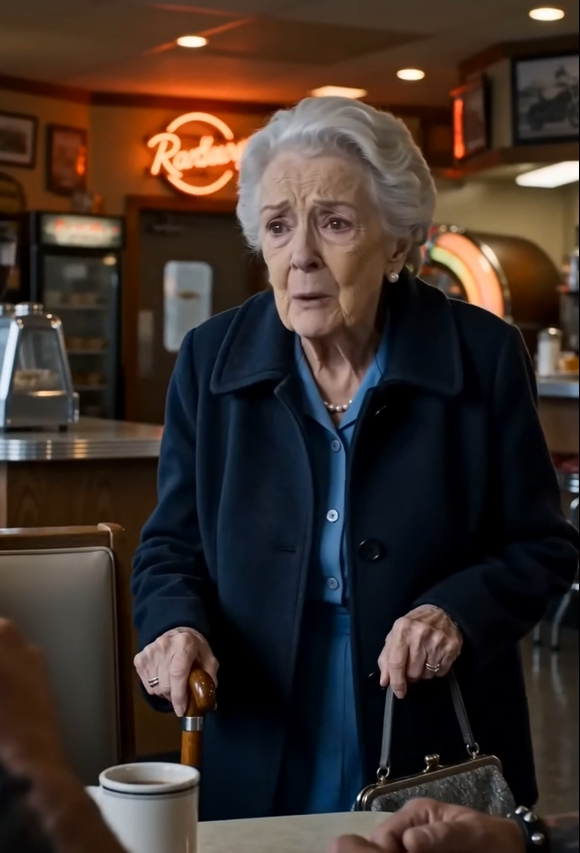
Calvin Webb stood and said he had driven six hundred and twenty miles and would have driven twice that.
Eleanor turned to Catherine.
Six hundred and twenty miles, she whispered.
For Thomas.
For Thomas, Catherine said.
A woman named Renee stood last.
She said she had pressed her best clothes and driven through the night.
She had arrived before dawn and stood in the cold because she was afraid to sleep and miss the service.
She said she had spent those hours thinking about what a life was after everything unnecessary was stripped away.
It was not money.
It was not applause.
It was not being important.
It was people standing beside you when it mattered.
Thomas Whitmore showed up his whole life, Renee said.
I hope wherever he is, he can see that people showed up for him.
Eleanor closed her eyes.
Her fingers found the ring at her throat.
She was speaking to Thomas without words.
Do you see this?
Look what you made.
I knew you mattered.
I did not know it would look like this.
The final hymn filled the church with four hundred voices.
Some knew the words.
Some did not.
It did not matter.
Goodbye, Eleanor realized, was not about how long you knew someone.
It was about whether you showed up.
At the graveside, the riders formed two lines from the church to the cemetery gate.
Eleanor walked between them slowly.
Her hip required it.
Her dignity required it.
She did not look at the ground.
She looked at faces.
An old man with a white beard bowed his head.
She nodded back.
A young woman cried silently.
Eleanor reached out and touched her sleeve.
Victor stood in line with his jaw tight.
Eleanor stopped before him.
Victor.
He looked down.
Your father knew, she said.
The same way Thomas knew.
They always know.
Victor’s mouth trembled.
You really believe that?
I know it.
I have been talking to Thomas every day for six months, and he has been listening.
Your father has been listening too.
Victor covered his face with one hand.
The man who had not cried at his father’s funeral cried in front of a ninety-seven-year-old widow who had known him for less than an hour.
Eleanor touched his arm.
Then she moved on.
At the grave, she placed her palm on the casket.
It was not warm.
She left her hand there anyway.
Reverend Mills spoke the old words.
Earth to earth.
Ashes to ashes.
Dust to dust.
The casket lowered.
Eleanor kept her hand on it until she could not.
Then she straightened and touched the ring against her heart.
I am here, Thomas.
I brought everyone.
After the committal, Jack turned to the gathered riders.
Anyone who wants to say goodbye to Thomas Whitmore may come forward.
For forty-seven minutes, they came.
One by one.
Two by two.
Sometimes in small groups.
They stood at the grave of a man they had never met and left pieces of themselves there.
A coin.
A stone.
A folded note.
A patch.
A prayer.
Victor crossed himself for the first time in twenty years.
Calvin Webb removed his hat and said quietly, Rest easy, Thomas.
She is going to be all right.
We will make sure of it.
Eleanor heard him.
She asked his name.
Calvin Webb, ma’am.
Lorraine’s husband.
We have been married thirty-eight years.
Does Lorraine know where you are?
Calvin almost smiled.
She handed me my thermos and told me to drive safe.
Eleanor nodded.
I would like to meet Lorraine someday.
I think she would like that too.
Then, when the last person stepped back, something unplanned happened.
One motorcycle engine started.
Not a roar.
Just an idle.
Then another.
Then another.
Hundreds of engines came alive softly, one after the other, until the air held a low, steady sound.
It was not noise.
It was presence.
Jack stood beside Eleanor at the cemetery fence.
They are going to ride one pass for Thomas, he said.
Eleanor did not fully understand the custom, but she understood the gesture.
The motorcycles moved through Silver Creek in formation.
Slow.
Steady.
Purposeful.
People came out of houses.
Neighbors stood on porches.
Shopkeepers stepped onto sidewalks.
Some cried without knowing they would.
Because it was not just motorcycles passing by.
It was proof.
A life of service had left a mark.
A man who had fixed things quietly for ninety years had not disappeared quietly.
The world had noticed.
Afterward, Jack stood with Eleanor by the iron fence.
Darnell appeared with two cups of coffee, as if necessary things simply revealed themselves to him.
Eleanor took one.
So did Jack.
For a while, they drank in silence.
Then Eleanor said, I came to you because I was desperate and trying not to show it.
Jack listened.
I sat in that diner for twenty minutes watching you.
I was trying to decide if you would be kind if you said no.
I knew I was going to ask something embarrassing.
I needed to know the rejection would not destroy me.
You thought there was a chance I would say yes.
Yes.
You had the look of a man who understood loyalty.
I was right about that.
She looked toward the road where the last engines faded.
But I was wrong about the scale.
I thought you might bring five people.
I told myself ten would be a miracle.
You gave Thomas four hundred.
You gave me the most important morning of my life.
After seventy-two years of important mornings, you gave me one more.
Jack looked at his coffee.
Mrs. Whitmore, you told me about a man who spent his life showing up.
Did you think people who believe in showing up would sit that one out?
Eleanor considered this.
Thomas would have come, Jack said.
If someone had called him.
If someone said a man needed people at his funeral, Thomas would have been there.
Yes, Eleanor said.
He would have.
Then we showed up for him.
That is all.
It was not all.
They both knew it.
But it was the right thing to say.
Inside the church hall, the women of Silver Creek had opened the kitchen and made food for people they had not expected to feed.
Eleanor sat at a table and met the riders one by one.
A man from Calgary who had crossed a border.
A woman from Boise who had brought her teenage son.
A retired teacher from Missoula who said she cried when she read Jack’s message.
Eleanor listened to each name.
She remembered them.
At ninety-seven, she still had the gift of making a stranger feel personally received.
Then Jack brought her a wooden box.
It was simple and slightly uneven, the latch not quite flush.
Someone had made it by hand.
Eleanor opened it.
Inside were letters.
Hundreds of them.
Notebook pages.
Folded receipts.
Envelope backs.
Photographs.
A child’s drawing of a motorcycle and a church.
Eleanor touched the papers as if they might vanish if handled carelessly.
What is this?
Letters, Jack said.
From the people who came.
Some wrote them on the road.