Most people filled silence with assumptions.
“I retired twelve years ago,” I said. “I still serve under contract in a technical oversight role. The handset is issued because the work involves public-safety communications continuity.”
Ruiz glanced toward Miller’s disabled cruiser.
“So you can shut down police radios?”
“No.”
“Can the phone?”
“No.”
She frowned.
“The network can isolate an individual subscriber.”
“Why?”
“Compromise. Theft. tampering. Unauthorized access. Certain emergency conditions.”
“And this qualified?”
“The handset initiated an authenticated emergency session. The network decided what to do after that.”
“Based on what?”
“Whatever rule set is currently active.”
“You don’t know?”
“I know how the architecture works. I don’t know which response profile your department is running today.”
She studied me.
“You designed this?”
“Parts of the original framework.”
That made her quiet.
Miller had moved closer again.
Ruiz turned toward him.
“Give us space.”
“I’m part of this incident.”
“Exactly.”
He walked away.
Ruiz looked back at me.
“Why didn’t you tell him who you were?”
I leaned my head against the seat.
“Would it have changed whether my placard was valid?”
“No.”
“Then it shouldn’t have mattered.”
She did not answer.
I could tell she wanted to disagree with the practicality of that and could not disagree with the principle.
“My father used to say a person tells you something about himself by how he treats a stranger he thinks can’t do anything for him.”
Ruiz looked toward the broken watch in my hand.
“His?”
“Yes.”
“I’m sorry.”
I nodded.
It was the first apology I had received, though she had done nothing wrong.
A lieutenant arrived fifteen minutes later.
Then an ambulance I had not requested.
I declined transport after a medic examined my wrist and documented swelling.
Miller’s cruiser remained untouched.
The amber screen stayed lit.
His body camera stayed on.
The secure network instruction had changed the scene in a subtle but important way.
Nobody could casually reboot equipment.
Nobody could lose a file because of a routine synchronization failure.
Nobody could later say they assumed another officer had preserved something.
Every digital system associated with the incident had been flagged.
At six fourteen that evening, I sat in a small interview room at the municipal police station with a paper cup of coffee I had no intention of drinking.
Sergeant Ruiz sat across from me.
A recorder rested between us.
I gave my statement from the beginning.
The parking space.
The walk from the pharmacy.
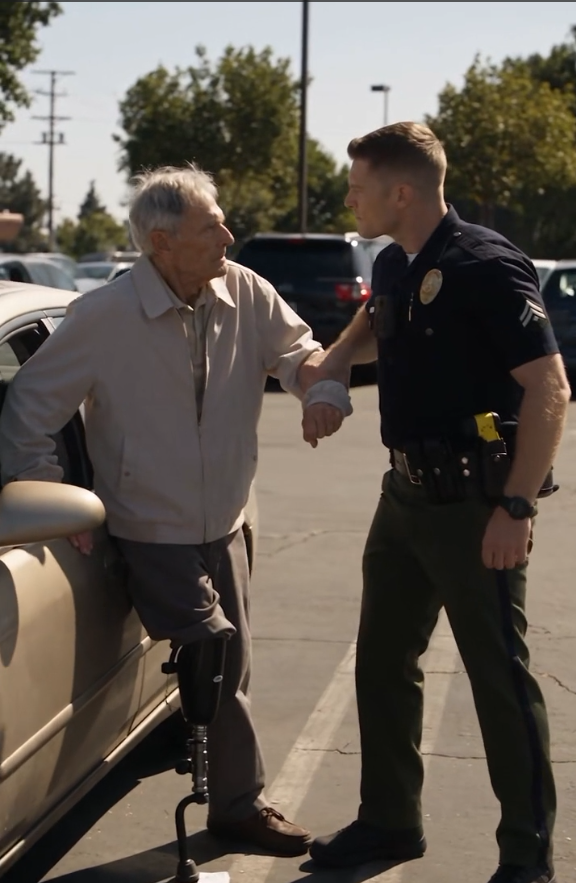
Miller’s hand on my wrist.
His accusation.
His comment about my leg.
The watch.
The order to place my hands on the roof.
The secure handset.
I kept my language plain.
Ruiz interrupted only when details required clarification.
“What exactly did Officer Miller say when the watch came off?”
“He didn’t say anything about the watch.”
“You told him what it was?”
“Yes.”
“When?”
“When he reached for it.”
“And his response?”
“He pulled harder.”
She wrote that down.
“What happened after it hit the pavement?”
“He told me to put my hands on the roof.”
“Did you refuse?”
“Yes.”
“Why?”
“I decided I needed to activate the secure device.”
“Were you afraid?”
I thought about the question.
“Yes.”
Ruiz waited.
I added, “Not in the way people usually mean.”
“What way, then?”
“I wasn’t expecting him to shoot me for standing beside my car. But once he started inventing explanations for what he was seeing, I stopped trusting that my cooperation would control the outcome.”
That made her pen stop.
I continued.
“He had already decided the placard was fake. Then he decided my gait proved it. Then he decided the watch was suspicious. Every fact became evidence for the conclusion he’d chosen first.”
Ruiz sat back slightly.
“You thought you needed a record outside the department.”
“I thought I needed preservation.”
“Why not call 911?”
I looked at her.
She gave a small nod.
“Fair question anyway.”
“The emergency handset establishes identity, location, timing, and network state simultaneously. It was designed for situations where ordinary communications may be unreliable or compromised.”
“Was the network compromised?”
“I didn’t know.”
“You used it because of the officer.”
“Yes.”
Her next question was quieter.
“Have you ever used that function before?”
“Once.”
“When?”
“Overseas. A long time ago.”
She did not ask for details.
I was grateful.
At seven thirty, Ruiz stepped outside.
At seven forty-six, the door opened again.
This time a man in a white uniform shirt entered with her.
He introduced himself as Deputy Chief Aaron Bell.
He had the careful manner of someone entering a room already aware that every word might someday be read aloud by an attorney.
“Sir,” he said, “I want you to know this matter is being reviewed.”
“I assumed it would be.”
“Officer Miller has been relieved from patrol duty pending that review.”
Ruiz did not look at me.
Bell sat down.
“There is also a question regarding the communications interference.”
“There shouldn’t be.”
His eyebrows lifted.
“The federal network center has already provided your department with the incident code.”
“You’ve spoken with them?”
“No.”
I pointed toward the wall.
“Your systems have.”
Bell glanced at Ruiz.
She nodded.
“The isolation notice cleared about twenty minutes ago,” she said. “All related data is locked for preservation.”
Bell folded his hands.
“Can you explain what happened?”
“I can explain the part I’m authorized to explain.”
His mouth tightened slightly.
“Go ahead.”
“The phone authenticated me. The session classified the event as a possible threat to a credential holder during contact with an armed public-safety employee. The network isolated the mobile radio subscriber involved in the incident and preserved associated records.”
Bell looked at me for several seconds.
“You’re saying the radio shut itself down.”
“I’m saying your network accepted an authorized command from a system your department voluntarily participates in.”
Ruiz looked down, hiding something that might have been the beginning of a smile.
Bell noticed.
He stood.
“I need to make some calls.”
Before leaving, he turned back.
“Sir, I’m asking you not to speak publicly about the communications system.”
“I have no intention of discussing protected technical information.”
“Or the incident.”
“That’s a different request.”
His expression cooled.
“I’m asking for patience until we know what happened.”
I looked at the recorder between us.
“You have a witness. Body-camera video. Radio logs. A dispatch record. My wrist. My watch. And Officer Miller’s report.”
Bell’s eyes narrowed.
“You’ve seen his report?”
“No.”
“Then you don’t know what it says.”
“No,” I said. “But I know he’s writing one.”
Bell left without replying.
Ruiz remained.
I watched the closed door for a moment.
“He’s worried,” I said.
“He has reasons to be careful.”
“That isn’t what I said.”
She capped her pen.
“No.”
I looked down at the silver fragments in the clear evidence envelope they had given me.
“Am I free to go?”
“Yes.”
“Good.”
Ruiz stood.
At the door, she hesitated.
“There’s something you should know.”
I waited.
“Officer Miller says you reached inside your jacket after he gave a lawful command and that he believed you were retrieving a weapon or electronic interference device.”