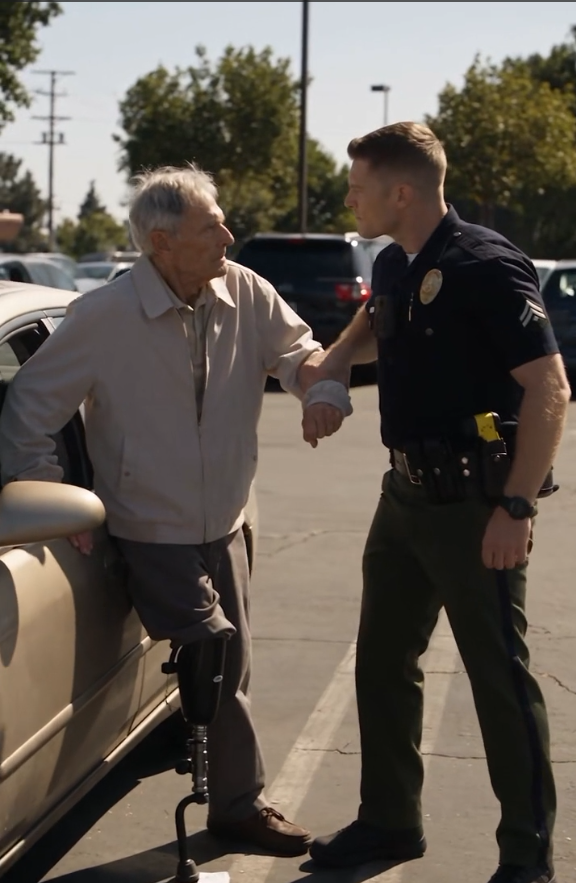
“I retrieved the phone.”
“I know.”
“That’s what his body camera will show.”
“Yes.”
She was still standing there.
“What else?”
“He says he had reasonable suspicion the disability placard was being misused.”
I looked at her.
“Based on my walking?”
“That’s what he says.”
“Did he run the placard?”
Her expression gave me the answer before her words did.
“I don’t know yet.”
That was the first moment all evening when I felt something colder than anger.
Because if Miller had not run it, he had been reckless.
But if he had—
then the entire encounter meant something else.
Part III — The Things Machines Remember
I slept badly that night.
Not because of Miller.
Because of the watch.
I laid the pieces on my kitchen table beneath the yellow light over the sink.
The crystal was ruined.
One bracelet link was bent.
The second hand had come loose inside the case and lay diagonally across the dial.
The old silver back was scarred in a way I had never seen before.
I turned it over between my fingers.
My father’s initials were still visible.
So was the date he had engraved after I came home from rehabilitation.
No message.
He had never been a man for engraved messages.
Just the date.
He gave me the watch without ceremony.
We were sitting on the back steps of his house.
I had been thirty-four, angry at the world, angry at my body, angry at my wife for helping me when I needed help and angry when she did not help because I insisted I could manage.
My father took the watch off his wrist.
“Here.”
I looked at it.
“What am I supposed to do with that?”
“Tell time.”
“I have a clock.”
“Then give it back.”
I took it.
He leaned forward, elbows on his knees.
After a while he said, “You keep waiting to become the man you were.”
I said nothing.
“He’s gone.”
I looked at him.
He nodded toward the watch.
“Doesn’t mean you are.”
That was as close as my father ever came to a speech.
I had worn the watch almost every day since.
At nine the next morning, the secure handset on my desk emitted two tones.
I pressed the side switch.
“Go.”
A familiar voice answered.
“Your incident generated enough paperwork to make three agencies dislike you before breakfast.”
“Morning, Elaine.”
Elaine Porter had spent fifteen years running regional communications assurance programs before taking over the technical review office where I still worked several weeks each quarter.
She was sixty, precise, and unimpressed by most forms of authority.
“You stable?” she asked.
“Yes.”
“Medical?”
“Bruised wrist.”
“Device?”
“Fine.”
“Watch?”
I looked at the pieces.
“Not fine.”
She had known my father.
That was why she asked.
“I’m sorry.”
“Thank you.”
A pause.
Then her professional voice returned.
“The local department wants a technical briefing.”
“They can have the standard incident explanation.”
“They’re asking why Unit Four-Seventeen was isolated.”
“Because the automated rule set accepted the credentialed emergency flag.”
“Correct.”
“What aren’t you saying?”
“Local system records created a secondary integrity flag.”
I sat straighter.
“What kind?”
“Pre-event database access.”
I said nothing.
Elaine continued.
“The mobile data terminal in Miller’s cruiser queried the disability placard eight minutes before your emergency activation.”
My eyes moved to the broken watch.
“And?”
“You know I can’t release local law-enforcement data to you directly.”
“Elaine.”
“I’m telling you enough so you understand why this has moved beyond a conduct complaint.”
“What did the query return?”
“Get it from their investigators.”
“Was the credential valid?”
She was silent.
That silence was enough.
I stood and walked to the kitchen window.
Across the street, a man was cutting his grass.
Normal morning.
Normal neighborhood.
Normal world.
“Did he know?” I asked.
“You need to let the evidence answer that.”
“Elaine.”
Her voice softened by half a degree.
“The record appears complete.”
I closed my eyes.
Miller had known.
Maybe not everything.
Maybe he had not confirmed the photograph.
Maybe he had convinced himself the placard was borrowed.
But he had not walked toward me ignorant.
He had walked toward me after checking something.
“Who has the logs?”
“Local internal affairs has been notified. Our office preserved the network copy because the emergency session triggered retention.”
“Does Bell know?”
“Yes.”
“Ruiz?”
“I don’t know.”
I looked at the secure phone in my hand.
For years I had defended systems like that handset because human recollection was fragile.
People forgot.
People rationalized.
People rewrote themselves by inches.
Machines had flaws too, but they did not generally wake up the next morning and decide yesterday had happened differently.
“Elaine.”
“Yes?”
“Do not release anything outside normal process because of me.”
“You think I would?”
“No.”
“Good.”
“I mean it.”
“I know what you mean.”
She paused.
“You’re worried this becomes about who you are.”
“Yes.”
“It already has.”
“That doesn’t mean I have to help it.”
“No.”
I heard her chair move.
“But understand something. If an officer used a public database, received a valid return, then confronted you as though he hadn’t, that matters whether you designed half the infrastructure on the East Coast or sold shoes.”
“That’s exactly my point.”
“I know.”
The call ended.
At eleven fifteen, Sergeant Ruiz called my ordinary phone.
“Are you available to come in?”
“When?”
“Today.”
“For what?”
“There are follow-up questions.”
“About the placard search?”
Silence.
Not long.
Long enough.
“You’ve been notified,” she said.
“I’ve been told a query occurred.”
“I can’t discuss details over the phone.”
“I’ll be there at one.”
I arrived six minutes early.
Ruiz met me in the lobby.
She looked tired.
Not disheveled.
Just tired in the eyes.
“You didn’t have to come alone,” she said.
“I know.”
“You can have counsel present.”
“I know.”
She studied me.
“You say that a lot.”
“People tell me things I already know a lot.”
That earned the smallest smile.
She took me to a different room.
Larger.
A window this time.
Deputy Chief Bell was there, along with a woman who introduced herself as Captain Naomi Warren from professional standards.
Warren was direct.
“I’m going to show you something.”
She turned a monitor toward me.
A digital record filled the screen.
Time stamps.
Vehicle identifier.
User credential.
Query category.
Miller’s badge number.
At 2:41 p.m., eight minutes before he put his hand on me, Miller had run my vehicle plate.
At 2:42, he had accessed the placard record associated with it.
The return showed:
PERMANENT MOBILITY DISABILITY CREDENTIAL — ACTIVE.
Registered holder: my name.
Then another line.
IDENTITY CROSS-REFERENCE AVAILABLE.
At 2:43, Miller opened it.
My driver’s-license photograph appeared.
Seventy years old at the time of renewal.
Gray hair.
Same face.
The photograph also showed part of the adaptive steering control installed for my left hand.
There was a medical restriction code attached to the license.
Not detailed.
Enough.
At 2:44, Miller closed the query.
At 2:49, his body camera activated.
Warren let me read the sequence twice.
Then she said, “We wanted you to see it before we asked additional questions.”