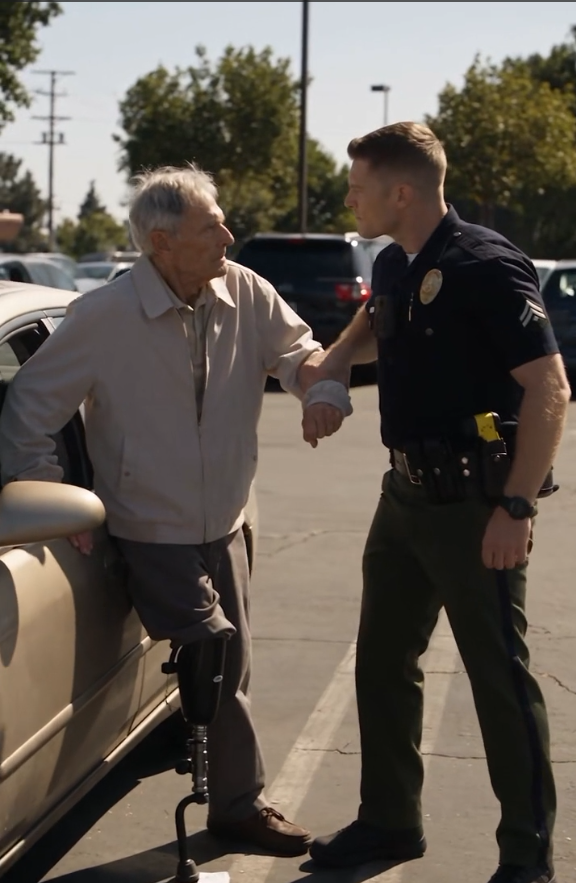
I looked at Bell.
His expression was controlled.
Too controlled.
“You knew last night.”
He did not answer immediately.
“We became aware of the query during the initial technical review.”
“How long before you asked me not to discuss the incident?”
Ruiz looked at him.
Bell’s eyes stayed on mine.
“I was still establishing facts.”
“That wasn’t my question.”
Warren stepped in.
“Sir, Deputy Chief Bell is not the subject of this interview.”
“No,” I said. “But his judgment is part of my experience.”
Bell leaned forward.
“What exactly are you suggesting?”
“I’m not suggesting anything.”
I pointed to the monitor.
“That’s the nice thing about records.”
The room went quiet.
Warren clicked to the next screen.
Officer Miller’s preliminary written report.
I read the relevant paragraph.
Observed elderly male displaying disability placard and ambulating from retail business without obvious mobility impairment. Subject appeared uncertain when negotiating curb. Based on training and experience, initiated contact to investigate suspected fraudulent use of disabled parking credential.
I read it again.
Then I looked at Warren.
“He wrote this after he had the database result?”
“Yes.”
“And after he saw my license photograph?”
“Yes.”
“Did he mention that?”
“No.”
Another paragraph.
Subject became argumentative and refused lawful direction. Subject reached into jacket and produced unknown electronic device. Immediately thereafter patrol radio became disabled, causing officer to believe subject had intentionally interfered with emergency communications.
I looked up.
“Argumentative.”
Ruiz shifted in her chair.
Warren said, “We’ve reviewed the body-camera footage.”
“And?”
“It does not show you raising your voice.”
“No.”
“It does show you refusing to place your hands on the vehicle.”
“Yes.”
“And reaching into your jacket.”
“Yes.”
“Those facts will be evaluated in context.”
“Good.”
I pushed the report back toward her.
“What did he write about the watch?”
Warren did not answer.
I looked down.
There was one sentence.
Subject dropped personal property during contact.
For several seconds, nobody spoke.
I felt the old sensation I had known during technical failure investigations: not anger exactly, but the sudden clean focus that came when a vague problem finally revealed its shape.
Miller had not merely been wrong.
He was editing.
The placard became “suspected.”
My calm answer became “argumentative.”
His hand pulling my father’s watch away became me dropping personal property.
The radio isolation became sabotage.
Every sentence moved responsibility a few inches away from him.
Enough inches, repeated often enough, could build an entirely different world.
“When do I see the video?” I asked.
Warren looked at Bell.
Then back at me.
“Your attorney can request it through the normal process.”
“I don’t have an attorney.”
“You may want one.”
I stood.
Bell said, “Sir.”
I looked at him.
He chose his words carefully.
“This department is taking the matter seriously.”
I looked at the report again.
“Then don’t protect yourselves from the truth faster than you investigate it.”
His face tightened.
I left.
That afternoon, I did something I had been avoiding.
I called a watchmaker.
Part IV — Pressure
The shop was narrow and quiet, tucked between a dry cleaner and a bookstore.
The man behind the counter wore a magnifying loupe over one eye and spoke to watches with the grave patience of a surgeon.
He placed my father’s watch on a black cloth.
“Impact was hard.”
“I noticed.”
He glanced at me.
“Sorry.”
“Bad joke.”
“I’ve heard worse.”
He worked the case open.
The movement inside was scratched but intact.
He lifted it toward the light.
“This is good.”
“It doesn’t look good.”
“The crystal took most of it. Balance is displaced. Second hand is loose. Bracelet can be repaired.”
“The case?”
“Scarred.”
“Can you remove it?”
“Some.”
He lowered the watch.
“Should I?”
That question caught me.
He pointed with a small tool.
“This mark here. Deep. If I polish until it disappears, I change the case shape. Better to clean it and leave what’s honest.”
I looked at the gouge along the silver edge.
“Leave it.”
He nodded.
“My father wore it.”
“That why it matters?”
“Yes.”
He placed the parts into a small tray.
“Then don’t make it new.”
I left the shop with an empty wrist.
That felt worse than I expected.
By evening, the parking-lot video had reached social media.
Not the body-camera footage.
The mother by the SUV had recorded forty-three seconds on her phone.
The clip began after Miller had already taken hold of my wrist.
It showed him accusing me of using a fake placard.
It showed me saying the placard was registered to me.
It showed him making the comment about a “real amputee.”
Then it showed his arm move.
The camera dipped because the woman had pulled one of her children backward.
When the image steadied, my father’s watch was on the ground.
The clip ended before I took out the secure handset.
That missing portion created exactly the kind of vacuum people enjoyed filling.
Some viewers decided I had done nothing wrong.
Others decided the clip was edited to protect me.
Several posts claimed the “mysterious black device” proved I was a federal operative who had deliberately disabled local police.
Another claimed I was a retired general.
I was not.
Another said I had been a senator.
I had never run for anything.
One man confidently identified me as the former director of an agency I had never worked for.
I turned the computer off.
My ordinary phone rang.
Elaine.
“You saw it.”
“Yes.”
“Your name is circulating.”
“Yes.”
“Reporters are calling the office.”
“I’m sorry.”
“You didn’t upload the video.”
“No.”
“Then don’t apologize.”
I walked to the kitchen.
“What are you telling them?”
“That we don’t discuss credentialed communications incidents.”
“That’ll calm everybody.”
“No,” she said. “It’ll make them worse.”
I opened the refrigerator and stared inside without wanting anything.
Elaine continued.
“The department requested that we issue a statement saying the radio isolation was automatic and not caused by unauthorized interference.”
“That seems reasonable.”
“It is.”
“Do it.”
“They also asked us to avoid confirming your role.”
“Also reasonable.”
“You sure?”
“Yes.”
“This would go easier if people understood you were authorized.”
I closed the refrigerator.
“That’s exactly what I don’t want.”
“Why?”
“Because then the story becomes that Miller grabbed the wrong old man.”
Elaine did not answer.
“If I had been retired from the post office,” I said, “would the watch be less broken?”
“No.”
“If the phone had been a grocery-store coupon app, would his report become accurate?”
“No.”
“If nobody important answered when I pressed the button, would I deserve less protection from a false report?”
“No.”
“Then I’m not giving him the defense that his real mistake was failing to recognize somebody with connections.”
Elaine was silent for a moment.
“You’ve been rehearsing that.”
“I’ve been thinking about it.”
“Same thing with better lighting.”
I smiled despite myself.
“There’s more,” she said.
Of course there was.
“What?”
“The preserved network packet includes several earlier queries from Miller involving disability credentials.”
“How many?”
“I can’t give you case data.”
“Enough to matter?”