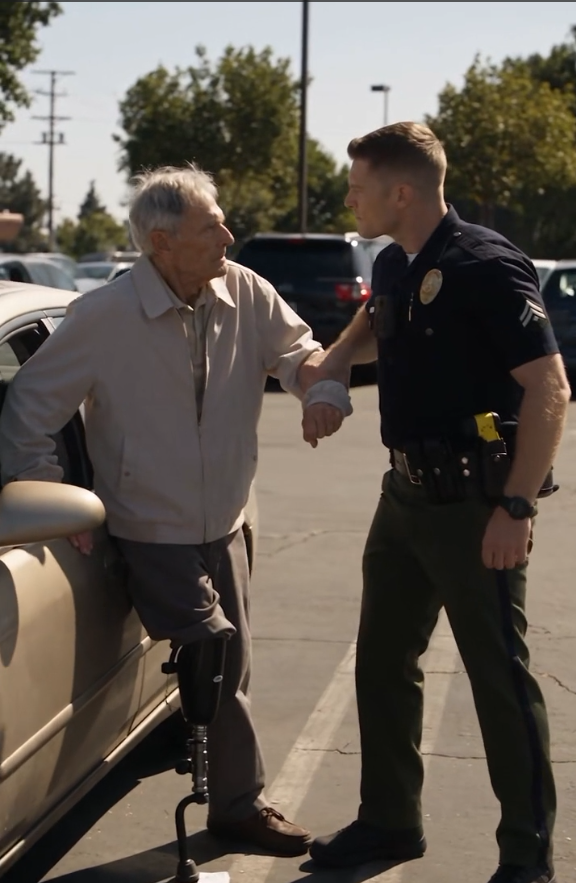
“Yes.”
I sat down.
“Complaints?”
“I don’t know.”
“You do.”
“I know enough to tell you professional standards is widening the review.”
I looked at my bare wrist.
The pale strip where the watch had protected the skin seemed oddly exposed.
“What are they looking for?”
“A pattern.”
Patterns were dangerous things.
Sometimes they revealed truth.
Sometimes people forced them because randomness made them uncomfortable.
“Let them prove it,” I said.
“They intend to.”
Two days later, Deputy Chief Bell came to my house.
He called first.
I almost told him no.
Then I changed my mind.
He arrived without an aide.
No uniform jacket, just a white shirt and dark tie.
I made coffee.
He accepted a cup and held it without drinking.
We sat at my kitchen table.
The empty place where the watch parts had been was between us.
Bell began carefully.
“The city attorney would like to discuss resolving the property damage and any medical expenses.”
“My wrist is fine.”
“The watch isn’t.”
“No.”
“We can cover full restoration.”
“Money isn’t the issue.”
“I understand.”
“No,” I said. “You understand the sentence. That’s different.”
He absorbed that without reacting.
I respected him slightly more for it.
He set down the cup.
“There is concern about disclosure of protected communications capabilities.”
“I’ve disclosed none.”
“I know.”
“The phone appears in public video only after the clip ends.”
“We have reason to believe longer footage exists.”
“The woman?”
“We haven’t asked her to suppress anything.”
“Good.”
“We did ask her not to post material that might compromise an active investigation.”
I leaned back.
“Why are you here?”
He looked at me directly.
“To ask whether you would consider resolving your complaint through an administrative settlement.”
“What does that mean?”
“Compensation for the watch. Written acknowledgment of inappropriate conduct. Policy review. Training.”
“And Miller?”
“Personnel matters would remain internal.”
“There it is.”
“This is not an attempt to protect him.”
“What is it?”
“An attempt to prevent a complicated incident from becoming a public fight over secure infrastructure.”
“The secure infrastructure isn’t the complicated part.”
“To you.”
“To anyone who reads the time stamps.”
Bell’s eyes sharpened.
“You’ve seen them.”
“You showed them to me.”
“I’m talking about the broader records.”
“I know they exist.”
He sat back.
“Who told you?”
“That isn’t relevant.”
“It is to me.”
“That may be part of the problem.”
Bell’s cup touched the table harder than he intended.
Not a slam.
Just enough.
“We are trying to manage risks you don’t have to manage.”
I looked at him.
“I spent forty years managing risks that were invisible to the people affected by them. That sentence can become an excuse very quickly.”
He breathed out.
“I’m not your enemy.”
“I didn’t say you were.”
“Then help me keep this proportionate.”
I thought about Miller’s hand on my wrist.
His words.
A real amputee doesn’t forget which leg is gone.
The watch hitting asphalt.
Subject dropped personal property.
“What would proportionate look like if I hadn’t had that phone?”
Bell said nothing.
“If your radio had kept working,” I continued, “and there was no network preservation, what would you have tonight?”
“Body-camera footage.”
“Assuming it uploaded.”
“It would.”
“Dispatch logs?”
“Yes.”
“Terminal history?”
“Yes.”
“Would anyone have frozen them in the first ten minutes?”
He looked away.
That was answer enough.
“Would Sergeant Ruiz have been sent immediately?”
“Maybe.”
“Would Miller have written the same report?”
Bell looked back at me.
“Yes.”
That answer surprised me.
I nodded.
At least he had said it.
“And then?”
Bell rubbed a thumb along the edge of his cup.
“I don’t know.”
“That’s the problem.”
He was quiet for a long time.
Then he said, “There were prior complaints.”
I did not move.
“How many?”
“I’m not authorized to discuss details.”
“You came into my house.”
“I know.”
“Then why tell me?”
“Because I don’t want you thinking we’ve discovered nothing.”
“That wasn’t what I was thinking.”
“What were you thinking?”
“That you discovered something too late.”
His expression hardened, then softened again.
“Fair.”
The word sat between us.
I had not expected it.
Bell continued.
“None of the prior complaints had the combination of independent video, complete system records, and a preserved data trail we have here.”
“Were they investigated?”
“Yes.”
“Were they sustained?”
“Some parts. Not the central allegations.”
“Why?”
“Conflicting accounts. Incomplete video. No corroboration.”
“Did any involve disability placards?”
Bell looked at me.
I had my answer.
I stood and carried my untouched coffee to the sink.
Behind me, he said, “I’m asking you to consider the consequences of making this public before the review is complete.”
I turned.
“I haven’t made anything public.”
“I know.”
“But somebody is going to.”
“Yes.”
“And then?”
“We deal with it.”
I studied him.
“No. You decide whether you deal with the facts or the optics.”
His face tightened again.
I continued.
“I’ll protect whatever technical information I’m legally required to protect. I won’t sign anything that turns the rest of what happened into confidential material.”
Bell stood slowly.
“I’ll tell the city attorney.”
“Good.”
At the door, he stopped.
“The watch.”
“What about it?”
“Can it be repaired?”
“Yes.”
He nodded.
Then, almost to himself, he said, “I’m glad.”
After he left, I stood at the window until his car disappeared.
I believed he meant it.
That did not make his earlier decisions harmless.
People were rarely simple enough to fit inside the version of them we found most convenient.
That included Miller.
I reminded myself of that because I could feel anger beginning to make him simple in my mind.
Cruel.
Dishonest.
Arrogant.
Maybe all true in moments.
But if the investigation was going to mean anything, it had to find what he had actually done, not merely produce a villain big enough to carry everybody else’s failures.
That standard had to apply even when I disliked the man.
Especially then.
Part V — Reversal
Three weeks passed before I saw Officer Miller again.
By then, the swelling in my wrist was gone.
My prosthetic socket had been adjusted.
My father’s watch was still at the repair shop.
And the professional-standards investigation had grown large enough that the city retained an outside hearing officer for the disciplinary proceeding.
Miller remained on administrative assignment.
The public knew very little officially.
The department had confirmed an internal investigation.
The communications office had issued a six-sentence statement saying the patrol radio interruption resulted from an authorized security protocol and not from unlawful electronic interference by a civilian.
That single sentence erased the most dramatic accusation in Miller’s report.
It did not erase the rest.
His attorney argued that the placard database return had not eliminated reasonable suspicion.
A valid credential, he said, could still be misused by someone other than the registered holder.
That argument lasted until the identity cross-reference was introduced.
My photograph.
My name.
My vehicle.
My adaptive-driving restriction.
All accessed before Miller walked toward me.
His attorney then argued that the officer could not be expected to memorize every detail displayed on a mobile terminal during routine patrol.