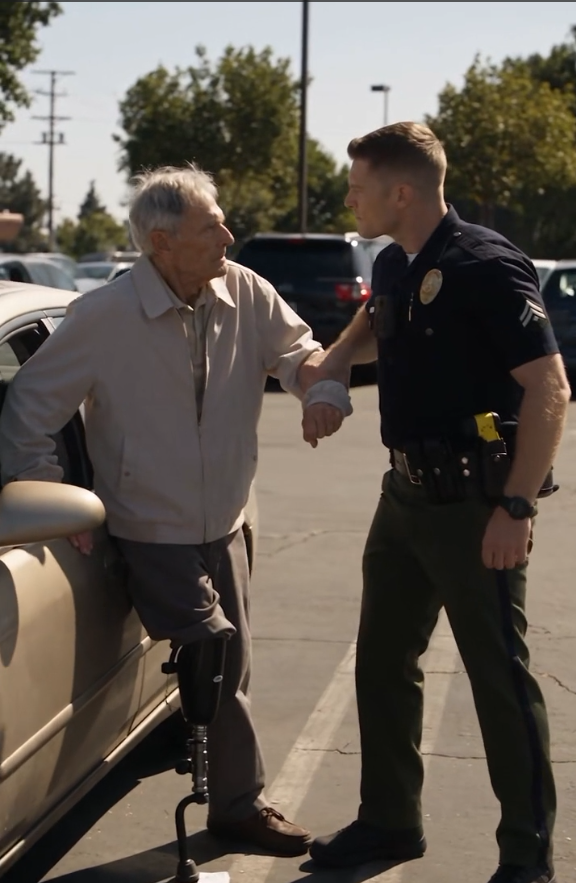
That might have worked.
Except the terminal logged screen duration.
Miller had kept my credential record open for forty-three seconds.
Then my photograph for twenty-one.
That was enough time to look.
Enough time to know.
The hearing took place in a municipal conference chamber that had been converted for administrative proceedings.
No jury.
No television cameras.
Just a hearing officer, attorneys, department representatives, a union representative, a court reporter, and several witnesses waiting outside.
I was scheduled after Sergeant Ruiz.
I listened from the hallway as her testimony carried faintly through the door.
She described the parking lot.
The isolated radio.
The watch.
The witness.
Then she was asked what Miller told her when she arrived.
“He said the subject had interfered with communications.”
“Did he identify the subject by name?”
“No.”
“Did he tell you he had already queried the subject’s vehicle and disability credential?”
“No.”
“Did he tell you he had viewed an identity cross-reference?”
“No.”
“Did you learn that later?”
“Yes.”
“How?”
“During the record review.”
The attorney paused.
“Would that information have affected your initial understanding of the encounter?”
“Yes.”
“How?”
Another pause.
“It would have caused me to ask why the officer described the placard as apparently fraudulent after the system had returned it as active and tied to the person he was confronting.”
There was no drama in her voice.
That made the sentence stronger.
When my turn came, I walked into the room using a cane.
Not because I always needed one.
Because the socket still became uncomfortable after long periods of standing, and I no longer had patience for proving I could walk without assistance.
Miller sat beside his attorney.
He looked older than he had in the parking lot.
Not transformed.
Not broken.
Just tired.
He did not meet my eyes at first.
I took the oath and sat.
The city’s attorney began with the encounter.
I told it again.
By then I had told it enough times that the sequence felt almost mechanical.
But when she reached the watch, something changed.
“What did Officer Miller do with it?”
“He pulled it from my hand.”
“What did you say?”
“I told him it was my watch.”
“Did you move toward him?”
“No.”
“Did you throw the watch?”
“No.”
“Did you drop it?”
“No.”
The attorney displayed a still frame from the body camera.
Miller’s hand around my wrist.
My palm partly open.
The silver case visible between his fingers.
Then the next frame.
His arm pulling away.
Then the watch falling.
No interpretation was required.
The city attorney asked, “Why did the watch matter to you?”
Miller’s lawyer stood.
“Relevance.”
The hearing officer considered.
“Limited relevance to property allegation and impact. Proceed briefly.”
I looked at the damaged-watch photograph on the screen.
“It was my father’s.”
“That all?”
I hesitated.
“No.”
I explained when he had given it to me.
Not the whole story.
Just enough.
He had given it to me after the injuries that cost me my right arm and right leg.
I had been trying to figure out what remained of my life.
He gave me the watch because he had no interest in treating me like something fragile.
The attorney did not ask more.
Then we reached the black handset.
“Did you use it to disable Officer Miller’s radio?”
“No.”
“Did you intend for his radio to become disabled?”
“No.”
“What did you intend?”
“To establish an authenticated emergency communications session and preserve a record.”
“Why?”
“Because I no longer trusted that his account of the encounter would match mine.”
Miller finally looked at me.
The attorney asked, “Why not simply comply?”
His lawyer objected.
The hearing officer allowed me to answer only as it related to my decision to retrieve the device.
I thought carefully.
“Because compliance had stopped resolving anything.”
I saw the court reporter look up.
I continued.
“I told him the placard was mine. That did not matter. My physical condition was visible. That did not matter. I told him the object in my hand was a watch. That did not matter. Each answer became another reason for him to distrust me.”
The attorney nodded.
“Did you know, at that time, that he had already confirmed the placard record?”
“No.”
“When did you learn?”
“The next day.”
“What was your reaction?”
Miller’s attorney objected again.
Sustained.
The city attorney changed direction.
“Do you believe your professional status should have affected how Officer Miller treated you?”
“No.”
“Why not?”
“Because he didn’t know it.”
She waited.
I added, “And because it shouldn’t have mattered if he did.”
The room was very quiet.
That was as far as I wanted to go.
Then Miller’s attorney stood.
He was good.
Not theatrical.
He did not insult me.
He began with the facts that helped his client.
“You refused Officer Miller’s instruction to place your hand on the roof of the vehicle.”
“Yes.”
“You then reached inside a jacket.”
“Yes.”
“He did not know what you were reaching for.”
“Not at first.”
“You agree that officers sometimes encounter weapons during traffic or parking enforcement?”
“Yes.”
“You agree that reaching into concealed clothing during a tense police encounter can increase danger?”
“Yes.”
“Yet you did it.”
“Yes.”
“Why should Officer Miller have known you were retrieving a phone?”
“He shouldn’t have.”
The attorney paused.
That answer had not helped the line he was building.
I continued before he could stop me.
“That is why I moved slowly, kept my remaining hand visible as long as possible, and told him I was retrieving a communications device.”
“You didn’t ask permission.”
“No.”
“You made the decision yourself.”
“Yes.”
“And moments later his radio stopped functioning.”
“Yes.”
He walked a few steps.
“From Officer Miller’s perspective, that could appear threatening.”
“Yes.”
The attorney turned slightly toward the hearing officer.
“So you acknowledge his concern was reasonable.”
“No.”
He looked back at me.
“You just said—”
“I said I understand why an unknown device could concern him. That isn’t the same as agreeing with everything he did before or after seeing it.”
The attorney held my gaze.
“Officer Miller had no way of knowing your credentials.”
“Correct.”
“No way of knowing what the device was.”
“Correct.”
“No way of knowing that a federal communications network would recognize you.”
“Correct.”
“So how can you criticize him for responding to what he actually knew?”
I looked at Miller.
This time he held my gaze.
“Because what he actually knew is why we’re here.”
The attorney frowned.
I pointed toward the evidence monitor.
“He knew the placard was active. He knew it was registered to me. He had my photograph. He knew all of that before he touched me.”
The attorney said, “That does not prove what he remembered at the moment—”
“No.”
I turned back to him.
“That’s what his report was for.”
He stopped.
I continued.
“If he forgot the database return in the parking lot, he had hours to remember it before writing his report.”
No one objected.
The attorney glanced toward Miller.
Then down at his notes.
For the first time, I understood where the case truly turned.