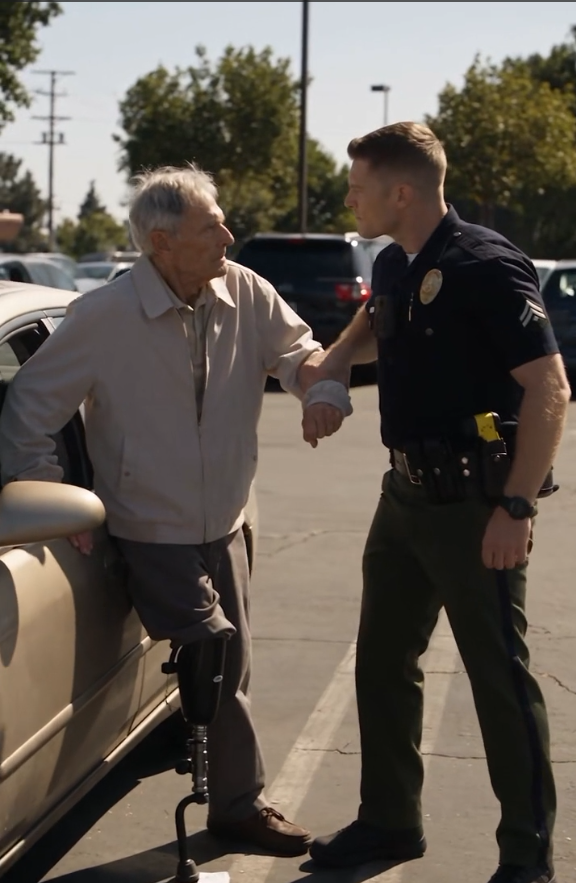
Not on the parking lot.
Not on the watch.
Not even on the radio.
People made bad judgments in seconds.
They became afraid.
They became irritated.
They misunderstood.
A system worth anything had to distinguish a bad moment from a dishonest choice.
Miller’s most serious decision had come later, sitting safely at a desk.
He had known the encounter was preserved.
He had known a witness existed.
And still he wrote that he had approached me because I displayed “no obvious mobility impairment.”
Still he wrote that I had “dropped” my watch.
Still he omitted the database result.
The hearing was never really about whether he had been wrong.
It was about what he had done after having time to know better.
The attorney sat down.
The hearing officer called a recess.
In the hallway, I found Sergeant Ruiz beside a vending machine.
“You okay?” she asked.
“Yes.”
“You always say that?”
“Usually when people ask.”
She pressed a button for coffee.
The machine made an unhappy mechanical noise.
“Don’t drink that.”
“I’ve survived worse.”
We stood there.
Then she said, “There’s something they haven’t gotten to yet.”
I looked at her.
“What?”
“The other stops.”
I had expected that.
Still, hearing it said made my stomach tighten.
“How many?”
“Enough.”
“Same thing?”
“Not exactly.”
The vending machine dropped a cup.
Ruiz watched it fill.
“Several placard contacts. Some legitimate violations. Some not. Two complaints about unnecessary physical handling.”
“Sustained?”
“No.”
“Body cameras?”
“One had no useful angle. One recording started late.”
“Reports?”
She looked at me.
“Very clean.”
I understood what she meant.
Too clean.
“What happens now?”
“They compare.”
The chamber door opened.
The clerk called us back.
The next witness was a department data analyst.
She showed the query history from six prior placard stops.
Miller had a pattern.
Not of targeting disabled people randomly.
Something more specific.
He would query the plate and placard first.
If the records were invalid, the stop proceeded normally.
If they were valid but the driver’s appearance did not match what Miller expected disability to look like, he initiated contact anyway.
That alone was not misconduct.
Officers could investigate possible misuse.
The pattern became troubling in the reports.
In four cases, Miller omitted the fact that he had obtained valid returns before contact.
In two, he described the database result as occurring after the initial encounter even though time stamps showed it happened before.
In one, he wrote that a driver “became evasive when asked about mobility limitations.”
The body-camera transcript showed the driver saying, “I don’t discuss my medical condition with strangers.”
I looked at Miller.
His face had lost color.
The city attorney displayed my report beside the older one.
Subject became argumentative.
Driver became evasive.
I saw it then.
Not a conspiracy.
Not a grand scheme.
A habit.
Miller did not invent entirely new events.
He tilted them.
One adjective at a time.
Argumentative.
Evasive.
Suspicious.
Uncooperative.
The kind of words that sounded factual because they were common.
The kind that moved judgment without admitting they were judgments.
Then came the final record.
Miller’s mobile-terminal activity from the afternoon he stopped me.
The analyst enlarged one line.
At 2:44:17 p.m., after viewing my photograph, Miller had entered a note into the field-contact scratchpad.
POSSIBLE PLACARD MISUSE. HOLDER APPEARS AMBULATORY.
At 2:44:32, he added:
VERIFY IN PERSON.
Then another line.
2:45:01.
SUBJECT HAS VISIBLE PROSTHETIC? UNCLEAR FROM DISTANCE.
The room changed.
Not dramatically.
No gasps.
No one shouted.
But I saw Ruiz close her eyes.
Miller’s attorney leaned toward him.
Because that note destroyed the last clean version of the story.
From the cruiser, before approaching me, Miller had considered the possibility that I was visibly disabled.
He had seen something.
He had written it down.
Then he approached.
Three minutes later, standing close enough to grip my arm, he told me a “real amputee” would not forget which leg was missing.
The contradiction was no longer memory against memory.
It existed in his own words.
The city attorney asked the analyst one final question.
“Was this note available to Officer Miller when he later completed his written report?”
“Yes.”
“Did he include it?”
“No.”
When the analyst stepped down, the hearing officer announced that Miller could testify or rely on the existing record.
His attorney requested a private conference.
Ten minutes later, Miller took the chair.
He swore to tell the truth.
For the first time since the parking lot, there was no badge on his chest.
He wore a gray suit.
He looked smaller without the equipment.
Not weaker.
Just more like everybody else.
His attorney guided him through his decisions.
Miller said he had spent eleven years on patrol.
He had encountered fraudulent placard use many times.
He said people borrowed relatives’ tags, used deceased family members’ permits, or displayed credentials while the disabled holder remained elsewhere.
He said my hesitation at the curb caught his attention.
He ran the records.
He saw they were valid.
He still believed visual verification was appropriate.
None of that was unbelievable.
Then his attorney asked about the watch.
Miller took a long breath.
“I thought he was manipulating something.”
“Did you intend to damage it?”
“No.”
“Did you know it had sentimental value?”
“No.”
“Would you have pulled it away had you understood what it was?”
Miller looked toward me.
“I don’t know.”
His attorney froze.
It was the first answer all day that sounded completely honest.
Miller swallowed.
Then he said, “I’d like to say no.”
His attorney tried to move on.
Miller did not.
“But I was angry.”
The attorney whispered something.
Miller shook his head.
The hearing officer said, “Officer, answer only the question asked.”
Miller nodded.
His attorney shifted to the report.
“Why did you omit the pre-contact database confirmation?”
“I didn’t think it changed the basis for the investigation.”
“Why describe the subject as having no obvious mobility impairment?”
Miller’s eyes moved toward my right leg.
“I wrote it badly.”
“Were you attempting to deceive anyone?”
“No.”
“Why write that he dropped the watch?”
A pause.
“I didn’t think the watch was important.”
I felt something inside me settle.
Not forgiveness.
Clarity.
That sentence was the whole encounter.
He did not think the watch was important.
He did not think the database result was important.
He did not think my explanation was important.
He did not think the distinction between “argumentative” and calm disagreement was important.
He decided what mattered.
Then he wrote the world accordingly.
The city attorney approached for cross-examination.
Her first question was simple.
“When did you realize the man you stopped was missing an arm?”
Miller stared at her.
“In the parking lot.”
“Before or after you accused him of faking a disability?”
“After.”
“Before or after you took the watch?”
He shifted.
“Before.”
“Did seeing an amputated arm cause you to reconsider whether he might also have a legitimate lower-body mobility impairment?”
Miller’s attorney objected.
The hearing officer allowed the question.
Miller answered.
“No.”
“Why?”
“I was focused on controlling the interaction.”
“When did control become necessary?”
“He was noncompliant.”
“What had he refused at that point?”