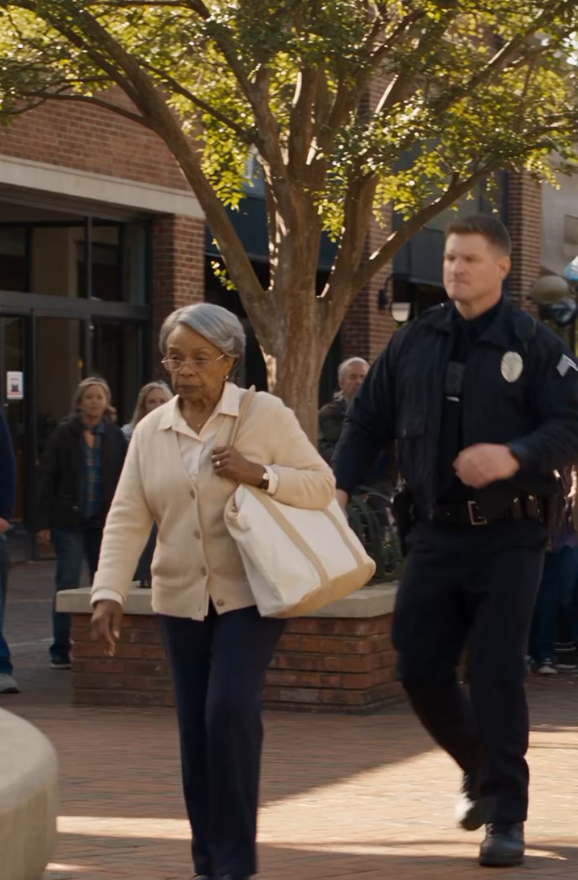
I objected.
She ignored me.
I drove her anyway.
The children had made cards.
Most were covered in drawings of books, hearts, flowers, and one surprisingly accurate police car drawn by a nine-year-old with an obvious interest in vehicles.
Odessa read every note.
She cried only once.
Not when she saw the cards.
When she noticed that someone had repaired the torn strap on her canvas bag.
Mrs. Gable had stitched it.
“You did this?”
Mrs. Gable shrugged.
“Good canvas shouldn’t go to waste.”
My mother ran her thumb over the thick new stitching.
“Thank you.”
I watched them hug between the library shelves.
For the first time that week, Keegan felt far away.
That lasted until our attorney called.
“We got the dispatch log.”
I stepped outside.
“And?”
“Come to the office.”
“Tell me.”
“Nyla.”
Something in his voice stopped me.
“What?”
“Come look at it yourself.”
The dispatch printout was twelve pages long.
Call entries.
Unit assignments.
Status changes.
Location updates.
Time stamps precise to the second.
I read the line relating to the jewelry store.
10:17:42 — silent alarm received.
10:18:09 — caller confirms theft.
10:18:31 — suspect description entered.
10:19:02 — units dispatched.
I went back to the top.
Read it again.
“What time did Mrs. Gable call me?”
Our attorney slid another page across the desk.
My phone record.
10:14:06.
The call lasted one minute, twelve seconds.
I remembered every second.
“Nyla, get to Lincoln Square right now.”
Two officers had already cornered my mother.
My attorney said, “Your mother’s encounter with Keegan began before the jewelry-store robbery was reported.”
I said nothing.
He pointed to another document.
The first bystander video had metadata.
10:13:21.
It showed Keegan already holding Odessa’s bag.
My pulse slowed.
That was what happened to me when something became very clear.
I stopped feeling angry.
I started working.
“The report says he was dispatched for the robbery.”
“Yes.”
“He wasn’t.”
“No.”
“He wrote that the robbery call was why he approached her.”
“Yes.”
“It couldn’t have been.”
Our attorney leaned back.
“Correct.”
I reread Keegan’s report.
A sentence I had skimmed before now stood out.
At approximately 1013 hours, Officer Keegan observed an individual matching the suspect description associated with the jewelry-store incident.
At 10:13.
The robbery had not been reported until 10:17.
Not an inconsistency.
An impossibility.
My mother had been asNextlted before the official reason for stopping her existed.
I looked at the attorney.
“Has internal affairs seen this?”
“They have access to the same logs.”
“That wasn’t my question.”
He understood.
“I sent a preservation letter this morning specifically identifying the time discrepancy.”
“Response?”
“Nothing yet.”
My mother arrived twenty minutes later.
I watched her read the documents.
She took longer than I had.
Not because she didn’t understand.
Because she checked every line.
Then she tapped the page once.
“So he invented the robbery afterward.”
“That’s what it looks like.”
“No,” she said.
I looked at her.
She pointed to the time.
“He didn’t invent the robbery. The robbery happened. He borrowed it.”
That distinction mattered.
Keegan had not created an imaginary crime.
He had taken a real event that occurred minutes later and built it backward around his conduct.
A lie that wore the clothing of truth.
“What was he doing before the robbery call?” Odessa asked.
“We don’t know.”
“Why did he approach me?”
“You tell me.”
She took off her glasses.
“I was walking from the donation center to the library.”
“Did you interact with him before he stopped you?”
“No.”
“Did you see him anywhere else?”
She thought.
“His patrol car was parked near the square.”
“Was Hollow with him?”
“Yes.”
“Did they say anything?”
“Keegan asked what was in my bag.”
“Before anything else?”
“Yes.”
“What did you say?”
“Books.”
“And then?”
“He said he wanted to see.”
“You said no.”
“I said he could ask politely.”
Despite myself, I smiled.
My mother continued.
“He said he was conducting an investigation.”
“What investigation?”
“He didn’t say.”
There it was.
The original lie had been vague.
The robbery came later.
Keegan had chosen a reason after he needed one.
Our attorney obtained prior complaint summaries over the next two weeks.
Most were heavily redacted.
Still, a pattern appeared.
Three complaints alleged unnecessary physical force.
Two claimed Keegan had searched bags or vehicles without clear legal justification.
One alleged that he changed the stated reason for a stop after making an arrest.
All had been closed without discipline beyond counseling.
There were also commendations.
Arrests.
Good performance evaluations.
Letters from supervisors praising his productivity.
Corruption rarely arrives wearing a sign.
Often it accumulates inside ordinary paperwork until everybody around it learns how not to look.
Hollow had fewer complaints.
But his name appeared beside Keegan’s more than once.
Partner.
Witness.
Corroborating officer.
Every time, Hollow’s report supported Keegan.
That was when my view of him changed.
Fear might explain one lie.
Habit explained a pattern.
Three weeks after the square, Hollow asked to speak with us.
Not directly.
His attorney contacted ours.
The meeting took place in a conference room on neutral ground.
Hollow entered wearing civilian clothes.
Without the uniform, he looked smaller.
Not physically.
Morally.
That thought was unfair, and I knew it.
I didn’t correct it.
My mother sat beside me.
Hollow sat across from us.
He did not look at Odessa at first.
His attorney began.
“Officer Hollow has information relevant to the ongoing investigation.”
I said, “Then he should give it to investigators.”
“He has.”
“After signing a false report?”
Hollow finally looked at me.
“Yes.”
His voice was barely above conversational.
“Yes, ma’am.”
“Don’t call me ma’am.”
“Nyla,” my mother said.
I leaned back.
Hollow turned toward Odessa.
“I’m sorry.”
My mother studied him.
“For which part?”
That question landed harder than anything I could have said.
Hollow swallowed.
“For not stopping him.”
She waited.
“For lying afterward.”
She kept waiting.
“For standing between the crowd and you instead of helping.”
Odessa said, “Good. At least you know what you’re apologizing for.”
His eyes dropped.
I asked, “Why now?”
Hollow’s attorney began to answer.
I held up a hand.
“I asked him.”
Hollow rubbed his palms together.
“Because Keegan told me the camera issue had been handled.”
My attention sharpened.
“What does that mean?”
“He told me neither camera had usable footage.”
“Was that true?”
“I thought it was.”
“You saw your camera recording.”
His eyes lifted.
“You noticed that?”
“I notice things.”
He nodded once.
“My body camera was on when you arrived. I had activated it after Mrs. Gable started yelling that people were filming.”
“So it missed the slap.”
“Yes.”
“What did it capture?”
His throat worked.
“Keegan talking afterward.”
“What did he say?”
Hollow looked at his attorney.
The attorney gave a slight nod.
Hollow answered.
“He said we needed to make the robbery call fit.”
Nobody moved.
My mother’s expression did not change.
Mine probably did not either.
Hollow continued.
“Dispatch came over the radio while the sergeant was on the way. Jewelry store robbery. Keegan heard the description and said we could use it to justify the stop.”
“What was the actual suspect description?”