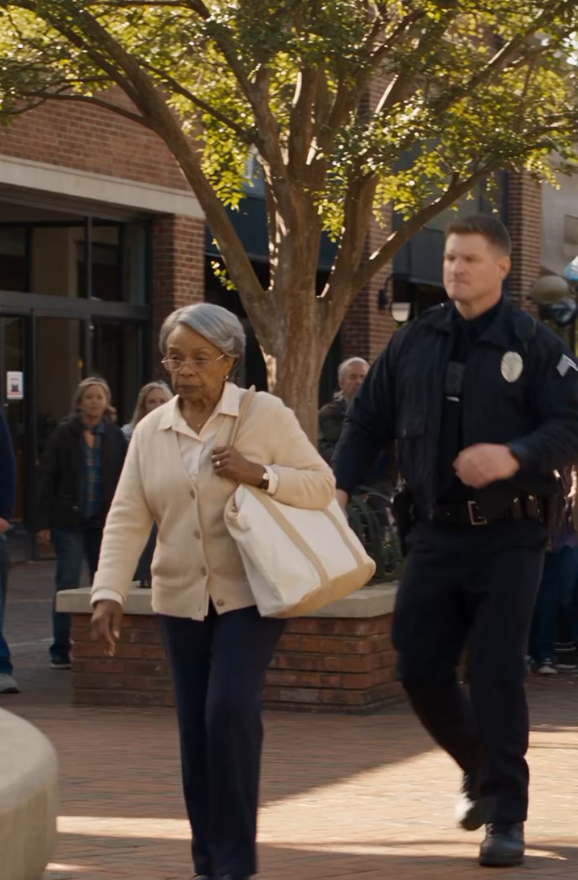
“A man. Early twenties. Gray sweatshirt. Black backpack.”
I stared at him.
My sixty-eight-year-old mother.
Cream cardigan.
Canvas bag of children’s books.
Hollow pressed his lips together.
“Keegan changed the narrative after the call.”
“And you signed it.”
“Yes.”
“Why?”
He looked down.
“I’ve been his partner fourteen months.”
“That doesn’t answer me.”
“He told me if I contradicted him, I’d go down with him. Said I had already failed to intervene, so I was involved either way.”
“You believed him?”
“I knew enough to believe it could happen.”
My mother spoke.
“Did you believe what he did was wrong?”
Hollow’s answer came quickly.
“Yes.”
“While he was doing it?”
“Yes.”
“And you did nothing.”
“No.”
My mother nodded.
Not forgiving him.
Recognizing the fact.
I asked, “Where is the footage?”
Hollow took a breath.
“That’s the problem.”
Of course it was.
“The file showed on the station system when we got back. I saw it listed.”
“Then?”
“The next morning it was marked upload failure.”
“You think somebody deleted it?”
“I don’t know.”
“Do you have a copy?”
“No.”
I turned toward his attorney.
“Then this is testimony against testimony.”
Hollow said, “Not exactly.”
I looked back.
He reached into a folder and removed a printed maintenance sheet.
“Our patrol vehicle automatically records equipment status. When body-camera files sync through the car dock, the system generates a transfer record.”
He slid it across.
There was a line containing Hollow’s camera identification number.
File transferred.
Duration: 07:41.
Checksum verified.
10:58 a.m.
The footage had uploaded successfully.
Whatever “technical problem” appeared later had happened after the system confirmed the file.
I looked at Hollow.
“You kept this?”
“I requested my vehicle service history before they took me off patrol.”
“Why?”
His face tightened.
“Because I didn’t trust anybody anymore.”
My mother said quietly, “Including yourself?”
Hollow looked at her.
“No, ma’am.”
He swallowed.
“Especially myself.”
That afternoon, internal affairs placed Hollow on administrative leave.
Keegan had already been on paid leave because of public pressure.
By evening, the missing video became the center of the investigation.
Not just what Keegan had done.
What happened to the recording after.
The next morning, the department announced that an outside agency would take over evidence review.
The story had changed.
What began as an officer claiming an elderly woman resisted him had become a possible falsified report tied to missing digital evidence.
I should have felt relief.
Instead, I felt the ground shifting beneath us.
Because powerful systems often tolerate bad conduct until somebody threatens to prove how it was tolerated.
And now we were no longer asking whether Travis Keegan had struck my mother.
We were asking how many people needed his version to survive.
Part IV — The Cost of the Truth
Keegan stopped speaking publicly.
His attorney did not.
The statements were careful.
Officer Keegan denied intentionally striking Odessa Freeman.
Officer Keegan maintained that his actions were reasonable under rapidly changing circumstances.
Officer Keegan believed media coverage had been influenced by Colonel Freeman’s military status.
That last part spread quickly.
Commentators asked whether my rank had intimidated investigators.
Anonymous accounts claimed I had threatened police at the scene.
One post said I arrived with “military personnel.”
I had arrived alone in a pickup truck.
Another claimed I carried a firearm.
I had not.
Someone posted a photograph of me from a deployment twelve years earlier beside a picture of Keegan in uniform.
The caption read: WHO DO YOU THINK THE CITY WILL BELIEVE?
My mother saw it.
She turned off her phone.
“Maybe I should have let you use your rank,” she said.
I studied her.
“Was that a joke?”
“A little.”
“Mom.”
“I am tired, Nyla.”
It was the first time she admitted it.
Not afraid.
Not injured.
Tired.
We were sitting on her back porch near dusk.
Cicadas buzzed in the trees.
A glass of iced tea sweated on the table between us.
“You don’t have to read any of it.”
“I taught children for thirty-six years. You think I don’t understand people saying foolish things?”
“That’s different.”
“Not really.”
She looked across the yard.
“I just wish truth traveled as fast as anger.”
I said nothing.
After a moment, she added, “But it never has.”
The outside investigators recovered Hollow’s body-camera file from a server archive nine days later.
Nobody told us immediately.
We learned because the district attorney’s office requested a meeting.
The video began with Hollow’s chest filling the frame as he activated his camera.
The first image beyond him was the square.
My mother was already on the ground.
Keegan was standing near her.
My truck had not yet arrived.
Audio crackled.
Mrs. Gable shouted from somewhere off-screen.
“You hit her!”
Keegan responded, “Back up.”
Hollow said, “Trav, we’ve got phones everywhere.”
Keegan answered, “I see them.”
Then dispatch broke through their radios.
“Units in central sector, stand by for commercial robbery, jewelry store, East Market, suspect male, approximately twenty to twenty-five, gray hooded sweatshirt, black backpack, last seen westbound.”
Hollow’s camera turned slightly toward Keegan.
For several seconds, Keegan said nothing.
Then, quietly enough that he probably believed only Hollow could hear:
“We were already checking her bag. If this becomes a thing, we make the robbery fit.”
Hollow replied, “That description doesn’t fit.”
Keegan looked directly toward him.
“Then write that she resembled a possible secondary.”
“There’s no secondary.”
“Brent.”
A pause.
Then Keegan said:
“Don’t make me explain how this works.”
The video continued.
My truck appeared.
I entered the frame.
“Step away from my mother.”
I watched myself approach.
Watched Keegan raise the Taser.
Watched Hollow’s camera swing toward me.
Everything that followed was exactly as I remembered.
Except one thing.
Memory had made Keegan seem larger.
On the video, he looked ordinary.
That was somehow worse.
My mother sat beside me through the entire recording.
When it ended, the district attorney switched off the screen.
Nobody spoke.
Finally, he said, “There is more.”
The outside review found no evidence that the file was deliberately deleted.
It had been incorrectly categorized by the department’s evidence system after a software update.
The transfer record saved it.
The “missing evidence” was bureaucratic failure, not conspiracy.
I was relieved.
And, to my surprise, disappointed in myself.
Some part of me had wanted the corruption to be larger because larger evil would have been easier to understand.
A network.
A cover-up.
A room full of villains.
The truth was less satisfying.
One violent officer.
One frightened partner.
An imperfect system.
Several people making small decisions not to challenge something quickly enough.
That was all it took.
The district attorney continued.
“We’re evaluating criminal charges against Officer Keegan. False reporting is straightforward. The asNextlt component will depend on how we charge and prove intent.”
“And Hollow?” I asked.
“His false statement creates exposure.”
My mother spoke before I could.
“But he corrected it.”
“After signing it.”
“Yes.”
The prosecutor folded his hands.
“Hollow’s cooperation is significant. His testimony may also be necessary to establish Keegan’s state of mind before and after the incident.”