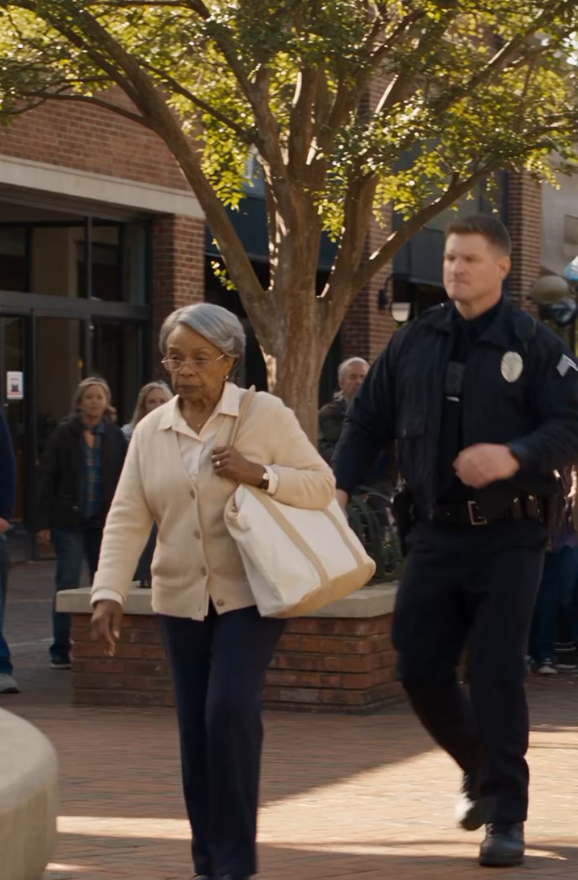
For the first time, he looked toward the back of the room.
Maybe toward the cameras.
Maybe nowhere.
His attorney argued that the statement had been sarcastic.
Keegan agreed.
He said he was frustrated.
He said officers use imprecise language under stress.
He said he had already suspected Odessa might be involved in suspicious activity unrelated to the robbery.
That was new.
Department counsel asked what suspicious activity.
“She was moving quickly through a commercial area carrying a large bag.”
My mother whispered, “I was walking.”
I almost laughed.
The counsel asked, “Did you observe her commit a crime?”
“No.”
“Did you have a report of a crime involving her?”
“Not specifically.”
“Did she refuse to identify herself?”
“No.”
“Did she provide identification?”
“Yes.”
“Was her identity connected to any outstanding warrant?”
“No.”
“Did the bag contain stolen property?”
“No.”
“Did you have her consent to search it?”
“No.”
“Did she attempt to flee?”
“No.”
“Then why did you seize the bag?”
Keegan paused.
“Officer safety.”
The answer hung there.
Even his attorney looked unhappy.
Counsel glanced toward the table where the bag sat as evidence.
A soft canvas tote printed with the words READ LOCAL.
“Officer safety from what?”
Keegan answered, “I did not know what was inside.”
Counsel nodded.
“Did Dr. Freeman tell you?”
“Yes.”
“What did she say?”
“Books.”
“And what was inside?”
Keegan’s jaw shifted.
“Books.”
Silence followed.
Not dramatic silence.
Not cinematic.
Just a room full of people receiving an answer that had nowhere useful to go.
Then Hollow testified.
He walked in wearing a plain gray suit.
No badge.
No gun.
No uniform.
Keegan finally looked directly at him.
Hollow took the oath.
His voice shook for the first few questions.
Then settled.
He described the initial encounter.
Keegan saw Odessa crossing the square.
Commented on the bag.
Said she was “acting stiff.”
Hollow saw nothing suspicious.
Keegan approached anyway.
Asked to look inside the tote.
Odessa asked why.
Keegan grew irritated.
The encounter escalated.
No crime had been reported involving her.
No jewelry-store dispatch had occurred.
Hollow admitted everything.
His failure.
His silence.
His false report.
The immunity agreement.
Keegan’s attorney attacked that immediately.
“You avoided prosecution by changing your story.”
“I corrected my story.”
“After receiving a deal.”
“Yes.”
“So your freedom depends on giving investigators what they want.”
“My agreement depends on telling the truth.”
“Convenient distinction.”
Hollow looked at him.
“It doesn’t feel convenient.”
The attorney paced.
“You stood beside Officer Keegan at the square.”
“Yes.”
“You did not believe he committed a crime then.”
“I believed what he did was wrong.”
“But you did not arrest him.”
“No.”
“You did not stop him.”
“No.”
“You did not immediately report him.”
“No.”
“You lied.”
“Yes.”
The lawyer stopped.
“So why should anyone believe you now?”
Hollow took a breath.
“Because I’m admitting the part that makes me look worst.”
A small sound moved through the chamber.
The lawyer frowned.
Hollow continued.
“I could tell you I was scared. I was. I could tell you Keegan was senior to me. He was. I could tell you I thought my career would be over if I crossed him.”
He looked toward Odessa.
“But none of that changes what I did.”
Then he turned back toward the panel.
“I watched something happen that I knew was wrong, and I decided protecting myself was more important than stopping it.”
He paused.
“That is why you should believe me now. Because I’m done protecting myself with a lie.”
Keegan’s attorney had no immediate question.
I did not feel sympathy for Hollow.
Not exactly.
But for the first time, I understood what my mother had been trying to tell me.
Consequence did not always look like a cell.
Sometimes it looked like a man forced to name himself accurately in public.
The hearing recessed before the final evidence.
In the hallway, Keegan approached me.
His attorney was talking to someone behind him.
For several seconds, Keegan and I stood alone beside a water fountain.
He said, “You got what you wanted.”
I looked at him.
“My mother got hit in the face carrying library books.”
“I’m talking about this.”
He gestured toward the chamber.
“You think I control this?”
“You made one phone call and half the state cared.”
“I made no phone calls.”
“You’re a colonel.”
“So?”
“People listen to you.”
“People listened to the video.”
His mouth hardened.
“You came into that square acting like you owned it.”
“No.”
“You ordered me around.”
“I told you to lower a Taser.”
“You think because you’ve got rank somewhere else, everyone is supposed to salute.”
I stepped closer.
Not threatening.
Just enough to make sure he heard me.
“My rank is the least important fact in this entire case.”
He laughed once.
“Easy for you to say.”
“You know what the most important fact is?”
He stared.
“At 10:13, there had been no jewelry-store robbery call.”
Something flickered behind his face.
There.
The first genuine reaction.
Small.
But real.
I continued.
“You wrote the time yourself.”
His eyes narrowed.
“What are you talking about?”
“You’ll hear it.”
His attorney called his name.
Keegan turned away.
My mother stood ten feet down the hallway.
She had heard us.
When Keegan disappeared through the chamber doors, she came over.
“You enjoyed that.”
“A little.”
“Nyla.”
“I didn’t threaten him.”
“No.”
“I didn’t touch him.”
“No.”
“I didn’t even raise my voice.”
“No.”
I looked at her.
“Can I have anything?”
She smiled.
“One small thing.”
We returned to the hearing.
Department counsel placed Keegan’s original incident report on the screen.
One line was highlighted.
At approximately 1013 hours, Officer Keegan observed an individual matching the suspect description associated with the jewelry-store incident.
The counsel turned to him.
“Did you write this?”
“Yes.”
“You signed it?”
“Yes.”
“You reviewed it for accuracy?”
“Yes.”
“Your attorney has suggested any errors were the result of confusion after a stressful encounter.”
“That’s correct.”
“Is 10:13 an error?”
Keegan looked at the screen.
“No. That’s approximately when we contacted her.”
“Good.”
The counsel changed the image.
Dispatch log.
10:17:42.
“Jewelry-store alarm received at 10:17.”
Another image.
10:18:31.
“Suspect description entered at 10:18.”
Another.
10:19:02.
“Units dispatched at 10:19.”
Then the documents appeared side by side.
10:13.
10:17.
10:18.
10:19.
Department counsel asked, “Officer Keegan, how did Dr. Freeman match a suspect description at 10:13 that did not exist until approximately five minutes later?”
Keegan stared at the screen.
His attorney stood.
“Objection to characterization.”
The panel overruled him.
Counsel waited.
Keegan shifted in his chair.
“I may have confused the sequence.”
“You just testified that 10:13 was accurate.”
“The time was accurate. The wording may not have been.”
“Which wording?”
He did not answer.
Counsel pointed to the sentence.
“The entire justification for the detention?”
“My report was written after a difficult incident.”
“How difficult?”
Keegan’s eyes snapped toward him.
Counsel continued before he could answer.
“Difficult enough that you accidentally inserted a future event into your explanation of a past decision?”
Keegan’s attorney objected again.
Sustained.
The counsel rephrased.
“When you approached Dr. Freeman, did you know about the jewelry-store robbery?”
“No.”
The word came out quietly.
I felt my mother’s hand move beside mine.