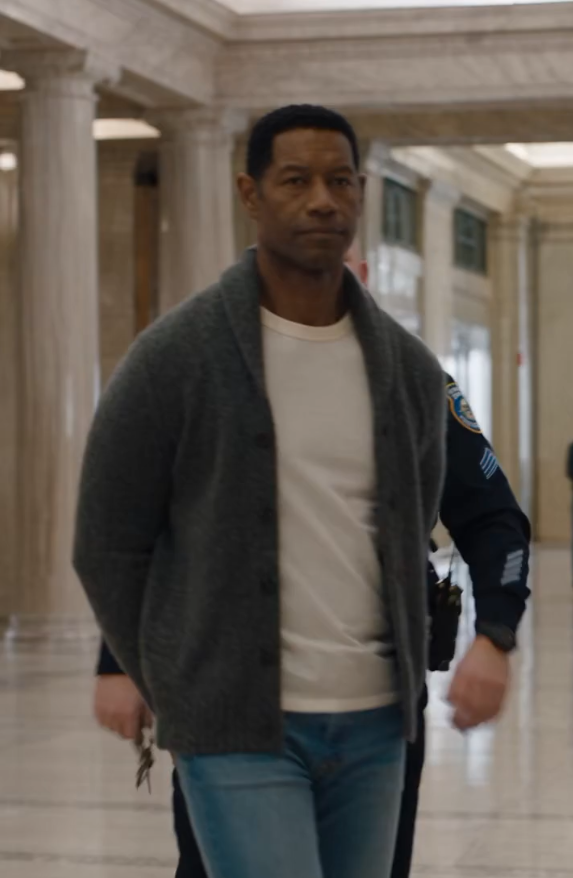
He looked down.
The screen lit.
KHLOE DAVIDSON.
Jenkins glanced at me.
“Who's Khloe?”
“My chief of staff.”
He gave a short laugh.
“Of course she is.”
The phone stopped.
A second later it rang again.
KHLOE DAVIDSON.
Jenkins looked at Miller.
Miller did not laugh.
Jenkins declined the call.
“Enough.”
He pushed open the doors.
Part III — The Room Waiting for Me
The council chamber was built for ceremony.
Rows of dark seats.
A raised dais.
The city seal mounted behind it.
Microphones glowing red.
Television cameras positioned along the rear wall.
There were perhaps sixty people inside: department heads, aides, reporters, residents, police representatives, city employees.
At the front, Chief William Granger stood beside the council table speaking quietly with Khloe.
She saw me first.
Her face changed so fast that anyone watching could understand something was wrong before they understood what.
Granger followed her gaze.
Then the room began noticing us in pieces.
A reporter turned.
A council member stopped reading.
Someone near the front whispered.
Jenkins kept walking.
He had not yet understood.
“Excuse me,” he called toward the dais. “Sorry to interrupt.”
Khloe took one step forward.
“What the hell?”
Jenkins raised his voice.
“Security situation in the lobby.”
Granger's eyes moved to my hands behind my back.
Then to Jenkins.
Then to Miller.
He did not move.
That frightened Jenkins more than shouting would have.
“Chief,” Jenkins said, relief entering his voice, “good. I caught this individual trying to access the executive floor without identification. Became argumentative, refused to comply—”
Khloe crossed the aisle.
“David.”
The room changed.
Not loudly.
It changed through recognition.
One council member slowly lowered his glasses.
A reporter lifted her phone.
Granger remained completely still.
Jenkins looked at Khloe.
Then at me.
Then back at her.
“What did you call him?”
Khloe ignored him.
She stopped three feet from me.
“Are you hurt?”
“I'm fine.”
“Your face is red.”
“Marble pillar.”
Her eyes moved to Jenkins.
I said, “Khloe.”
She looked at me again.
“Not yet.”
That was enough.
She understood.
Granger finally spoke.
“Officer Jenkins.”
The words were quiet.
Jenkins turned toward him.
“Yes, Chief.”
Granger pointed to the cuffs.
“Remove them.”
Jenkins blinked.
“Chief, this man—”
“Remove them.”
“Sir, he was trespassing.”
Granger's face did not change.
“That man is Mayor David Harrison.”
Nobody moved.
For perhaps two seconds, Jenkins' hand remained frozen near his belt.
The disbelief on his face was almost childlike.
He looked at me again.
Not as a person.
As information rearranging itself.
“No.”
It slipped out before he could stop it.
Khloe said, “Yes.”
Jenkins looked around the chamber.
Every face confirmed it.
His hand moved toward the cuff key.
Suddenly he was clumsy.
The key missed the lock once.
Then again.
My wrists came free.
I lowered my arms slowly.
Pain shot through my right shoulder.
Miller noticed.
So did Granger.
Jenkins stepped back.
“Mayor, I—”
I rubbed one wrist.
“Don't.”
He stopped.
My voice was not loud.
It did not need to be.
“You've spoken enough for the moment.”
Behind him, one of the television cameras turned fully toward us.
Khloe noticed.
Her eyes flicked to mine.
This was no longer only an internal incident.
Jenkins seemed to understand that too.
His breathing changed.
Chief Granger approached me.
“Mayor Harrison, I need to get you checked.”
“I don't need an ambulance.”
“Then a medic.”
“After the meeting.”
“David.”
It was the first time he had used my first name in front of the council.
I looked at him.
“We have a budget hearing.”
He stared at me like I had just suggested continuing a baseball game during a thunderstorm.
“The hearing can wait.”
“No.”
Khloe lowered her voice.
“Your shoulder.”
“Still attached.”
“That is not the standard.”
I looked around the chamber.
Everyone was waiting to see what I would do.
That realization carried more weight than the handcuffs had.
A mayor getting mistreated by police was a story.
What the mayor did next would become policy.
I turned toward Jenkins.
“Officer, did you activate your body camera?”
His face tightened.
“Yes.”
“Officer Miller?”
Miller nodded.
“Yes, sir.”
I looked at Granger.
“Secure both recordings.”
Jenkins spoke quickly.
“Chief, I can explain—”
Granger raised one hand.
“You will not discuss the incident with anyone except the investigating command staff and your representative.”
The union representatives near the back shifted.
One of them stood.
“Chief, Officer Jenkins is entitled—”
“He will receive every right required by policy and contract.”
Granger's eyes remained on Jenkins.
“He will also surrender his badge and weapon pending administrative review.”
Jenkins stared at him.
“You're suspending me?”
“I am removing you from duty pending investigation.”
“For doing my job?”
Something went cold in Granger's face.
“Do not make me answer that question before we review the evidence.”
Jenkins looked toward me.
“Mayor, I didn't know who you were.”
The sentence landed harder than an apology would have.
I held his gaze.
“That,” I said, “is exactly the problem.”
No one spoke.
I turned toward the dais.
“Give me ten minutes.”
Khloe looked at me.
“For what?”
“To change.”
“You don't have another suit.”
“I have a jacket in my office.”
She stared at my fleece, then at the red mark along my cheek.
“David.”
I lowered my voice.
“If I leave this building now, this becomes only a story about me.”
She said nothing.
“If I stay, maybe we can make it about what happened.”
Chief Granger watched me.
“You're going forward with the budget hearing.”
“Yes.”
“After this.”
“Especially after this.”
He let out a breath through his nose.
“I think that's a mistake.”
“Add it to the list.”
For the first time, something almost like reluctant respect crossed his face.
“Your office elevator is open.”
“Good.”
I headed toward the side exit.
My shoulder protested with every step.
Behind me, reporters began shouting questions.
I did not turn around.
Part IV — Evidence
Khloe followed me into my office and closed the door.
Then she locked it.
“Sit.”
“I have nine minutes.”
“You have a bruise forming on your face and you can't lift your right arm normally.”
“I can lift it.”
I tried.
The result proved her point.
Khloe folded her arms.
“Sit.”
I sat.
She went to a cabinet, found an ice pack from a small emergency kit, wrapped it in a towel, and handed it to me.
I pressed it against my cheek.
“This is dignified.”
“You lost dignified when you dressed like a contractor.”
“My wallet.”
She froze.
Then covered her eyes with one hand.
“Oh, God.”
“What?”
“Your wallet.”
“Yes.”
“It was in the suit.”
“Yes.”
“I knew that.”
“You did.”
“I told you I knew that.”
“You did.”
She stared at me.
“This is partly my fault.”
“No.”
“If I had brought the wallet—”
“No.”
She stopped.
I lowered the ice pack.
“Do not do that.”
“David—”
“He did not put me in handcuffs because you took my wallet to the cleaner.”
“He stopped you because you had no ID.”
“He escalated because I asked him to follow policy.”
She looked toward the door.
“Half the building has video.”
“I know.”
“Reporters are already posting.”
“I know.”
“Your communications team is going to have a nervous breakdown.”