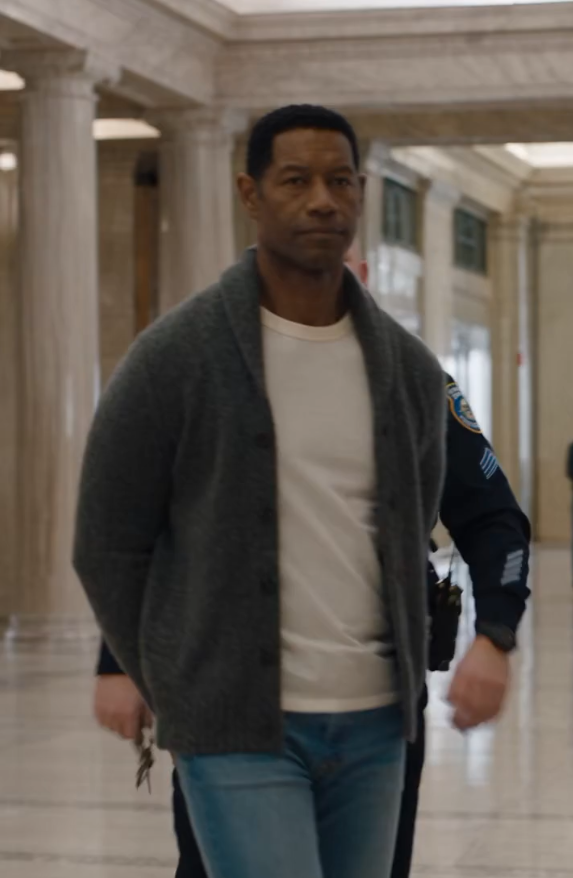
His expression sharpened.
“The goal is to stop treating guesses like facts.”
Miller nodded slowly.
Then he said, “There's something else.”
I waited.
“When Officer Jenkins said he'd show the council what happens when somebody sneaks in, I knew there was no reason to take you into that room.”
“Why did he?”
“I think he wanted an audience.”
That matched my own impression.
Miller continued.
“He liked being right in front of people.”
“Did that happen often?”
“Not like this.”
“That's not what I asked.”
He looked down.
“No.”
“So it happened.”
“Sometimes.”
“With civilians?”
“Yes.”
“Complaints?”
“I don't know.”
I believed him.
Young officers often knew culture before they knew files.
“Are you afraid of testifying?”
He looked up sharply.
“I already gave my statement.”
“That wasn't the question.”
His jaw tightened.
“Yes.”
“Of what?”
“Being the guy who ended a twenty-two-year career.”
I shook my head.
“You didn't put my face against a pillar.”
“I know.”
“Then don't steal responsibility from the man who did.”
Miller sat very still.
After a moment he nodded.
When he stood to leave, I said, “Toby.”
He turned.
“You did speak twice.”
His face showed no relief.
Good.
“But next time,” I said, “speak early enough that there isn't a second time.”
He left without answering.
Three minutes later, Khloe entered from the side office.
“You were hard on him.”
“He needed it.”
“He's twenty-five.”
“And wears a badge.”
She sat.
“You think he'll stay?”
“In the department?”
“Yes.”
“I don't know.”
“Would you?”
I looked toward the window.
“I spent fifteen years suing institutions I still believed could be better.”
“That is not an answer.”
“It is the closest one I have.”
Part VII — The Political Usefulness of Pain
By the end of the week, the video had been viewed millions of times.
A seventeen-second clip dominated television.
Jenkins pushing me against the marble.
The cuffs.
The walk.
Then the chamber doors opening.
Online, everyone chose the portion that supported what they already believed.
Some saw proof of institutional bias.
Some said I had deliberately provoked the officer by refusing to identify myself.
Some accused me of setting Jenkins up.
That one fascinated me.
Apparently I had spilled coffee on myself, forgotten my wallet, arranged for a burst pipe to close the garage, entered through the public lobby, and manipulated a veteran officer into arresting me—all before breakfast.
Khloe wanted me to ignore it.
“Never wrestle with a conspiracy theory,” she said. “You both get covered in mud, but only one of you is enjoying it.”
“That's unusually poetic.”
“I stole it from somewhere.”
The police union held a press conference.
They did not defend Jenkins' language.
They focused on procedure.
No identification.
Executive-floor security.
Unclear access.
The union president said, “We caution city leaders against destroying an officer's career based on a politically charged incident before a full investigation is complete.”
I agreed with that sentence.
Khloe hated that I said so publicly.
“You don't have to help them.”
“I am not helping them.”
“You just repeated their argument.”
“Because due process doesn't become optional when I'm angry.”
She paced in front of my desk.
“Do you know what they're saying about you?”
“Yes.”
“They're saying you're using this to push your oversight board.”
“Then I shouldn't prove them right by firing a man from a press conference.”
She stopped.
“You want Jenkins fired.”
I looked at her.
“I want the investigation finished.”
“That wasn't what I said.”
“No.”
She waited.
I sighed.
“Yes.”
“So you're pretending.”
“No.”
“What do you call it?”
“Government.”
That made her laugh despite herself.
The investigation took three weeks.
Longer than the public wanted.
Faster than the union wanted.
In the meantime, the council delayed the final vote on the independent review system.
Chief Granger came to my office twice without being summoned.
The first meeting was about policy.
The second was not.
He stood near the window and said, “I offered my resignation.”
I looked up from a budget memo.
“To whom?”
“You.”
“No, you didn't.”
His mouth tightened.
“I am now.”
“I don't accept it.”
“You should think first.”
“I have.”
“David.”
“Sit down.”
He remained standing.
I closed the folder.
“Are you resigning because you think you're unfit to lead?”
“No.”
“Are you resigning because the department has lost confidence in you?”
“Some have.”
“That's not new.”
“More now.”
“Still not new.”
His face darkened.
“I mishandled Jenkins six years ago.”
“Yes.”
“I defended a system that failed.”
“Yes.”
“I told you to slow down.”
“Yes.”
“You enjoy this?”
“No.”
“Could've fooled me.”
I leaned back.
“You are trying to resign because guilt feels cleaner than reform.”
His expression changed.
“That is convenient.”
“It is accurate.”
“You don't know what I feel.”
“No. But I know what resignation does. You leave. Somebody else inherits the department. You spend the next ten years giving speeches about lessons learned.”
His eyes sharpened.
“And what do you want?”
“I want you to stay long enough to change the things you now admit need changing.”
“You think officers will trust me after I suspend one of their most senior people?”
“Some won't.”
“You think activists will trust me after they learn I gave him informal counseling six years ago?”
“Some won't.”
“So I'm useful to everybody.”
“No.”
I paused.
“You may be useful to the work.”
That quieted him.
I stood.
“William, accountability is not the same as disappearance.”
He looked toward the floor.
“I spent years thinking leadership meant protecting the institution from damage.”
“And now?”
“Now I'm wondering how much damage comes from that instinct.”
I nodded.
“That sounds like a reason to stay.”
He finally sat.
We worked for two hours.
Part VIII — The Finding
The administrative report arrived on a Monday.
Three hundred twelve pages.
Interviews.
Video analysis.
Security policies.
Training records.
Prior complaints.
Body-camera transcripts.
I read every page.
So did Granger.
So did Khloe, though she complained continuously about the appendix formatting.
The findings were direct.
Jenkins had no lawful basis to arrest me for trespassing.
I had complied with security screening.
I had not attempted to bypass access controls.
I had requested supervisory review.
He had escalated after being questioned.
His comments violated department conduct standards.
His force, while not causing serious injury, was unnecessary under the circumstances.
The earlier complaint had not been properly documented as a potential bias-related incident.
The report also found a broader failure.
Serious civilian complaints were categorized by alleged rule violation rather than behavioral pattern.
That meant similar incidents disappeared into separate boxes.
Courtesy.
Procedure.
Search.
Detention.
Language.
No one was looking sideways across the categories.
Patterns could exist without ever becoming visible.
The finding I cared about most was buried on page 241.
Twelve years of complaint data showed that officers with repeated conduct complaints were far more likely to receive informal intervention than formal retraining until an event became serious enough to trigger mandatory review.
The system did not exactly ignore warning signs.
It diluted them.
One at a time.
I called Granger.
“You read page 241?”
“Yes.”
“That's the policy problem.”
“I know.”
“Do you?”
A pause.
“Yes.”
I believed him.
Jenkins' disciplinary hearing was scheduled for Friday.
Under department rules, Granger would make the final employment recommendation subject to appeal.