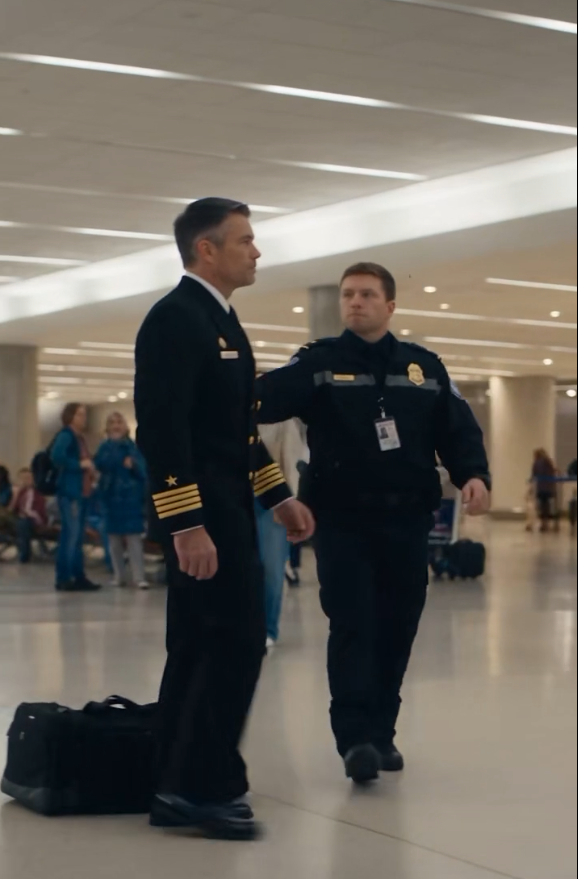
I thought about Vance saying that he had once let an actual impersonator walk.
That did not excuse what he did.
But it explained something important.
People often carry their last failure into the next decision.
Sometimes so tightly that they cannot see what is actually in front of them.
“Yes,” I said.
“I'll file it.”
Ruiz looked up.
The investigator slid a form toward me.
I put my hand on it but did not start writing.
“One condition.”
The attorney's eyebrows rose.
“What condition?”
“My complaint should be evaluated on policy and evidence. I am not requesting a specific disciplinary outcome.”
The investigator nodded.
“That's standard.”
“Good.”
I picked up the pen.
“And if anyone asks me publicly whether Officer Vance should be fired, my answer will be that it isn't my decision.”
The watch commander studied me.
“Why?”
I looked at him.
“Because I don't want him punished by the same kind of certainty he used on me.”
Ruiz's eyes moved toward the window.
Nobody said anything for a moment.
Then I began writing.
Part V — The Hearing
Three weeks later, I returned to Atlanta.
This time I wore a dark civilian suit.
No ribbons.
No shoulder boards.
No polished military shoes.
My sea bag stayed at home.
The internal review had moved quickly because the incident was public, the video was clear, and the relevant records were preserved.
The airport asked me to appear for a formal administrative hearing involving senior police leadership, internal affairs, legal counsel, and representatives from the agencies affected by my delayed arrival.
I agreed.
Not because I wanted to see Vance punished.
Because incomplete records have a way of becoming permanent records.
I wanted mine complete.
Ruiz was already seated when I entered.
She stood.
“Captain.”
“Elena.”
It was the first time I used her first name.
She smiled faintly.
“You remembered.”
“You were wearing a name tag.”
“That didn't help everybody.”
I almost laughed.
Almost.
“How have you been?”
“Busy.”
“I can imagine.”
Her expression changed.
“I've been told not to discuss findings before the hearing.”
“I didn't ask.”
“I know.”
We sat.
Vance arrived several minutes later with a representative from his department.
He looked different out of patrol gear.
Not smaller.
Just more ordinary.
He wore a uniform but no duty belt. His face was tired.
Our eyes met.
He gave a brief nod.
I returned it.
Nothing else.
The hearing began at nine.
The internal-affairs investigator laid out the sequence.
8:07: initial contact.
8:08: request for identification.
8:09: first directive to turn around.
8:10: restraints applied.
8:12: Sergeant Ruiz arrives.
8:13: airport operations requests location confirmation.
8:16: bag recovered.
8:24: command confirms prior coordination inquiry.
8:31: military identification independently authenticated.
8:34: active-duty rank confirmed.
8:36: detention ended.
Twenty-nine minutes.
That was the entire event.
Twenty-nine minutes.
Long enough to become one of the most watched moments of my life.
The investigator played the footage.
I had watched it only once before.
That was enough.
Seeing yourself from another person's camera is disorienting. Memory gives events a center. Video does not care where the center is.
On screen, I looked more tired than I remembered.
Vance looked more certain.
The crowd looked closer.
“Take off the costume.”
There it was.
No ambiguity.
Then my voice.
“My identification is right there. Verify it.”
I watched Vance on the screen step between me and the bag.
He had not remembered that in his initial report.
The investigator paused the video.
“Officer Vance, at this point, did you believe Captain Hayes presented an immediate physical threat?”
“No.”
“Did you believe the bag contained a weapon?”
“I didn't know what it contained.”
“Did Captain Hayes attempt to reach into it after you told him not to?”
“No.”
“Did he attempt to leave?”
“No.”
“Did he threaten you?”
“No.”
“Did he refuse an order to turn around?”
There was a pause.
“No.”
“Did he resist handcuffing?”
“No.”
“Did he provide his name?”
“Yes.”
“Rank?”
“Yes.”
“Branch?”
“Yes.”
“Location of his identification?”
“Yes.”
The investigator let the silence do its work.
Then she asked, “Why did you restrain him before checking the identification?”
Vance's answer came slowly.
“Because I believed he was lying.”
“Based on what?”
“The way he answered questions. The uniform. His refusal to explain his destination.”
“Was knowledge of his destination required to verify his military status?”
“No.”
“Did you identify a specific defect in his uniform?”
“No.”
“Did you have training in Navy uniform regulations sufficient to determine it was fraudulent by appearance?”
Vance looked down.
“No.”
“Did you tell him you lacked that expertise?”
“No.”
“Did you request a supervisor before restraining him?”
“No.”
“Why?”
He took a breath.
“Because I thought I was right.”
No one moved.
The investigator looked toward me.
Then back at him.
“And after the radio call?”
“I wasn't sure.”
“Did you remove the handcuffs?”
“No.”
“Why not?”
“I didn't want to reverse the detention until we verified.”
The investigator nodded.
“That part is understandable.”
The answer surprised several people.
It shouldn't have.
Once a detention had occurred, immediately releasing someone solely because a radio broadcast repeated his name would have been another assumption.
The investigator continued.
“The issue is not whether you questioned Captain Hayes. The issue is whether sufficient facts supported the escalation when it occurred.”
Vance nodded once.
“I understand.”
“Do you?”
His representative shifted.
The investigator did not look at him.
“Because your written report says Captain Hayes was noncompliant.”
Vance's face changed.
“Yes.”
“We have reviewed every available video angle. Identify the noncompliance.”
He did not answer.
The room waited.
Finally he said, “He wasn't cooperative about the orders.”
“That isn't what I asked.”
Another pause.
“There was no physical noncompliance.”
“Verbal?”
“He wouldn't tell me where he was going.”
“Was he legally or procedurally required to disclose restricted military travel details to establish his identity?”
“No.”
“So identify the noncompliance.”
Vance looked at me.
For the first time since the airport, there was no accusation in his face.
Only the uncomfortable distance between what he had believed and what the record showed.
“I can't.”
The investigator closed the file.
That should have felt satisfying.
It didn't.
Watching someone lose an argument with evidence is different when you know the argument may cost him his career.
The chair of the review panel turned to me.
“Captain Hayes, you may make a statement.”
I had prepared one.
Two pages.
Carefully written.
I left it inside my folder.
Instead I looked at Vance.
Then Ruiz.
Then the panel.
“I've spent most of my adult life in organizations where people make decisions with incomplete information.”
No one interrupted.
“Sometimes the information is late. Sometimes it's contradictory. Sometimes the person in front of you appears to be exactly what he claims. Sometimes he does not.”
I rested my hands on the table.
“I don't object to Officer Vance asking who I was. I don't object to him checking my identification. If he had done that at the beginning, I would probably remember the morning as an inconvenience.”
Vance lowered his eyes.
“What happened instead was different. Suspicion became a conclusion before verification happened. After that, every answer I gave was interpreted through the conclusion.”
I paused.
“That's dangerous in any profession with authority.”
The panel chair asked, “What outcome are you seeking?”