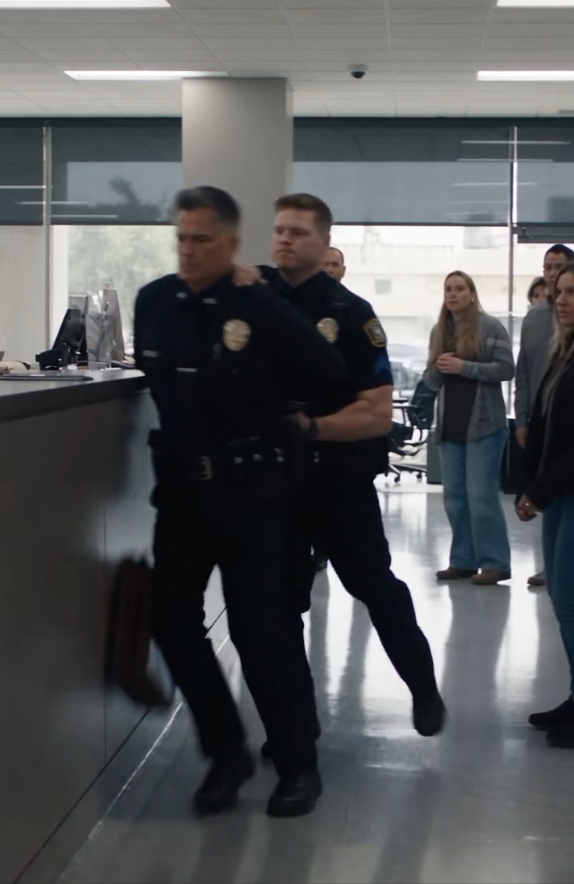
Jordan answered before the first full ring.
“You’re alive.”
“I’m fine.”
“You got handcuffed.”
“I did.”
“By your own department.”
“Technically, yes.”
There was a pause.
“That is the most Dad thing that has ever happened to you.”
Marcus laughed despite himself.
“Explain that.”
“You spent ten years telling me not to make assumptions, then your new coworkers made the biggest assumption possible.”
“Fair.”
“You hurt?”
“Small cut.”
“Mom would’ve lost it.”
The mention settled between them.
Marcus’s wife, Leah, had died six years earlier after a short illness. Jordan had been eleven. Since then, father and son had learned an awkward form of honesty that depended heavily on knowing when not to fill silence.
Jordan spoke first.
“You still going back tomorrow?”
“I haven’t left today.”
“That wasn’t my question.”
Marcus looked out the office window at the parking lot.
Below, two officers were speaking beside a cruiser. One looked up toward the chief’s office, then away.
“Yes,” Marcus said. “I’m going back.”
“Okay.”
“You sound surprised.”
“I’m not.”
Another pause.
“Maybe a little.”
Marcus smiled.
“I’ll be home for dinner.”
“You said that last week.”
“I mean it today.”
“Third-time tie promise?”
Marcus looked down at his tie.
“Third-time tie promise.”
After they hung up, Marcus stayed by the window.
He had once believed leadership meant absorbing pressure so other people did not have to.
Experience had corrected him.
Leadership meant deciding which pressure belonged to you and which belonged where everyone could see it.
At 12:20, he called the command staff into the conference room.
Deputy Chief Vale sat on Marcus’s right. Captain Lena Brooks, who ran patrol operations, sat farther down the table. Lieutenant David Kim from professional standards brought a legal pad and looked unhappy before the meeting began.
Sergeant Caldwell was not present.
Marcus had placed him on administrative duty after reviewing three of the complaints Price had brought upstairs.
Not suspended.
Not cleared.
Separated from public contact pending review.
That distinction had already irritated half the building.
Marcus stood at the end of the table.
“This morning’s incident will be reviewed under the same standards we would apply if I were any other person who walked into that lobby.”
Vale shifted.
“Chief, respectfully, you’re not any other person.”
“That’s the point.”
Marcus passed copies of a one-page directive around the table.
“We are preserving video, radio traffic, dispatch logs, access-control logs, and all related messages. Professional standards will conduct interviews. Nobody involved in the incident will be interviewed by their direct supervisor.”
Kim looked up.
“That’s not our usual practice.”
“I know.”
Vale folded his arms.
“Changing procedure on day one is going to look like you don’t trust your command staff.”
Marcus met his eyes.
“I don’t trust anyone I haven’t evaluated yet.”
The room went quiet.
Marcus continued.
“That includes me. Which is why city legal will receive copies of the review files.”
Brooks spoke for the first time.
“What exactly are we looking for beyond what happened in the lobby?”
Marcus looked at her.
“Patterns.”
“In Caldwell?”
“In us.”
Vale leaned back.
“You’re turning one bad encounter into an indictment of the department.”
“No.”
Marcus slid a second paper across the table.
“These are the nine complaints involving Sergeant Caldwell over the last three years.”
Vale’s expression changed.
Only slightly.
Brooks noticed.
Marcus did too.
“Three involved detention before identification was confirmed. Two involved force used after the subject verbally questioned authority. Four alleged report language that did not match available video.”
Kim looked at the page.
“I haven’t seen all of these.”
“You should have.”
Kim flushed.
Vale said, “Because some were resolved at the supervisory level.”
Marcus looked at him.
“Four by you.”
“I supervised Garrett for years.”
“Then you’re familiar with the details.”
“I’m familiar with the outcomes.”
Marcus did not answer immediately.
That was enough to make Vale continue.
“What?”
“Nothing.”
“You looked like you had something to say.”
Marcus folded his hands.
“I’m wondering why you remember the outcomes better than the allegations.”
Vale’s mouth flattened.
Brooks glanced down.
Marcus changed direction.
“Captain Brooks, how often are lobby incidents audited?”
“Randomly.”
“How randomly?”
She hesitated.
“We’re supposed to review five public-contact incidents per month.”
“Do we?”
“Usually.”
“Usually isn’t a number.”
Brooks looked at Kim.
Kim answered.
“Some months are missed.”
“How many in the last year?”
“I’d have to check.”
Marcus nodded.
“Check.”
He turned toward Vale.
“And the arrival notice?”
Vale had anticipated the question.
“Dispatch received it at 7:43. The bulletin was entered but not pushed to lobby terminals until 8:51.”
Marcus looked at the wall clock though the answer had nothing to do with the current time.
“One minute after I was handcuffed.”
“Yes.”
“Why?”
“System delay, according to communications.”
Kim frowned.
“We don’t usually have a fifty-eight-minute delay.”
Vale looked at him.
“Systems fail.”
Marcus spoke quietly.
“Who entered the bulletin?”
Vale opened a folder.
“Dispatcher Marisol Vega.”
“Who approved it?”
“Morning watch commander.”
“Caldwell?”
Vale said nothing for one beat too long.
“Yes.”
Marcus looked around the table.
“Was Caldwell required to read it?”
Brooks answered.
“He would’ve received an alert on his terminal.”
Marcus sat.
“So he approved the arrival bulletin.”
Vale raised a hand.
“That doesn’t mean he opened the attachment.”
“No.”
Marcus looked at the nine complaints in front of him.
“It means he had an opportunity.”
Nobody spoke.
Marcus dismissed the meeting except for Vale.
The deputy chief remained seated.
Marcus closed the door.
“You knew that before you came in here.”
Vale’s face was unreadable.
“Knew what?”
“That Caldwell approved the bulletin.”
“I learned it this morning.”
“When?”
“About ten.”
“You told me you were checking.”
“I was.”
“You didn’t mention the approval.”
“It didn’t strike me as relevant until communications pulled the audit.”
Marcus watched him.
Vale had the controlled face of a man who had spent decades sitting through interviews he was never afraid of.
“You want Caldwell gone?” Marcus asked.
The question surprised him.
“No.”
“You defended him pretty hard.”
“I’m defending proportionality.”
“Why?”
“Because I’ve seen chiefs come in from outside, find one ugly event, and decide the only way to prove independence is to burn somebody publicly.”
“I’m not interested in burning anyone.”
“Good.”
“I am interested in why you keep assuming accountability means destruction.”
Vale stood.
“Because you haven’t been here long enough to know what this place has survived.”
Marcus remained seated.
“Then tell me.”
Vale looked toward the window.
“Budget cuts. Hiring freezes. Two officer suicides. A federal consent review that went nowhere but wrecked morale for a year. The city wants cleaner numbers with fewer bodies, faster response with fewer cars, fewer complaints without giving us enough people to answer calls.”
“And?”
“And men like Caldwell kept showing up.”
Marcus nodded slowly.
“That matters.”
Vale seemed almost relieved.
Then Marcus added, “It doesn’t erase what they did while they were here.”
Vale’s expression closed again.
“No.”
“Where are the original complaint files?”
“Professional standards archive.”
“I want them.”