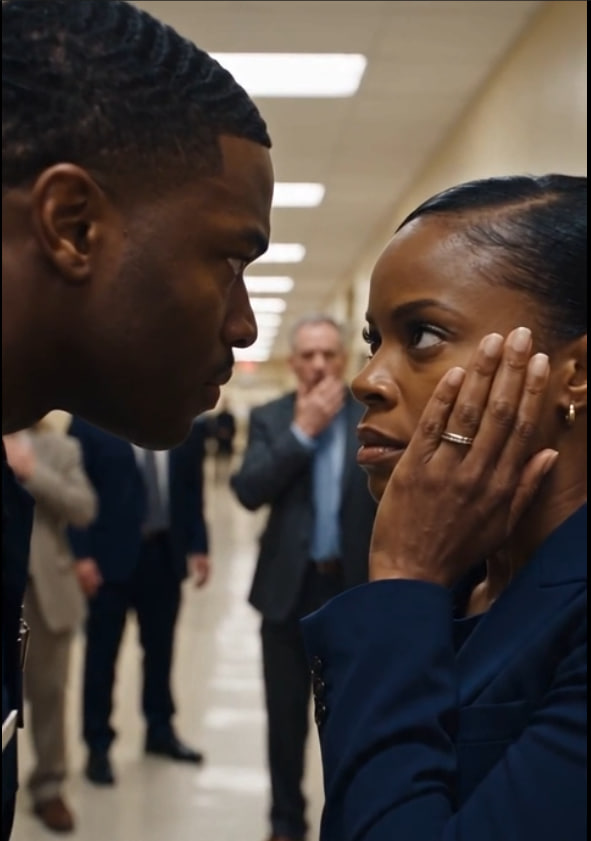
By noon, the courthouse steps were covered with cameras.
I could see the news vans from my chamber window.
My face was everywhere online.
But I was not interested in watching myself get slapped again.
I was interested in the folder sitting on my desk.
Twenty-three names.
Men.
Women.
Young people.
Older people.
Most had been defendants or family members of defendants.
Several had no criminal charges at all.
One name immediately caught my attention.
Anthony Vega.
I recognized it.
He had appeared before me the previous year on a misdemeanor trespassing charge that was later dismissed.
I remembered something unusual about that morning.
He had arrived with a swollen eye.
When I asked what happened, the prosecutor had said there had been an “incident during transport.”
Mercer’s name appeared beside Anthony’s in Maya’s folder.
I closed my eyes.
Had I seen evidence and failed to understand it?
A knock came.
Elena entered.
“You have about forty messages from judges.”
“I’ll return them later.”
“Your sister has called six times.”
That made me smile despite everything.
“Tell Angela I’m alive.”
“I tried.”
“And?”
“She said she wants proof.”
My smile faded when Elena added, “Your mother saw the video.”
I groaned.
“That will be worse.”
“It already is.”
My phone rang again.
Mom.
I answered.
“Hi.”
“Josephine Elaine Caldwell.”
I held the phone away from my ear.
“Yes, Mom.”
“Are you hurt?”
“I have a bruised cheek and split lip.”
“I am coming there.”
“No.”
“I wasn’t asking.”
Despite everything, I felt my eyes sting.
“I’m okay.”
“I saw somebody hit my daughter.”
Her voice cracked.
That broke something inside me.
Until that moment, I had viewed the incident almost clinically.
Evidence.
Procedure.
Authority.
Now I imagined my mother sitting at home watching a man slap me across the face.
“I’m sorry you saw it.”
“Why are you apologizing?”
“I don’t know.”
“Don’t.”
She took a breath.
“Come home tonight.”
“I will.”
“Promise.”
“I promise.”
After I hung up, Walter stood quietly beside the bookcase.
“You don’t have to be strong every second.”
“I know.”
“You’re doing it anyway.”
I almost laughed.
Then Deputy Chief Brooks returned.
This time he carried two thick binders.
“You asked for the complaint history.”
He put them down.
“That quickly?”
His expression told me something was wrong.
“I think you should see this.”
I opened the first binder.
Mercer’s seven formal complaints were inside.
But Brooks had included something else.
Incident reports.
Dozens.
I began reading.
A nineteen-year-old college student detained for “aggressive posture.”
A sixty-three-year-old man pushed to the floor after questioning why his daughter was being searched.
A woman handcuffed for nearly two hours after Mercer claimed she matched a shoplifting suspect.
Another man charged with resisting arrest.
Another.
Another.
The phrase repeated so often it became impossible to ignore.
Resisting arrest.
I looked up.
“How many resistance charges has Mercer filed?”
Brooks exhaled.
“In eleven years?”
“Yes.”
“Eighty-four.”
Walter whispered, “Jesus.”
“How does that compare with other officers?”
Brooks looked uncomfortable.
“Significantly higher.”
“How significantly?”
“Nearly four times the department average.”
I stared at him.
“And nobody thought that required review?”
“It did trigger a supervisory flag.”
“When?”
“Three years ago.”
“What happened?”
He slid another document toward me.
A supervisor had recommended intervention training and temporary reassignment.
Someone had overridden it.
The signature at the bottom made Brooks look sick.
Captain Raymond Holt.
Mercer’s former commanding officer.
“Why?”
Brooks shook his head.
“I don’t know.”
“You do know something.”
He sat down.
“Holt and Mercer are related.”
My stomach tightened.
“How?”
“Holt’s wife is Mercer’s aunt.”
Walter swore softly.
“So his uncle protected him.”
“It appears possible.”
“Possible?” Walter snapped.
I raised a hand.
“We stay with facts.”
Walter stopped.
But his anger reflected mine.
I turned another page.
Two years earlier, another supervisor had raised concerns.
That report disappeared after reaching Holt’s office.
A complaint from Maya Lewis had been labeled unsubstantiated despite photographs of bruising.
Anthony Vega’s incident had never been formally investigated.
The pattern was no longer difficult to see.
It was glowing.
“Where is Holt now?”
Brooks looked at me.
“Retired.”
“When?”
“Seven months ago.”
“Benefits?”
“Yes.”
I leaned back.
Mercer had not simply avoided consequences.
Someone had repeatedly cleared the road in front of him.
A knock came.
Elena entered again.
“Judge Caldwell, there’s something happening downstairs.”
“What?”
“A reporter obtained another video.”
My chest tightened.
“Of Mercer?”
“Yes.”
Brooks immediately stood.
“From when?”
“Last year.”
We went to the conference room where a television was playing silently.
Elena increased the volume.
The footage appeared to come from a convenience-store security camera.
Mercer was visible beside a patrol car.
A young man stood in front of him with both hands raised.
Anthony Vega.
Mercer shoved him.
Anthony stumbled.
He raised his palms higher.
Mercer struck him in the stomach.
Anthony doubled over.
Then Mercer grabbed him and slammed him against the vehicle.
The reporter spoke over the video.
“According to court records, Vega was later charged with resisting arrest. Those charges were dismissed.”
My throat tightened.
The video continued.
Anthony never swung at him.
Never lunged.
Never threatened him.
Mercer had lied.
Brooks stared at the screen.
Walter whispered, “There it is.”
But the footage was not finished.
Another officer entered the frame.
A younger deputy.
He clearly saw what Mercer had done.
Mercer spoke to him.
The second officer looked around.
Then he reached toward the store camera.
The picture went black.
The room became silent.
Brooks whispered one name.
“Darren Cole.”
“Who is that?”
“One of Mercer’s former partners.”
My stomach sank.
“Still employed?”
“Yes.”
Before Brooks could say more, his phone rang.
He answered.
His expression changed within seconds.
“What?”
He listened.
Then he looked at me.
“Mercer just disappeared.”
“What do you mean disappeared?”
“He was ordered to remain available for questioning.”
“And?”
“He left his house.”
“Where is he?”
“We don’t know.”
Walter moved toward the door.
Brooks raised his hand.
“There’s more.”
I waited.
“Before he left, he called someone.”
“Who?”
Brooks looked toward the complaint binders.
“Retired Captain Holt.”
That was when I understood.
This was no longer one officer panicking because he had asNextlted the wrong woman.
Mercer knew there were records.
He knew there were witnesses.
And now he knew people were finally looking.
The most dangerous moment for a buried truth is the moment someone starts digging.
I looked at Brooks.
“Find them.”
He nodded.
Then I looked again at the dark television screen.
Because if Mercer and Holt were running toward the evidence before investigators could secure it, the question was no longer whether there had been a cover-up.
The question was how far it went.