I went home after midnight.
My mother was waiting on my couch.
So was my sister.
Angela stood the second I entered.
“Oh, Joey.”
She crossed the room and hugged me so tightly I almost lost my balance.
My mother rose more slowly.
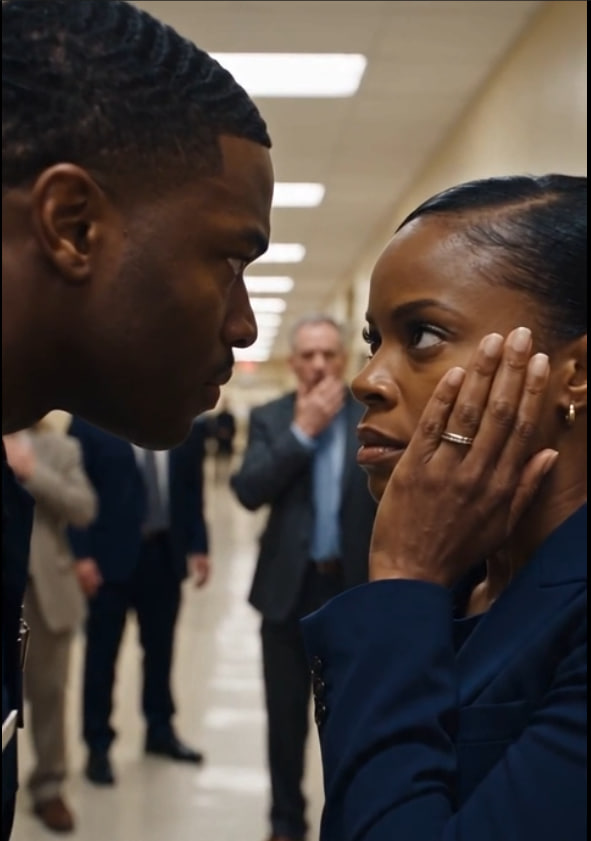
Her eyes went straight to my bruised face.
She touched my cheek with trembling fingers.
“That man hit you.”
It wasn’t a question.
“Yes.”
Her mouth tightened.
My mother, Evelyn Caldwell, had spent thirty-five years as an elementary school teacher.
I had watched her calm screaming parents, crying children, and even one man who threw a chair at a school board meeting.
But I had rarely seen her truly angry.
Now she was shaking.
“I want him in prison.”
“Mom.”
“I said what I said.”
Angela almost smiled.
I took off my coat.
“There’s going to be an investigation.”
“Good.”
Mom sat.
“Will they actually investigate?”
That question hurt.
Not because she doubted me.
Because she had lived long enough to know institutions sometimes protected themselves.
“They will now.”
Angela handed me tea.
“What does that mean?”
I told them enough to explain the pattern.
I did not reveal confidential details.
But I told them there were other alleged victims.
Mom became quieter with every sentence.
When I finished, she stared into her hands.
“You know what bothers me most?”
“What?”
“If he had known you were a judge, he wouldn’t have touched you.”
“No.”
“But he thought you were someone else.”
“Yes.”
“He thought you were someone he could hurt.”
My eyes filled.
That was the truth beneath everything.
Mom looked at me.
“So make this about her.”
“Who?”
“The woman he thought you were.”
Maya.
My mother nodded as if she could read my mind.
“Make sure everybody remembers that.”
The next morning, I woke to news that Mercer had been located.
He had not fled the state.
He had gone to Holt’s property outside the city.
Investigators found both men there.
They also found a fire burning behind a detached garage.
Brooks called me at 6:12 a.m.
“What was in the fire?”
“We’re still determining that.”
“Paper?”
“Yes.”
“Records?”
“Possibly.”
I closed my eyes.
“Were they arrested?”
“Holt was detained for obstruction. Mercer is in custody on the asNextlt investigation.”
“Anything recovered?”
“Some partially burned files.”
My stomach tightened.
“What kind?”
“Complaint records.”
That changed everything.
By breakfast, the district attorney had announced the creation of an independent investigative team.
The attorney general’s office joined by afternoon.
Mercer’s union attorney appeared on television insisting the incident with me had been a “split-second misunderstanding.”
I nearly threw the remote.
A misunderstanding was calling me Maya.
A misunderstanding was directing me toward the wrong courtroom.
Grabbing me was a choice.
Hitting me was a choice.
Falsifying allegations afterward was another.
Later that morning, I received a call from an unfamiliar number.
“Judge Caldwell?”
“Yes?”
“My name is Anthony Vega.”
I stood.
“I know your name.”
He was silent.
“I’m sorry,” I said. “That sounded ominous.”
He laughed nervously.
“I saw what happened to you.”
“I saw the video involving you.”
His breathing changed.
“So now people believe me.”
I hated the pain in those words.
“They should have listened before.”
“No one cared before.”
“I’m sorry.”
He went silent again.
Then he said something I would remember for years.
“When Mercer hit me, I thought the worst part was the pain.”
I sat down.
“It wasn’t.”
“What was?”
“Watching everybody decide he must have had a reason.”
I closed my eyes.
Anthony continued.
“My mom believed me. My girlfriend believed me. But when the police report came out, even some friends asked what I had done first.”
“I’m sorry.”
“I started wondering too.”
His voice cracked.
“I watched that video a hundred times after the store owner gave me a copy. I kept thinking maybe I moved wrong. Maybe I looked threatening.”
“You did nothing wrong.”
There was a long pause.
“Thank you.”
After we hung up, I sat alone for several minutes.
Then Richard Patterson entered without knocking.
“You need to see something.”
He put a document on my desk.
It was an internal courthouse memo.
Three years old.
The subject line referenced Officer Mercer’s courtroom conduct.
I read it twice.
A court clerk had complained that Mercer routinely used unnecessary force with detainees.
She had requested reassignment.
The request had been denied.
At the bottom was an approval signature.
Not Holt’s.
Richard’s.
I looked up slowly.
He looked devastated.
“I forgot about it.”
“You signed it.”
“I signed hundreds of staffing documents.”
“The clerk warned you.”
“I never saw the underlying complaint.”
“You approved the denial.”
“I trusted security leadership.”
I stood.
“And there it is.”
“What?”
“The sentence that protects every failing system.”
He flinched.
“I trusted someone else.”
“Josephine—”
“Did the clerk speak to you?”
He said nothing.
“Richard.”
“She tried.”
My stomach turned.
“What did you do?”
“I told her to follow the chain of command.”
I stepped away.
“You sent her back to the people she was complaining about.”
“I didn’t understand the seriousness.”
“You didn’t ask.”
His eyes filled with shame.
“No.”
For the first time, this reached beyond Mercer.
Beyond Holt.
Maybe nobody had deliberately ordered Mercer to hurt people.
But plenty of people had decided not to look.
Richard sat heavily.
“What do I do?”
I looked at him.
“Tell the truth.”
“It could end my career.”
“Yes.”
He stared at me.
I did not soften it.
Because Anthony Vega had nearly had his future destroyed.
Maya Lewis had been called a liar.
Others had carried injuries and charges.
Richard’s career was not more valuable than their lives.
An hour later, he contacted investigators.
By evening, another development surfaced.
Former clerk Melissa Crane—the woman who had written the warning—agreed to speak publicly.
Her statement contained one sentence that changed the entire investigation.
“I reported Officer Mercer because I watched him asNextlt a handcuffed detainee in a courthouse holding room.”
There had been another witness.
And according to Melissa, there had once been video.
Video that vanished three years ago.