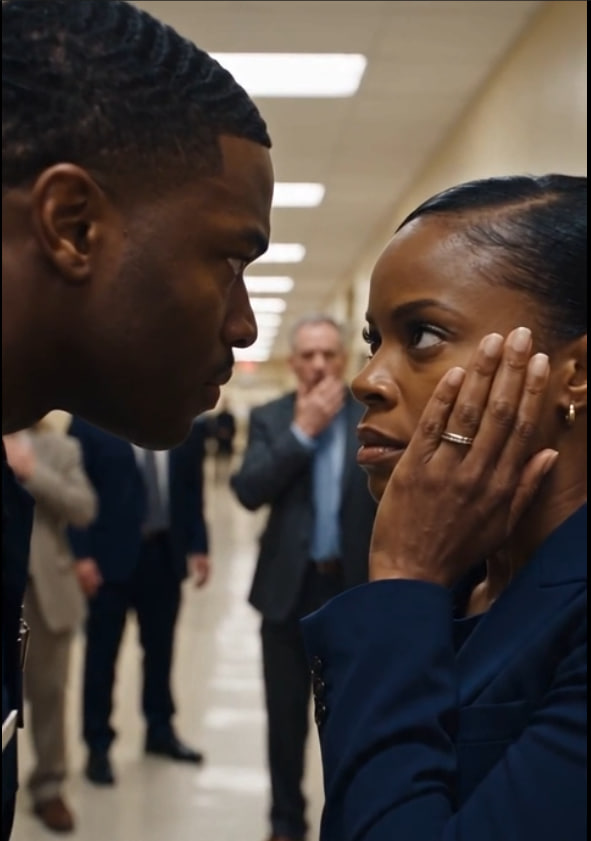
Melissa Crane met investigators in a conference room away from the courthouse.
I was not part of the interview.
I had no legal right to be.
But later, with her permission, I was told what she said.
Three years earlier, Melissa had entered the holding area carrying files.
She heard shouting.
When she reached the doorway, she saw Mercer standing over a handcuffed man named Leonard Price.
Leonard was on his knees.
Mercer kicked him.
Melissa screamed.
Mercer stopped.
Another security employee entered seconds later.
Mercer claimed Leonard had tried to head-butt him.
Melissa said that was impossible.
Leonard’s hands were cuffed behind him, and he had been kneeling several feet away when Mercer attacked.
Melissa reported it.
She was told security footage would be reviewed.
Two days later, she was informed the camera had malfunctioned.
Three months after that, she requested a transfer.
Six months later, she left courthouse employment completely.
Leonard Price remained incarcerated on another matter and never filed a complaint.
When investigators located him, he initially refused to talk.
“I complained once,” he reportedly said. “It made everything worse.”
Those words traveled through me.
The system had not merely failed to protect people.
It had taught them silence.
Richard held a press conference that afternoon.
I watched from chambers.
He looked ten years older.
“Three years ago, concerns regarding Officer Mercer reached my office,” he said.
“I failed to examine them with the seriousness they deserved.”
Reporters shouted questions.
Richard continued.
“I relied on assurances from security leadership when I should have asked more questions. That failure is mine.”
He announced he would temporarily step aside from administrative duties pending review.
Walter watched beside me.
“That couldn’t have been easy.”
“No.”
“You think he did the right thing?”
“Now?”
“Yes.”
I considered it.
“Yes.”
“Enough?”
“No.”
Walter nodded.
“That sounds about right.”
Meanwhile, investigators searched Holt’s property.
The burned documents turned out to include copies of disciplinary complaints involving Mercer and two other officers.
Darren Cole was placed on leave.
Then he requested an attorney.
By the following morning, he wanted to talk.
Cole admitted that Mercer had told him to disable the convenience-store camera after the Anthony Vega asNextlt.
He claimed he had obeyed because Mercer threatened to ruin his career.
But Cole revealed something bigger.
Captain Holt had maintained an unofficial file.
Not documenting Mercer’s misconduct.
Tracking complainants.
People who complained about Mercer sometimes found themselves suddenly investigated for unrelated violations.
Traffic stops.
Probation checks.
Code enforcement visits.
Nothing that looked coordinated by itself.
Together, it looked terrifying.
I met Maya outside the courthouse two days later.
Her criminal matter had been reassigned to another judge.
I could not discuss it.
But she approached me after meeting her attorney.
“How are you?”
I almost laughed.
“I think I’m supposed to ask you that.”
“You’re the one with the bruise.”
“It’s fading.”
She looked at my cheek.
“So is mine.”
I frowned.
She touched the memory of an old injury near her jaw.
“You can’t really see it anymore.”
I understood.
“The other kind takes longer,” I said.
Her eyes softened.
“Yes.”
We stood near the courthouse steps.
People passed around us.
Maya looked nervous.
“Can I ask you something?”
“Yes.”
“When he thought you were me…”
She stopped.
I waited.
“Did he say my name?”
“Yes.”
Her eyes filled.
“How?”
“What do you mean?”
“Like he knew me?”
I remembered.
Don’t lie to me, Maya.
“He seemed familiar with it.”
She closed her eyes.
“My lawyer thinks he was looking for me.”
“That is being investigated.”
Maya nodded.
Then she whispered, “I knew it.”
“What?”
“He told me after I filed the complaint that I’d better pray I never crossed his path again.”
Cold spread through my chest.
“Did you report that?”
“Yes.”
“To whom?”
“Holt.”
Of course.
“And?”
“He said I misunderstood.”
I looked toward the courthouse.
For the first time, the building I had devoted much of my life to looked different.
Not evil.
Institutions were not living creatures.
People made choices inside them.
Some brave.
Some cowardly.
Some cruel.
Some indifferent.
Enough bad choices could turn marble halls into dangerous places.
That afternoon, Brooks called.
“We found the unofficial file.”
I stood.
“Where?”
“Holt had a storage unit.”
“What’s in it?”
“Complaint copies. Notes. Names. Background checks.”
My stomach tightened.
“And?”
“One file is labeled Caldwell.”
I stopped breathing for a second.
“Me?”
“Yes.”
“How old?”
“That’s the problem.”
His voice became quiet.
“It was created before Mercer asNextlted you.”
I gripped the phone.
“How long before?”
“About four months.”
“Why would Holt have a file on me?”
“We’re trying to determine that.”
“What’s inside?”
“Your rulings.”
“My rulings?”
“Cases where you dismissed charges based on officer misconduct or suppressed evidence.”
My heart began pounding.
I had handled several such cases.
Not involving Mercer directly.
At least, I thought they hadn’t.
“There are handwritten notes.”
“Whose?”
“We believe Holt’s.”
“What do they say?”
Brooks hesitated.
“Problem judge.”
I almost laughed from disbelief.
“Anything else?”
“Yes.”
“What?”
“Too willing to believe defendants.”
I sat slowly.
This had never just been about Grant Mercer’s temper.
Someone had been paying attention to judges who questioned police behavior.
Someone had considered fairness a threat.
Then Brooks said one more thing.
“There’s a photograph in the file.”
“Of what?”
“You.”
My hand tightened around the phone.
“Where?”
“Outside your home.”
The room suddenly felt cold.
“When was it taken?”
“Three months ago.”
I looked toward my chamber door.
For the first time since Mercer hit me, I felt something I had not allowed myself to feel.
Fear.
Not for my career.
Not for the courthouse.
For my safety.
And for my mother, who had been inside that house when someone stood outside taking pictures.