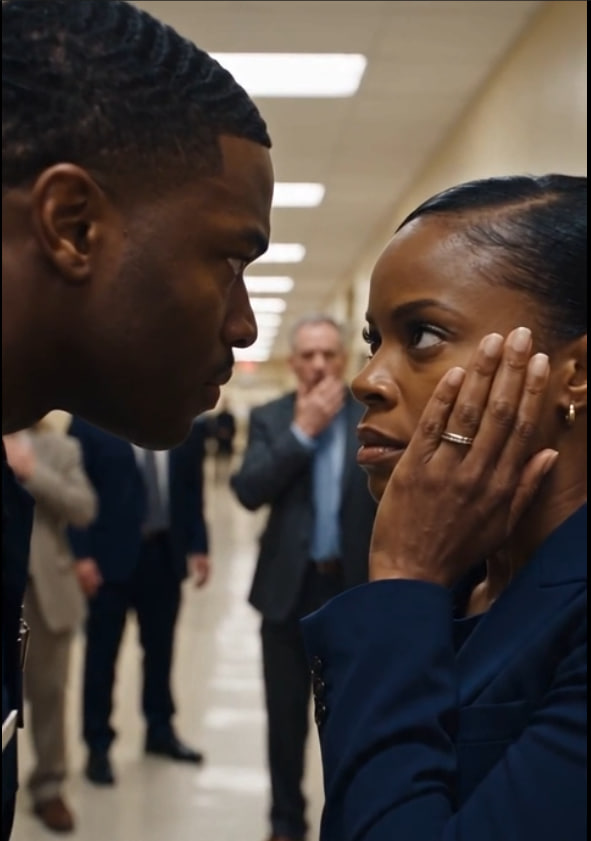
The police placed a patrol car outside my home that night.
I hated it.
Not because I believed protection was unnecessary.
Because my mother saw it.
She stood at the window staring at the cruiser.
“You said you were safe.”
“I believed I was.”
She turned toward me.
“Did somebody threaten you?”
“We don’t know.”
“That means yes.”
“Mom.”
“Don’t ‘Mom’ me.”
Angela was sitting at the kitchen table.
She looked frightened too.
I told them about the photograph.
My mother lowered herself into a chair.
“When?”
“Three months ago.”
“Was I home?”
“I don’t know.”
She looked toward the window again.
For the first time, this investigation had entered the place where I slept.
I felt violated in a way the slap had not managed.
That injury had happened publicly.
This felt like someone had been standing in the dark studying my life.
Brooks came to the house personally.
“We don’t know who took the photograph.”
“Holt?”
“Possibly.”
“Mercer?”
“Possibly.”
“What was the purpose?”
“We’re investigating.”
I disliked that phrase more every time I heard it.
Brooks sat across from me.
“There’s something else.”
Of course there was.
“What?”
“We found notes related to three cases you handled.”
I recognized all three.
In each, I had excluded evidence because officers had violated constitutional protections.
None of those officers had been Mercer.
But two had worked under Holt.
Brooks continued.
“Holt believed judges like you were making police work impossible.”
“Judges who enforce the Constitution?”
“I’m telling you how he described it.”
“He wrote that?”
“Yes.”
Another note described defense attorneys as enemies.
Another referred to civilian complaints as weapons.
The mentality was clear.
Anyone questioning police conduct was not part of accountability.
They were an opponent.
Later that evening, I sat with Mom on the porch.
The rain had finally stopped.
“You remember when you decided to become a judge?” she asked.
“I remember you telling everybody before I even got confirmed.”
She smiled.
“I was proud.”
“You’re still proud.”
“Obviously.”
I laughed.
Then she became serious.
“Your father would have been furious.”
My smile faded.
Dad died seven years before I became presiding judge.
He had been a city bus driver.
He never went to college.
But he read every newspaper he could find.
He believed the law mattered because ordinary people needed something stronger than whoever held power.
“He used to say a badge doesn’t make a person good,” Mom said.
“I remember.”
“And a criminal charge doesn’t make someone bad.”
“Yes.”
She squeezed my hand.
“Maybe this is why you ended up there.”
I leaned against her shoulder.
“I’d prefer destiny with less facial swelling.”
She laughed.
For a moment, we were simply mother and daughter.
Then headlights appeared.
A vehicle slowed in front of the house.
The patrol officer immediately stepped out.
My body stiffened.
The vehicle kept moving.
Probably nothing.
But fear does not care about probability.
That night, I slept badly.
At 4:30 a.m., my phone rang.
Brooks.
“We arrested Holt.”
I sat up.
“For what?”
“Obstruction, evidence tampering, conspiracy.”
My chest tightened.
“And Mercer?”
“Additional charges are coming.”
“Based on what?”
“Cole gave us access to archived messages.”
I waited.
“They discussed Maya Lewis.”
I stopped breathing.
“What did they say?”
“Mercer told Holt he planned to ‘teach her a lesson’ at the courthouse.”
My stomach turned.
“So he was waiting for her.”
“Yes.”
“And he found me.”
“Yes.”
The words changed the incident completely.
Mercer had not randomly mistaken me for Maya.
He had entered that hallway intending to intimidate her.
He saw me and believed he had his target.
The slap was not an unpredictable reaction.
It was the destination.
I closed my eyes.
“There’s more,” Brooks said.
“What?”
“Holt responded to Mercer.”
I already knew I would hate it.
“What did he say?”
“Keep it off camera.”
For several seconds, I could not speak.
“Josephine?”
“I’m here.”
“We now believe the malfunctioning holding-cell camera three years ago was deliberately disabled.”
“By Holt?”
“We’re building the case.”
“And the picture outside my house?”
“No answer yet.”
That question haunted me for two more days.
Then investigators found the answer.
The photograph had been taken by a private investigator.
Holt had hired him.
The investigator claimed Holt asked him to document which judges met privately with defense attorneys.
It was ridiculous.
Judges routinely met counsel in legitimate court-related settings.
But Holt apparently believed there was a conspiracy against his officers.
The investigator followed me three times.
Once to my home.
Once to a legal conference.
Once to my father’s grave.
When Brooks told me that, my anger overwhelmed my fear.
“My father’s grave?”
“Yes.”
“For what?”
“We don’t know.”
I stood.
“No. I want to know.”
“We will.”
I looked at him.
“You keep saying that.”
He didn’t become defensive.
“You’re right.”
That softened me slightly.
Brooks removed his glasses.
“I should tell you something.”
“What?”
“I knew Mercer had complaints.”
I went still.
“I didn’t know the extent. But I knew he had a reputation.”
“And you did nothing?”
“I spoke to Holt once.”
“What did Holt say?”
“That Mercer was aggressive but effective.”
I stared at Brooks.
“And that satisfied you?”
“No.”
“But you left it there.”
“Yes.”
His shame was obvious.
“I failed too.”
I sat.
He continued.
“I keep thinking about what Walter said. Everybody moved when it happened to a judge.”
He looked at me.
“I’m part of everybody.”
I respected him more for admitting it.
“What will you do?”
“Help investigators get everything.”
“Even if it damages your department?”
“Especially then.”
That afternoon, Brooks gave investigators access to records nobody had previously requested.
The search revealed fourteen additional complaints that had never entered the formal disciplinary system.
Fourteen.
One belonged to the family of Leonard Price.
His mother had complained two days after the holding-cell asNextlt.
Her complaint had simply vanished.
She had died the previous year.
Leonard cried when investigators told him they found it.
“She believed me,” he said.
That sentence nearly broke me.
Then the district attorney announced a grand jury investigation.
Mercer.
Holt.
Cole.
Potentially others.
The courthouse asNextlt had become the thread that unraveled years of concealed misconduct.
But there was one more surprise.
A former officer contacted investigators anonymously.
He claimed Holt’s protection network extended beyond courthouse security.
And he said there was one person who could prove it.
A retired lieutenant named Marcus Dean.
The problem was Marcus Dean had disappeared from public life five years earlier.
According to the former officer, Holt had destroyed Dean’s career.
Because Dean had tried to expose everything.