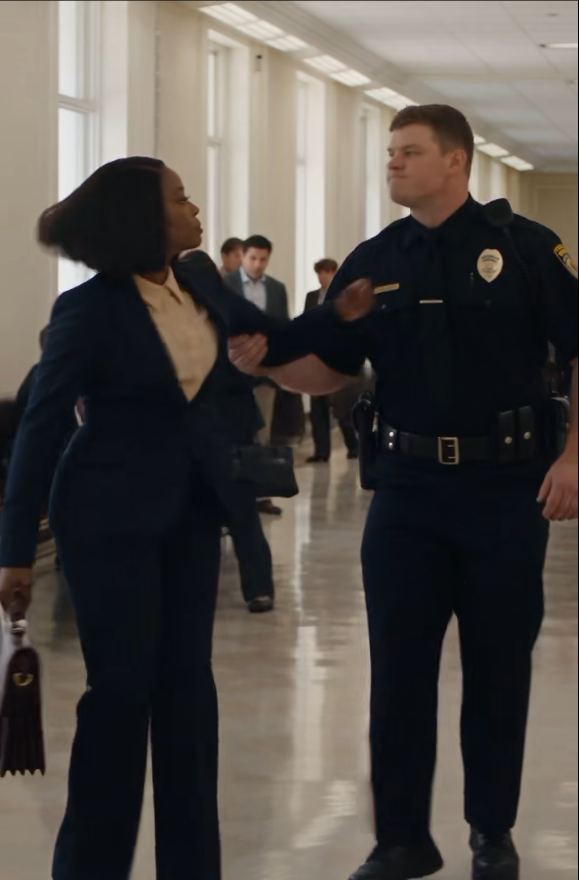
Both attorneys entered.
Maya came with her public defender.
I knew her immediately.
Not because she resembled me.
She barely did.
She was shorter, wore her hair differently, and had a narrow face that did not resemble mine except in the broadest description.
Black woman.
Adult.
Dark clothing.
That had apparently been enough.
Maya saw my cheek.
Her step slowed.
Her eyes moved from me to the bailiff, then back.
I knew from her expression that she had already heard.
Courthouse news traveled faster than any official announcement.
“All rise.”
Everyone stood.
I sat.
“Please be seated.”
Maya lowered herself beside her attorney.
I looked at the lawyers.
“There is a matter I need to address before we proceed.”
The prosecutor stood.
“Your Honor, if this concerns this morning—”
“It does.”
Maya’s public defender looked at her.
I continued.
“Officer Bradley Miller is a material witness in the pending suppression motion. This morning, I had an encounter with Officer Miller that makes it inappropriate for me to hear any contested matter involving his credibility or conduct.”
The prosecutor nodded immediately.
“We agree, Your Honor.”
Maya’s lawyer rose more slowly.
“We understand.”
“I’m recusing myself from this case. It will be reassigned.”
Maya looked at me.
Not angry.
Not relieved.
Studying.
I closed the file.
“Anything further?”
Her attorney glanced at her.
Maya whispered something.
The lawyer shook her head slightly.
Maya whispered again.
Then the attorney faced me.
“My client is asking permission to speak.”
The prosecutor began to rise.
I lifted one hand.
“Not about the merits of the case.”
Maya stood.
She kept both hands on the table.
“Did he really think you were me?”
The courtroom became motionless.
Her lawyer touched her arm.
“Maya.”
“It’s all right,” I said.
I looked at her.
“Yes.”
She glanced at my bruised cheek.
“Did you tell him who you were?”
“Yes.”
“And he didn’t believe you?”
“No.”
She gave a short breath that contained no humor.
Then she looked down.
“Okay.”
One word.
Nothing else.
But I understood what had happened.
She had not asked because she needed information.
She had asked because part of her wanted to know whether my title had protected me.
It had not.
Not until someone else confirmed it.
Maya sat.
I transferred the case.
That should have been the end of my connection to her.
It was not.
By noon, someone had posted a twelve-second cellphone video online.
It began too late to show Miller’s initial approach.
It showed me saying, “Take your hand off me.”
It showed him gripping my arm.
It showed me pulling away.
Then the camera jerked as several people moved.
The slap itself occurred partly outside the frame.
The sound did not.
The video ended seconds after Thomas said, “Your Honor.”
Twelve seconds.
That was enough.
By two o’clock, reporters stood outside the courthouse.
By three, the police department issued a statement describing “an incident involving an officer and a member of the judiciary.”
The statement said Miller had been placed on administrative leave pending an internal investigation.
It did not say he hit me.
It did not say he had mistaken me for a defendant.
It did not say I told him my name.
It did not say Maya Reynolds was Black.
At four thirteen, my phone rang in chambers.
Police internal affairs.
I had expected the call.
The investigator asked whether I could give a statement that afternoon.
“Yes.”
“Would you prefer we come to you?”
“No. I’ll come there.”
Thomas, who had been standing near my office door, frowned.
After I hung up, he said, “You sure about that?”
“Yes.”
“You don’t owe them convenience.”
“That’s not why.”
“Then why?”
I picked up my coat.
“Because I want to walk into the same building everybody else does.”
He shook his head.
“You judges get strange ideas about symbolism.”
“You’ve worked for judges thirty-two years.”
“That’s how I know.”
The interview room at internal affairs had beige walls, a metal table, and fluorescent lights that made everyone look tired.
Two investigators sat across from me.
A recording device rested between us.
I had brought counsel.
Not because I believed I was in danger of prosecution, but because I had spent fifteen years telling clients never to assume an interview was informal simply because everyone was polite.
The lead investigator explained the process.
I listened.
Then she asked me to describe what happened.
I did.
From the elevator to Thomas’s arrival.
Slowly.
Precisely.
Without adjectives I could not prove.
When I finished, she asked, “Did Officer Miller tell you why he believed you were Ms. Reynolds?”
“He said she was supposed to report to Courtroom 4B.”
“Did he describe her?”
“Not before stopping me.”
“Did you show identification?”
“No.”
“Why not?”
My attorney shifted slightly.
I answered.
“Because I was not legally required to prove my identity merely because he had made an unsupported assumption.”
The investigator nodded.
“Do you believe showing identification might have prevented the physical confrontation?”
There it was.
A question I had heard in different forms for fifteen years.
Why didn’t you just comply?
Why didn’t you make it easier?
Why didn’t you solve the officer’s mistake for him?
I kept my voice level.
“It might have.”
She waited.
“That does not make his actions lawful.”
“I understand.”
“Do you?”
She looked up.
I regretted the sharpness almost immediately.
But I did not withdraw it.
She folded her hands.
“I understand the distinction you’re making.”
“Good.”
She continued.
“When Officer Miller grabbed your arm, you attempted to pull free?”
“Yes.”
“Did you strike his wrist?”
“I moved his hand away when he reached for me again.”
“Could that have appeared aggressive?”
“To whom?”
“To Officer Miller.”
“He had already decided I was lying about my identity. I can’t testify to what he imagined after that.”
My attorney glanced at me.
A warning.
Stay factual.
I exhaled.
The investigator asked, “Did you tell him you were a former public defender?”
“Yes.”
“What was his response?”
“He asked whether I wanted to ‘play lawyer.’”
She wrote something.
Then: “Did he make any statement you interpreted as racial?”
I looked at her.
“He said, ‘You people always think you can argue your way out of everything.’”
“Did he specify what he meant by ‘you people’?”
“No.”
“Could he have meant defendants?”
“He believed I was a Black female defendant.”
The investigator paused.
I continued.
“I am not asking you to record my interpretation as fact. Record the words.”
She nodded.
“We will.”
When the interview ended, she turned off the recorder.
Then she remained seated.
“One more thing.”
“My attorney is still here.”
“I know.”
She looked uncomfortable.
“We reviewed Officer Miller’s body camera.”
I waited.
“It was not recording during your encounter.”
My attorney leaned forward.
“Malfunction?”
“No.”
“Battery?”
“No.”
The investigator’s jaw tightened.
“It had been manually deactivated approximately fourteen minutes earlier.”
I stared at her.
“Why?”
“We don’t know yet.”
“Was he required to have it activated?”
“In public enforcement contacts, yes.”
“How long had it been off?”
“Fourteen minutes before the incident through three minutes after.”