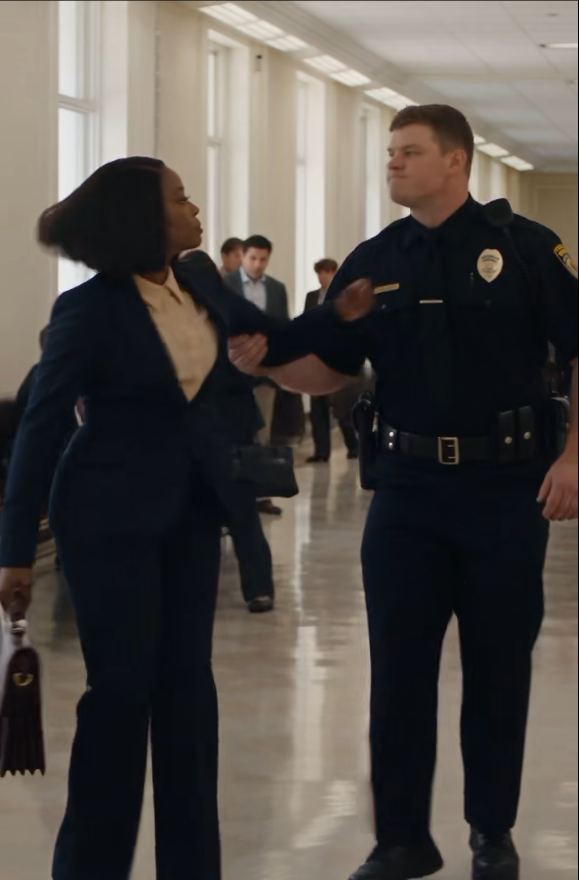
My attorney asked, “When did it resume?”
The investigator looked at me.
“Shortly after Senior Bailiff Gallagher identified Judge Caldwell.”
The room seemed smaller.
I sat back.
“Are you saying Miller turned his camera on after he learned who I was?”
“We are still establishing the exact sequence.”
“Do you have activation timestamps?”
“Yes.”
“Then you have the sequence.”
She did not argue.
For the first time since the hallway, I felt something colder than anger.
Miller had not merely lost control.
At some point before meeting me, he had made a choice to turn off the device intended to document what he did.
And once he discovered I was a judge, he made another choice.
He turned it back on.
Thomas was waiting outside.
He stood when I emerged.
“Well?”
“The camera was off.”
His expression barely changed.
“How convenient.”
“Manually.”
That changed it.
He looked down the corridor.
“I need to tell you something.”
“What?”
“Not here.”
We went downstairs and sat in an empty courthouse cafeteria after closing.
Rain tapped against the windows.
Thomas placed his coffee on the table but did not drink it.
“You remember a guy named Leon Price?”
“No.”
“Disorderly conduct case. Maybe six months ago. Young Black guy. Delivery driver.”
I shook my head.
“You probably never had the case. Happened downstairs. Miller brought him in.”
“What happened?”
“Price had a warrant for missing court on a traffic matter. Miller arrested him near security. Kid kept saying the warrant had been recalled. Miller told him to shut up. Price said he wanted someone to check.”
Thomas rubbed his thumb against the paper cup.
“Miller shoved him against the wall.”
“You saw it?”
“Part of it.”
“Did Price resist?”
“Not that I saw.”
“What happened afterward?”
“He filed a complaint.”
“And?”
“Nothing.”
“How do you know?”
“He came back a month later asking whether anyone had talked to me. Nobody had.”
I stared at Thomas.
“Did you report what you saw?”
“No.”
“Why?”
“I told myself I hadn’t seen the beginning.”
“That didn’t stop you from seeing the end.”
“I know.”
His voice had gone quiet.
I looked away.
The cafeteria lights reflected off the dark windows.
Thomas continued.
“There was another woman last year. Older. Miller accused her of ignoring an order at security. Grabbed her bag, dumped everything on the floor.”
“Complaint?”
“Don’t know.”
“You never told anyone?”
“I complained to another bailiff. He said Miller was an ass.”
“That was it?”
“That was it.”
I wanted to be angry at him.
Part of me was.
But another part recognized the system he was describing.
Not conspiracy.
Not secret meetings.
Not people agreeing to protect misconduct.
Something more ordinary.
Each person saw one small piece.
Each piece seemed insufficient on its own.
Everyone assumed someone else had a better view.
The absence of certainty became permission to do nothing.
Miller did not need everyone to approve of him.
He only needed them to doubt themselves.
Thomas stared at his coffee.
“I keep thinking about what I said in your office.”
“Which part?”
“That he picked the wrong person.”
I waited.
“That’s not right.”
He looked at me.
“He picked the same kind of person he always picks. He just happened to be wrong about what would happen afterward.”
Part III — Reversal
The bruise darkened overnight.
By Wednesday morning, makeup could not hide it.
I did not try.
My first hearing involved a plea agreement.
The second involved a landlord dispute.
The third was postponed because a witness had not appeared.
Life inside the courthouse continued.
That bothered some people.
They seemed to expect the building to become entirely about what had happened to me.
It did not.
People still needed restraining orders.
Juries still deliberated.
Parents still fought over children.
Defendants still sat beside lawyers and waited to learn whether they were going home.
The institution continued because institutions always do.
That is both their strength and their danger.
At eleven, the chief judge came to my chambers.
“The department wants you to avoid commenting publicly until the investigation is complete.”
“I haven’t commented.”
“They’re concerned about appearances.”
I looked at him.
“Whose?”
He sighed.
“Josephine.”
“I’m asking.”
“The entire courthouse is under a microscope.”
“Good.”
“That microscope includes us.”
“Also good.”
He sat.
“There are already questions about whether defendants can get fair hearings involving city officers.”
“They’re entitled to ask.”
“And questions about whether judges here are too close to law enforcement.”
“They’re entitled to ask that too.”
He studied me.
“You’ve changed.”
“Since Tuesday?”
“No.”
He shook his head.
“Since you came to the bench.”
I leaned back.
“How?”
“You were more patient with imperfect systems as a lawyer.”
“That is a remarkable sentence.”
“You know what I mean.”
“I really don’t.”
“You understood constraints.”
“I still do.”
“You understood that sometimes the record in front of the court is incomplete.”
I looked at him for several seconds.
“Are we talking about Miller?”
“We’re talking about the courthouse.”
“No. You came here because you’re worried my experience will affect my judging.”
“I came here because I’m worried you think seeing one ugly thing means everything around it is rotten.”
I stood.
“Get out.”
He blinked.
“Josephine.”
“I said get out.”
He stood too.
“This is exactly what I’m talking about.”
“No. What you’re talking about is whether being struck in a courthouse hallway has made me unreasonable.”
“That’s not what I said.”
“It’s what you came to ask without asking.”
His face tightened.
“I’m trying to protect the institution.”
I walked to the door and opened it.
“The institution did not get slapped.”
He stopped beside me.
For a moment, neither of us spoke.
Then he said, “Neither did every officer in this county.”
“I know.”
“Do you?”
“Yes.”
I looked directly at him.
“That’s why Miller’s individual history matters.”
He frowned.
“What history?”
I said nothing.
His expression changed.
“Josephine.”
“You should go.”
After he left, I closed the door.
My hands were shaking.
I hated that.
Anger had always made my hands cold.
As a young lawyer, I had learned to hide them beneath counsel tables.
As a judge, I usually folded them above the bench.
I sat at my desk until they steadied.
Then my clerk called.
“Maya Reynolds’s attorney is asking whether you have a minute.”
I nearly said no.
Instead, I said, “What for?”
“She says it’s not about the pending motion.”
I thought about recusal.
About appearances.
About boundaries.
“Five minutes.”
The public defender entered alone.
She closed the door.
“Maya asked me to give you something.”
“If it concerns her case, I can’t receive it.”
“It doesn’t.”
She placed a photocopy on my desk.
A complaint form.
Officer involved: Bradley Miller.
Complainant: Maya Reynolds.
Date: three weeks earlier.
I did not touch it.
“What is this?”
“She filed it the morning after her arrest.”
“I can’t review evidence related to her motion.”
“This complaint isn’t part of the motion.”
“It could become part of it.”
“That’s why I’m not asking you to act on it as a judge.”