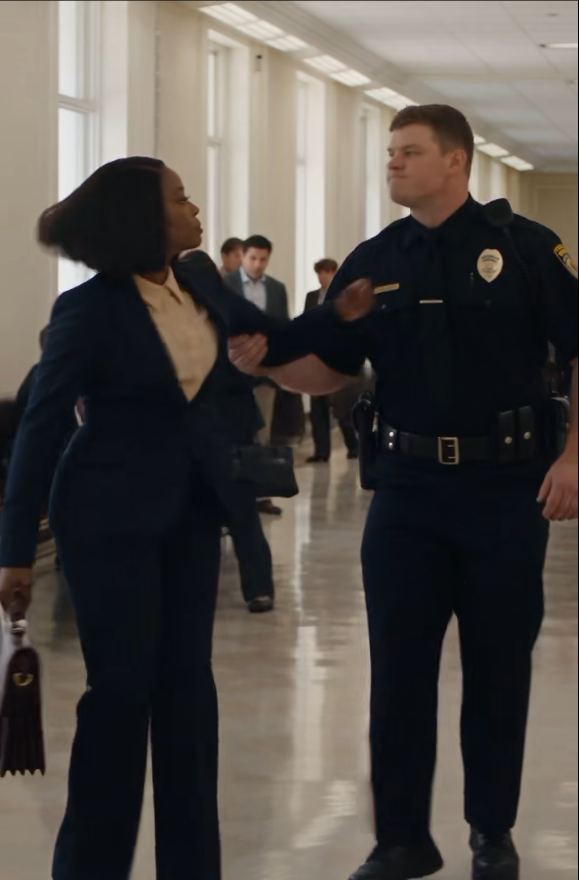
“Then why are you here?”
“Because internal affairs told her yesterday they had no record of a prior complaint.”
I looked at the paper.
Maya’s attorney continued.
“She has her copy.”
“Stamped?”
“Yes.”
There was a received stamp at the bottom.
MONROE COUNTY POLICE — PROFESSIONAL STANDARDS.
Three weeks earlier.
I felt the room tighten around me.
“Where was it filed?”
“Department headquarters.”
“With whom?”
“She dropped it at the desk. They stamped her copy.”
“And internal affairs says it doesn’t exist?”
“They said they could not locate it.”
I did not touch the page.
“Take this to the investigator.”
“We are.”
“Then why bring it here?”
The attorney hesitated.
“Maya wanted you to know she wasn’t waiting for a judge to get hit before she complained.”
The words landed cleanly.
No accusation in the lawyer’s voice.
None was necessary.
I stared at the complaint.
“Take it.”
She picked it up.
At the door, I said, “Counsel.”
She turned.
“Tell Ms. Reynolds…”
I stopped.
What?
That I believed her?
I had not heard the evidence.
That I was sorry?
For what exactly?
For a system larger than me?
For not knowing?
For being protected by a title she did not possess?
“Tell her I understand why she wanted me to know.”
The attorney nodded.
“That’s enough.”
After she left, I sat alone.
Then I did something I had warned myself not to do.
I searched my memory for every case in which Bradley Miller’s name had appeared before me.
Not because I intended to reopen them.
Because I needed to know whether I had missed something.
Three cases came immediately.
A drug possession matter.
A warrant arrest.
A resisting charge dismissed by the prosecutor.
In none had Miller’s credibility been directly litigated.
Then I remembered a fourth.
A young man accused of obstruction.
His lawyer had argued at sentencing that Miller escalated the arrest unnecessarily.
I had said something from the bench.
I could almost hear myself.
An allegation without corroboration cannot become a finding.
Legally correct.
Still correct.
But suddenly incomplete in a way that troubled me.
How many uncorroborated allegations remained uncorroborated because each one was sealed inside a separate file?
I called my clerk.
“Can you ask records for a list of public cases in which Officer Bradley Miller testified before this court over the last two years?”
She paused.
“For what purpose?”
“A conflict review.”
That was true.
“Okay.”
“And only public docket information. Nothing sealed.”
“Got it.”
An hour later, she returned with eleven case numbers.
I did not read transcripts.
I did not investigate.
I did not have that authority.
But the number itself bothered me.
Eleven appearances in my courtroom.
How often had I seen his name and registered nothing?
That afternoon, internal affairs called again.
They had found Maya’s complaint.
It had been misclassified.
“Misclassified as what?” I asked.
“General correspondence.”
“Who classified it?”
“We’re reviewing that.”
“Was Miller notified?”
Another pause.
“Yes.”
“When?”
“Two days after it was filed.”
“And when did his body-camera activation begin showing irregularities?”
The investigator became careful.
“I can’t discuss the broader review yet.”
“That means there is a broader review.”
“I didn’t say that.”
“You didn’t have to.”
She exhaled.
“Judge Caldwell, I need you to let us do our job.”
I looked through my office window at the courthouse plaza below.
“That is exactly what I’m doing.”
Friday morning, a second video surfaced.
Not of me.
Of Leon Price.
The delivery driver Thomas had mentioned.
Someone had recorded his courthouse arrest six months earlier.
The video began with Price pressed against a wall near the security checkpoint.
Miller had one hand between Price’s shoulder blades.
Price kept saying, “Check the warrant. Just check it.”
Miller told him to stop resisting.
Price’s hands were visible.
He was not resisting.
At least not in the portion recorded.
Miller pushed him harder.
Price turned his head.
“I’m not fighting you.”
Miller replied, “Then stop acting like you run this place.”
The video ended.
By noon, a local reporter had identified two other complaints involving Miller.
By afternoon, the police union released a statement urging the public not to “rush to judgment based on edited video fragments.”
That statement was factually reasonable.
Video fragments can mislead.
I had made that argument myself in court.
But fragments accumulate.
So do choices.
Internal affairs found that Miller’s body camera had been manually deactivated during seven enforcement contacts in the previous four months.
Not every deactivation involved a complaint.
Not every complaint alleged force.
But three did.
My incident made four.
The department did not release that information immediately.
It leaked.
When I read the report that night, I felt no satisfaction.
I was at home, standing barefoot in my kitchen.
The bruise on my face had turned yellow at the edges.
My phone lay beside the sink.
I switched it off.
For the first time all week, I cried.
Not dramatically.
No collapse.
No sobbing.
I stood at the sink while tears ran down my face, and I hated how ordinary the kitchen looked.
A cup on the counter.
A dish towel hanging crookedly.
Rainwater drying on the window.
I thought of Maya asking, Did you tell him who you were?
I thought of Leon Price saying, Just check the warrant.
I thought of Thomas saying he had never had anything concrete.
I thought of myself telling a defendant that allegations without corroboration could not become findings.
All those statements could be true at once.
That was the problem.
The law demanded proof.
Justice required attention before proof became catastrophe.
I had always understood the first.
I was only beginning to understand the second.
Part IV — Reckoning
By the following Monday, Officer Bradley Miller had an attorney.
The attorney issued a statement saying Miller had been placed in “an impossible, rapidly developing situation involving mistaken identity, noncompliance, and physical resistance.”
The statement described the slap as a “defensive open-hand technique.”
I read that phrase twice.
Then I laughed.
Not because it was funny.
Because I recognized the language.
Every profession develops vocabulary that can turn human events into abstractions.
Judges did it too.
We said disposition instead of outcome.
Custodial status instead of jail.
Collateral consequence instead of a person losing work, housing, or custody because of a conviction.
Language could clarify.
It could also create distance.
A slap became a technique.
A frightened person became noncompliant.
A mistake became rapidly developing.
My own title appeared only once.
Judge Caldwell was later identified as a member of the judiciary.
Later identified.
As though my identity had not been offered directly and rejected.
Thomas entered my chambers carrying coffee.
He set one cup on my desk.
“I assume you’ve seen it.”
“Yes.”
“Defensive open-hand technique.”
“Yes.”
He sat.
“Back in my day, we called that slapping somebody.”
I took the coffee.
“You are becoming reckless in old age.”
“I’ve been waiting thirty-two years.”
My smile faded.
“What happens to you?”
“For what?”
“You’re a witness.”
“So?”
“So you still work with city officers every day.”
Thomas shrugged.
“I’m retiring in eight months.”