“That wasn’t my question.”
He looked at me.
“I’ll be fine.”
“Thomas.”
He sighed.
“A couple officers stopped talking to me.”
“Because you intervened?”
“Because I told investigators what I’d seen before.”
“What did you tell them?”
“Everything.”
I set the coffee down.
“The Price incident?”
“Yes.”
“The woman at security?”
“Yes.”
“Anything else?”
“Things I heard. Things I didn’t report. I told them that too.”
I studied him.
“How did that feel?”
“Bad.”
“Why?”
“Because I kept waiting for the investigator to ask why I hadn’t said something sooner.”
“Did she?”
“Eventually.”
“What did you say?”
Thomas looked at the floor.
“I said because nothing seemed serious enough until it happened to somebody I knew.”
He raised his eyes.
“That answer has been bothering me ever since.”
I said nothing.
He leaned back.
“You know, people think cowardice feels like fear.”
“What does it feel like?”
“Most of the time?”
He picked at the cardboard sleeve around his cup.
“Reasonableness.”
The county prosecutor appointed an outside prosecutor to review Miller’s conduct in my case.
That was necessary.
The local office appeared before me regularly.
No decision could look compromised.
The outside prosecutor requested an interview.
I gave one.
Miller’s attorney requested preservation of courthouse surveillance video.
It was preserved.
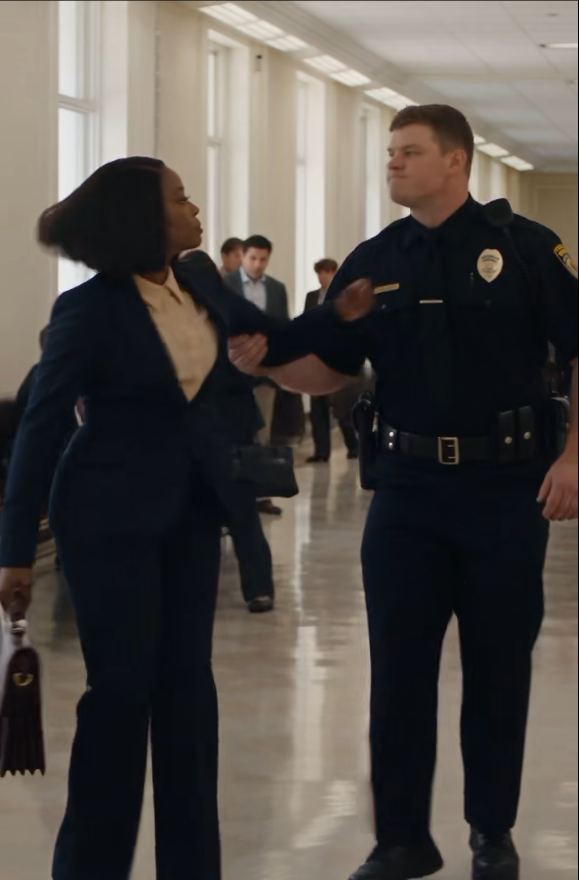
The western hallway camera had captured most of the encounter.
No audio.
But enough.
Miller approaching.
Me stopping.
His hand on my arm.
Me pulling back.
Him reaching again.
Me knocking his wrist aside.
The slap.
The handcuffs coming out.
Thomas arriving.
Video does not eliminate interpretation.
But it can limit imagination.
Miller’s claim that I had “lunged” toward him did not survive the footage.
His attorney changed language.
Now I had made “sudden physical contact.”
True.
I had moved his wrist.
After he grabbed me.
The department investigation widened.
Seven body-camera deactivations became nine after technicians reviewed device logs.
Three occurred shortly before complaints.
In two others, Miller had issued resisting-arrest citations later dismissed.
Maya’s complaint was no longer misplaced.
It had become central.
Her suppression hearing was assigned to another judge from outside the county to avoid the appearance of institutional conflict.
I did not attend.
I did not read media reports while it was pending.
That required discipline.
I wanted to know everything.
I forced myself not to.
My role mattered precisely when curiosity made restraint difficult.
Two weeks after the hallway incident, Maya’s attorney came to my chambers again.
I almost refused the meeting.
“She wants to thank you,” the lawyer said.
“For what?”
“For recusing.”
“That’s not something she needs to thank me for.”
“She knows.”
I paused.
“What happened?”
“The court granted the suppression motion.”
I said nothing.
The lawyer continued.
“The judge found the initial detention lawful because of the warrant. But he found Miller’s description of the physical encounter inconsistent with video from a building security camera.”
There had been video.
Maya’s apartment building.
Another camera.
Another angle.
The lawyer placed no documents on my desk this time.
“The resisting-related evidence is out.”
“And the underlying theft case?”
“Still pending.”
I nodded.
“That’s all I can discuss.”
“I understand.”
She turned to leave.
“Counsel.”
She looked back.
“How is Ms. Reynolds?”
The lawyer considered the question.
“Less surprised than everyone else.”
Then she left.
Miller was suspended without pay before Christmas.
Not because I was a judge.
The department emphasized that point publicly.
The suspension concerned multiple policy violations, including improper force, failure to activate his body camera, inaccurate reporting, and conduct unbecoming.
His attorney appealed.
The union defended him.
Some officers privately told Thomas the department was sacrificing Miller because I was powerful.
Others argued that any officer could make a mistaken identification.
Both statements contained pieces of truth.
Mistakes happen.
Institutions protect themselves.
But neither explained the nine camera deactivations.
Neither explained Maya’s complaint.
Neither explained Leon Price.
Neither explained why Miller treated my identity as a joke until another man authenticated it for him.
Those facts remained.
By January, the outside prosecutor announced charges stemming from my asNextlt.
Simple battery.
Official misconduct.
Falsification related to his initial incident report.
The last charge mattered most to me.
Miller’s first written account stated that I had “refused repeated lawful commands, initiated physical resistance, and struck the officer’s arm immediately before a proportional defensive response.”
He filed it forty-eight minutes after learning I was a judge.
Forty-eight minutes.
He had time to calm down.
Time to review what had happened.
Time to understand who I was.
Time to know there were witnesses.
And he still wrote that version.
That changed the case.
A mistake can happen quickly.
A lie written slowly is something else.
The summons requiring me to testify arrived in February.
I stared at it for a long time.
I had issued thousands of subpoenas and orders.
Receiving one felt strangely invasive.
Thomas found me holding it.
“You knew it was coming.”
“Yes.”
“You nervous?”
“No.”
“That means yes.”
I put it down.
“I don’t like being the witness.”
“Judges are terrible witnesses.”
“Why?”
“You’re used to interrupting people.”
“I do not interrupt people.”
Thomas raised one eyebrow.
“Get out.”
“Yes, Your Honor.”
He reached the door.
“Thomas.”
He turned.
“Are you testifying?”
“Day before you.”
I nodded.
He opened the door.
Then paused.
“You know what Miller’s lawyer will do.”
“Yes.”
“He’ll say you escalated.”
“Yes.”
“He’ll say you wanted special treatment.”
“Yes.”
“He’ll say you could’ve just shown ID.”
“Yes.”
Thomas waited.
I looked at him.
“What?”
“You practicing being calm?”
“No.”
“Could’ve fooled me.”
The door closed behind him.
I looked again at the subpoena.
In fifteen years as a public defender, I had prepared hundreds of clients for cross-examination.
Answer only what is asked.
Do not argue.
Do not guess.
Do not fill silence.
Do not try to win every point.
Tell the truth and let it be enough.
It was easier advice to give than follow.
Part V — The Witness Chair
Miller waived a jury trial.
His lawyer said the case had become too publicly charged for an impartial jury.
The outside prosecutor did not object.
A visiting judge was assigned.
The courtroom chosen for the trial was not mine.
I was grateful for that.
On the morning I testified, I entered through the public doors.
The judicial elevator had been repaired months earlier.
I could have used it.
I did not.
Thomas noticed.
He was sitting near the courtroom entrance after finishing his own testimony the previous day.
“You’re stubborn,” he said.
“Good morning to you too.”
“You could’ve gone upstairs.”
“I know.”
He looked at my charcoal suit.
The same one.
I had not planned it consciously.
At least that was what I told myself.
Thomas noticed anyway.
“Seriously?”
“What?”
“That suit?”
“It’s a suit.”
“You own others.”
“This one survived.”
He shook his head.
“You judges are dramatic.”
“You’re still here.”
“I’m old. Drama is free entertainment.”
My name was called.
Inside, Miller sat beside his attorney.
I had not seen him in person since the hallway.
He looked smaller.
Not physically.