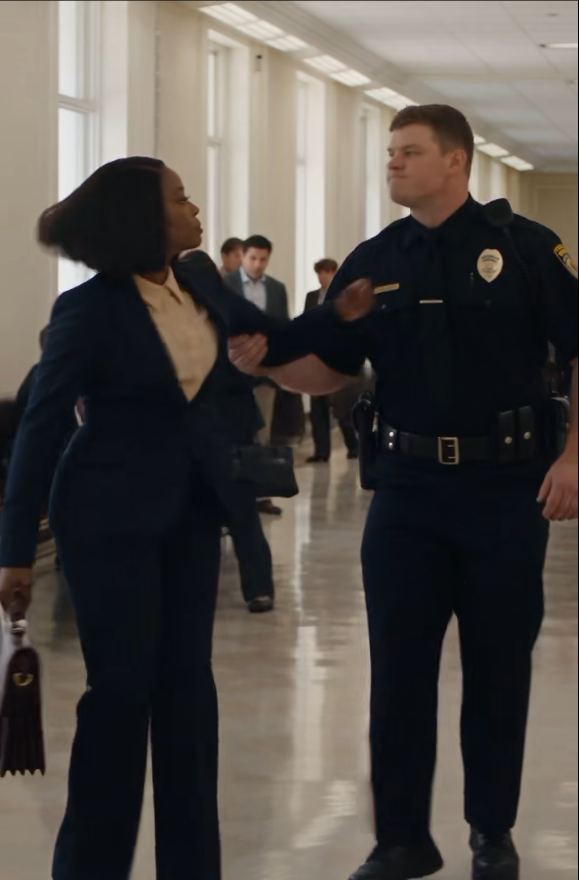
Authority had once filled the space around him.
Now he was a man in a dark suit at a defense table.
No uniform.
No badge.
No duty belt.
I reminded myself that this did not make him less entitled to fairness.
That was not generosity.
It was the point.
I took the oath.
Sat.
The prosecutor began simply.
“State your name.”
“Josephine Caldwell.”
“Occupation?”
“Superior Court judge.”
“How long?”
“Just over three years.”
“And before that?”
“Public defender for fifteen years.”
He walked me through the morning.
The elevator.
The hallway.
Miller calling after me.
His accusation.
My name.
His disbelief.
The grip.
My attempt to remove his hand.
The slap.
Thomas arriving.
The prosecutor did not ask how I felt.
I was grateful.
Then he played the hallway surveillance video.
Watching myself get hit was different from remembering it.
Memory contains sensation.
Video contains distance.
I watched a woman in a charcoal suit step around a uniformed officer.
I watched him seize her arm.
I watched her turn.
I watched the hand move.
Fast.
Efficient.
Almost casual.
The prosecutor paused the video.
“What happened there?”
“He slapped me.”
“Did you strike Officer Miller before that?”
“No.”
“Did you threaten him?”
“No.”
“Did you tell him your identity?”
“Yes.”
“How many times?”
“Once by name and once by explaining where my chambers were.”
“Did he believe you?”
“No.”
The prosecutor returned to his table.
“No further questions.”
Miller’s attorney rose.
He was experienced.
Calm.
That made him more dangerous than someone theatrical.
“Judge Caldwell.”
“Yes.”
“You were a criminal defense attorney for fifteen years?”
“A public defender.”
“So you are familiar with police-citizen encounters.”
“Yes.”
“You’re familiar with the fact that officers sometimes have to make rapid decisions.”
“Yes.”
“And citizens sometimes disagree with those decisions.”
“Yes.”
He walked toward the screen.
“When Officer Miller asked for identification, you refused.”
“Yes.”
“Even though you had identification available.”
“Yes.”
“So there was a simple method by which you could have corrected the misunderstanding.”
“There were several.”
He stopped.
“Please answer my question.”
“I did.”
The visiting judge looked at me.
I knew that look.
The same one I gave argumentative witnesses.
I almost smiled.
Miller’s attorney continued.
“Showing identification would have established your identity, correct?”
“Most likely.”
“But you chose not to.”
“Correct.”
“Why?”
“Because he had no lawful basis to require it.”
“That wasn’t my question.”
“Yes, it was.”
The visiting judge said, “Judge Caldwell.”
A warning.
I nodded.
Miller’s attorney let the silence work.
Then he said, “You were offended.”
“I was concerned about the legality of the detention.”
“You were offended.”
“I was also offended.”
“Thank you.”
He walked a few steps.
“You believed Officer Miller was treating you like a criminal.”
“He told me I was a defendant.”
“And that angered you.”
“Yes.”
“So when he attempted to control the situation physically, you pulled away.”
“When he grabbed me, I pulled my arm back.”
“You resisted.”
“I withdrew my arm.”
“Those are different words for the same physical action, aren’t they?”
“No.”
He glanced toward the judge.
“Your Honor—”
The judge said, “Move on.”
Miller’s attorney turned back.
“You then knocked Officer Miller’s wrist away.”
“Yes.”
“So you did make physical contact.”
“Yes.”
“Before the slap.”
“Yes.”
He let that sit.
“Judge Caldwell, you testified that Officer Miller said, ‘You people always think you can argue your way out of everything.’”
“Yes.”
“You interpreted that racially.”
“I testified to the words he used.”
“Did you interpret them racially?”
The prosecutor stood.
“Relevance.”
“Goes to perception and bias of the witness.”
The judge considered.
“Limited. You may answer.”
I looked at Miller’s attorney.
“At the time, I understood him to be referring either to defendants or to people he believed belonged in that category. Since he had specifically identified me as a Black female defendant, race was part of the context whether he intended the phrase racially or not.”
His attorney nodded.
“Very carefully phrased.”
“I’m under oath.”
A faint stir moved through the gallery.
The judge looked up.
Silence returned.
The attorney changed direction.
“You said Officer Miller laughed when you identified yourself as a judge.”
“Yes.”
“Is it possible he believed you were trying to deceive him?”
“He apparently did.”
“So his disbelief was not necessarily about your race.”
“I cannot testify to his private motive.”
“Exactly.”
“Yes.”
For the first time, he seemed mildly annoyed.
He moved closer.
“When Senior Bailiff Gallagher called you ‘Your Honor,’ Officer Miller immediately stopped using force.”
“Yes.”
“So when your identity was confirmed, he responded appropriately.”
I looked at him.
“No.”
He paused.
“No?”
“He stopped committing the act.”
“Judge—”
“Stopping after learning the person you hit has institutional power is not the same as having acted appropriately.”
The prosecutor stood.
The defense attorney said, “Nonresponsive.”
The visiting judge looked at me.
“Judge Caldwell, answer only the question.”
I nodded.
“Yes, Your Honor.”
Miller’s attorney waited.
He had gotten what he wanted.
A flash of anger.
Not much.
Enough to show I had one.
Good lawyers do not need to destroy a witness.
They need only make the witness human.
He continued.
“You have since become publicly associated with criticism of Officer Miller.”
“I have not made public statements about his guilt.”
“You cooperated with internal affairs.”
“Yes.”
“With prosecutors.”
“Yes.”
“You provided information leading to review of his previous cases.”
“No.”
He stopped.
“No?”
“I did not provide information about his previous cases.”
“Did you request a list of his appearances in your courtroom?”
“Yes.”
“Why?”
“To determine potential conflicts.”
“Did that occur before the department expanded its investigation?”
“I don’t know.”
“Were you concerned about his prior conduct?”
“After learning he was the officer involved in Ms. Reynolds’s pending suppression motion, yes.”
“So you began looking backward.”
“I identified cases in which I might need to consider recusal.”
“Eleven cases.”
“Yes.”
“That sounds like an investigation.”
“It was not.”
“Because you call it something else?”
“Because I did not review evidence, interview witnesses, make findings, or provide the list to investigators.”
He looked at his notes.
“Did you feel responsible for not recognizing Officer Miller’s alleged pattern sooner?”
The question hit harder than I expected.
The prosecutor objected.
“Relevance.”
The defense attorney said, “Bias.”
The judge thought.
“Overruled, within limits.”
Miller’s attorney faced me.
“Did you feel responsible?”
I could have answered no.
It would have been defensible.
I had not supervised Miller.
I had not received complaints about him as an administrator.
I had not been presented with evidence establishing misconduct.
But the oath mattered.
“Yes.”
His expression changed slightly.
“How?”
I looked at Miller.
For the first time all morning, he looked directly back.
“I wondered whether there had been things I failed to notice.”
The attorney stepped closer.
“And that guilt affected how you viewed what happened to you.”
“No.”
“How can you know?”
“Because what happened to me was recorded.”
He stopped.
I continued before he could object.
“And because I was there.”
The prosecutor stood.
The judge said, “The answer may stand.”
Miller’s attorney returned to his table.
“One final question.”
He picked up a document.