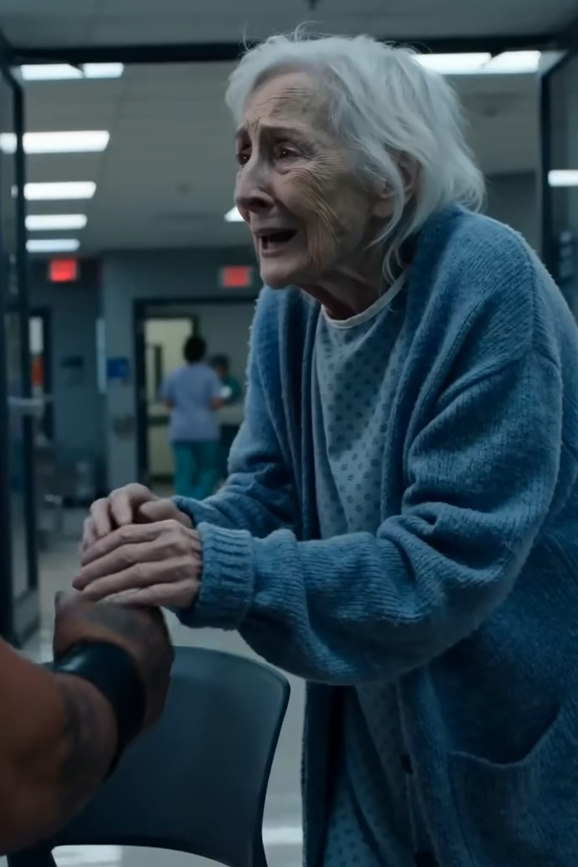
A nurse moved closer, her badge bouncing slightly against her chest.
“Mrs Higgins,” she said gently, “we discussed this earlier.”
Margaret’s mouth tightened.
“You discussed it at me,” she said.
The nurse hesitated.
“You told me what you thought I should want,” Margaret said.
“You did not listen to what I did want.”
Brick felt something in his chest shift.
The old woman had been quiet before.
Now her voice carried just enough steel to fill the silence.
The resident flipped through the chart.
“We cannot authorize an AMA discharge without the attending physician.”
“Then get him,” Brick said.
“The attending is on call.”
“Good.”
Brick crossed his arms.
“Call him.”
The resident looked toward the hallway.
“He may not be immediately available.”
Brick lowered his chin.
“I got all night.”
Then he glanced at Margaret, whose breath was already coming thin and uneven.
“But she doesn’t.”
The resident’s fingers tightened around the chart.
“So I suggest you start moving your feet.”
Fifteen minutes passed like an hour.
Margaret sat in a wheelchair while Brick stood beside her with his arms folded, a wall of leather and menace planted in front of the nurses station.
Nobody asked him to move.
Nobody asked about his patches again.
The resident disappeared twice and returned paler each time.
Nurses passed behind the counter pretending not to watch.
A security guard appeared near the far doors, took one look at Brick, then found a sudden interest in the vending machine alcove.
Margaret sat with her hands folded on her lap.
The blue cardigan slid down one narrow shoulder.
Brick reached down and pulled it back up without looking at her.
She looked up at him.
That was the first time he saw gratitude in her eyes.
Not the kind that asked for pity.
The kind that recognizes protection.
At 3:00 in the morning, the senior attending finally arrived.
He came fast, coat unbuttoned, gray hair neatly combed, jaw set in the hard line of a man accustomed to winning arguments before they began.
He carried the scent of authority with him.
Expensive soap.
Coffee.
Impatience.
His eyes moved from Margaret to Brick.
They sharpened when they landed on the vest.
“Who are you?”
Brick did not move.
“David Higgins.”
“Relation?”
“Grandson.”
The attending’s mouth pinched.
“Mrs Higgins has not listed a grandson as an active emergency contact.”
“Then your paperwork is behind.”
The doctor’s eyes hardened.
Brick’s expression did not change.
The attending turned to Margaret.
“Mrs Higgins, you are in acute decompensated heart failure.”
“I know.”
“You are retaining fluid.”
“I know.”
“Your oxygen saturation has been unstable.”
“I know.”
“If you leave tonight, you are almost certainly choosing death.”
Margaret held his gaze.
“I was not confused the first four times you told me.”
The hallway went still.
The doctor’s nostrils flared.
Brick almost smiled.
Almost.
The attending lowered his voice.
“This hospital has an ethical responsibility to protect vulnerable patients from decisions made under distress.”
Margaret’s fingers tightened on the wheelchair arms.
“I am not asking you to protect me from distress,” she said.
“I am asking you to stop protecting me from my own home.”
The doctor glanced at Brick again.
“Sir, I need to make certain no coercion is occurring here.”
Brick tilted his head.
“You think I’m forcing her to leave?”
“I am saying the situation is unusual.”
“No,” Brick said.
“It is inconvenient.”
The doctor’s jaw clicked.
“Those are not the same thing.”
Brick stepped closer to the counter.
The resident behind it stopped breathing for a second.
“I watched my brother get dragged under a car tonight,” Brick said.
His voice went colder, quieter.
“I know what force looks like.”
He looked at Margaret.
“This woman walked up to me and asked for help because nobody else would listen.”
Then he looked back at the doctor.
“You can dress that up however you want, but it ain’t confusion.”
The attending said nothing.
Brick let the silence work.
He had spent years learning that silence frightened people more than shouting.
Shouting gave them something to push against.
Silence made them imagine what might happen next.
The doctor turned back to Margaret.
“Do you understand that refusing treatment may result in death tonight?”
“Yes.”
“Do you understand that medical intervention could extend your life?”
Margaret looked tired suddenly.
Not uncertain.
Just tired of repeating her own will to people paid to hear it.
“Extend it into what?” she asked.
The doctor paused.
“A hospital bed?”
She swallowed hard.
“A tube?”
Her voice thinned.
“A ceiling tile I have never seen before?”
Brick saw the nurse look down.
“My husband died under a hospital ceiling,” Margaret said.
“Arthur watched a clock for three days because there was nothing else in the room that belonged to him.”
She shook her head.
“I will not do that.”
The attending looked as though he wanted to argue.
Maybe he had good reasons.
Maybe he had legal fears.
Maybe he had seen people panic and then regret it.
Maybe he had built his whole life around keeping bodies breathing because that was the only victory medicine could promise.
But Margaret was beyond victory.
She was asking for ownership of the end.
Finally, the doctor exhaled sharply.
He turned, marched to a printer, and pulled several pages from the tray.
The paper was warm when he slapped it onto a clipboard.
“Against medical advice discharge,” he said.
His voice was clipped.
“If you sign, you acknowledge that leaving may result in severe harm or death.”
Margaret reached for the pen.
Her hand trembled too violently to grip it.
The attending looked at Brick.
Brick took the cheap plastic pen.
“You are making a fatal mistake,” the doctor said.
Brick looked at Margaret.
She looked back at him, small, exhausted, and entirely clear.
“No,” Brick said.
“She is making a choice.”
He bent over the clipboard and signed the name she had given him.
David Higgins.
The letters came out jagged and ugly.
He pushed the clipboard back.
“Something you people seem to forget she’s allowed to do.”
No one answered.
Hospital policy dictated that Margaret had to be wheeled out.
An orderly arrived with a wheelchair, saw Brick take the handles, and wisely let him.
The rubber wheels squeaked down the long corridor.
Every sound seemed too loud.
The faint beeping from distant rooms.
The whisper of nurses.
The flap of papers on a clipboard.
Margaret sat very straight in the chair, both hands folded over one another, as if she were leaving a church service instead of walking away from machines that could keep her alive another day.
Brick pushed her slowly.
He did not know why he was careful.
He was not a careful man.
He had broken noses in parking lots.
He had kicked in doors.
He had ridden through sleet with no visor and laughed about it.
But with his hands on the wheelchair handles, he moved like the whole world might crack if he went too fast.
At the elevators, Margaret lifted her head.
“Are you afraid?”
Brick looked down at her.
“Of what?”
“Being caught.”
The elevator doors slid open.