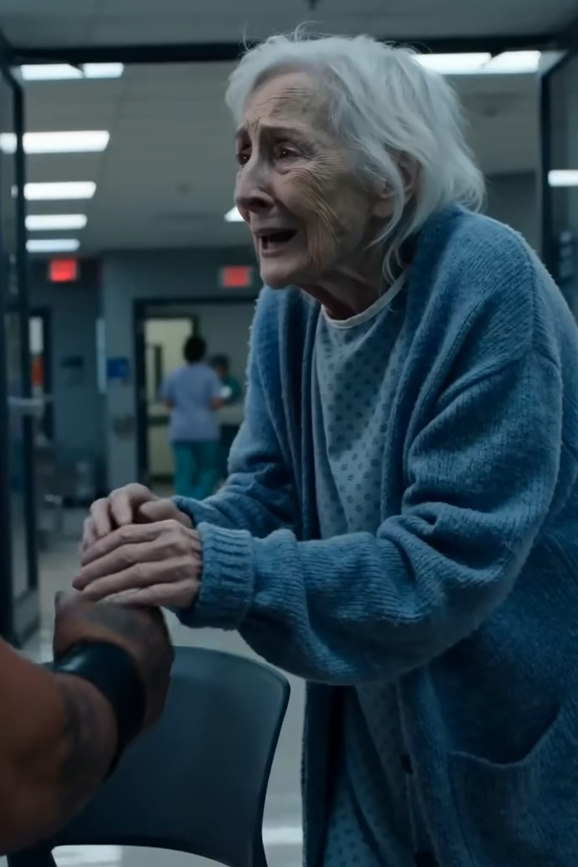
Brick wheeled her in.
“I have been caught plenty.”
The doors closed.
Margaret gave a weak laugh that turned into a cough.
It rattled deep in her chest.
Brick’s hand tightened around the chair.
“Don’t do that,” he said.
“Don’t do what?”
“Sound like you’re about to die in the elevator.”
She smiled faintly.
“I will do my best.”
He looked at the numbers descending above the door.
Fourth floor.
Third.
Second.
First.
The elevator opened into the lobby.
At that hour, it felt abandoned.
The security desk stood under a cone of yellow light.
A man in uniform watched them pass but did not speak.
Maybe he had been told.
Maybe he had decided a dying old woman and a Hell’s Angel were above his pay grade.
The automatic glass doors parted.
Cool, damp night air rushed in.
The smell hit Brick like mercy.
Diesel exhaust.
Wet asphalt.
Rain waiting in the clouds.
City trash.
Real air.
Anything was better than bleach and plastic.
Margaret took one breath and closed her eyes.
For a second, she looked almost alive again.
Brick stopped the wheelchair under the overhang.
“Thank you,” she whispered.
“Don’t thank me yet.”
He scanned the dark driveway.
“How are you getting home?”
“I thought I would call a taxi.”
Brick pulled out his phone.
The cracked screen glowed 3:15 a.m.
In that part of the city, at that hour, a taxi would take an hour if it came at all.
He looked across the parking lot.
His Harley-Davidson Road Glide sat under a flickering streetlight, blacked out and enormous, like a sleeping animal.
Margaret followed his gaze.
The smallest smile pulled at the corner of her mouth.
“You ever been on a motorcycle, Margaret?”
“Not since 1968.”
Brick looked at her hospital slippers.
Then at the bike.
Then at the empty road beyond the lot.
“Well,” he said, “your chariot awaits.”
It took almost ten minutes to cross the parking lot.
Brick walked at a pace that would have annoyed him on any other night.
Margaret leaned against him, her fingers hooked around his forearm.
Her weight was almost nothing, but every step cost her.
The pavement shone under the streetlights.
A cold mist hung in the air.
Somewhere in the distance, a siren rose and fell, then faded.
When they reached the bike, Brick opened the hard saddlebag and pulled out his spare helmet.
It was far too big.
When he placed it on Margaret’s head, it swallowed her white hair and made her look even smaller.
He fastened the strap with careful fingers.
“Too tight?”
“No.”
“Don’t lie.”
“It’s tight enough.”
“Hold on to me,” he said.
“I mean it.”
She looked up at him through the helmet visor.
“I heard you.”
He lifted her onto the passenger seat as if she were made of twigs.
Then he swung one heavy leg over the saddle and turned the ignition.
The engine roared awake.
The sound rolled across the parking lot, deep and guttural, shaking water from the chrome and sending a pulse through the night.
Margaret flinched, then laughed.
It was not loud.
It was not young.
But it was real.
Brick looked over his shoulder.
“Where to?”
She gave him an address on the east edge of the city, in an old neighborhood built before the interstate split it apart and left it to age in the exhaust.
Brick nodded.
He dropped the bike into first gear and eased forward.
He did not ride the way he usually rode.
There was no speed.
No arrogance.
No slicing through lanes like the rules were suggestions written for smaller men.
He kept the Harley under forty.
He took turns wide and smooth.
He avoided potholes like they were land mines.
All the while, Margaret’s weak arms circled his waist.
Her helmet rested between his shoulder blades.
He could feel the fragile tap of her breath through his back.
The city slid past them in dark pieces.
Closed gas stations.
Liquor store signs.
Red lights blinking over empty intersections.
Rows of sleeping houses.
A stray dog trotting through an alley with something in its mouth.
Brick had ridden those streets drunk, angry, laughing, hunted, free, and broken.
He had never ridden them like this.
With a dying grandmother who was not his grandmother holding on to him as though he were the last handrail in the world.
The cold air tore at his beard.
It slid under his vest and through the damp patches of blood on his shirt.
He should have been thinking about Jackson.
He should have been thinking about the cops if the hospital called.
He should have been thinking about his outstanding warrants.
Instead, he thought about the old woman’s words.
I want to die in my own bed.
It was such a small demand.
A bed.
A ceiling.
Dust.
The things most people hated about their homes until they were about to lose them forever.
Brick had never had a house he missed.
He had garages.
Clubhouses.
Motel rooms.
Cells.
Rented rooms with stains on the curtains.
A mother’s apartment he had left at seventeen and never returned to.
Home had always been a person or a bike or a patch on his back.
For Margaret, home was a destination.
For Brick, it had always been a moving target.
They turned onto a quiet street lined with old maples and cracked sidewalks.
The houses were small, single-story places built in a time when working people believed a front porch and a patch of lawn meant they had made it.
Most were dark.
One had a porch light glowing weakly.
Another had a collapsed chain-link gate.
Margaret lifted one trembling hand and pointed.
“There.”
Brick pulled up beside a little house with peeling paint and an overgrown yard.
The mailbox leaned crookedly by the curb.
Weeds pushed through the walkway.
The windows were dark.
The front porch sagged slightly in the middle.
It looked like a place that had been slowly forgotten, not all at once, but day after day until neglect became its own kind of weather.
Brick killed the engine.
The sudden silence felt enormous.
He climbed off and lifted Margaret down.
When he removed the helmet, her white hair stood up in a wild static halo.
Her face was pale, almost gray, but her eyes seemed brighter than they had in the hospital.
“We’re here,” Brick said.
Margaret looked at the house.
She did not move.
For a long moment, she only stared at the peeling front door.
Brick waited.
The mist settled on his beard.
“You know,” Margaret said quietly, “I lied to you.”
Brick leaned one hip against the Harley.
“About what?”
“My grandson.”
Her voice fell around the word.
“David.”
Brick did not interrupt.
“He didn’t change his number.”
A car hissed by on the next block.
“He died three years ago.”
Brick’s face stayed still, but something inside him braced.
“Heroin,” Margaret whispered.
The word hung between them, ugly and final.
Brick looked at the old house, at the dark windows, at the weeds swallowing the path.
He understood then why the name David had sounded less like a lie and more like a prayer.