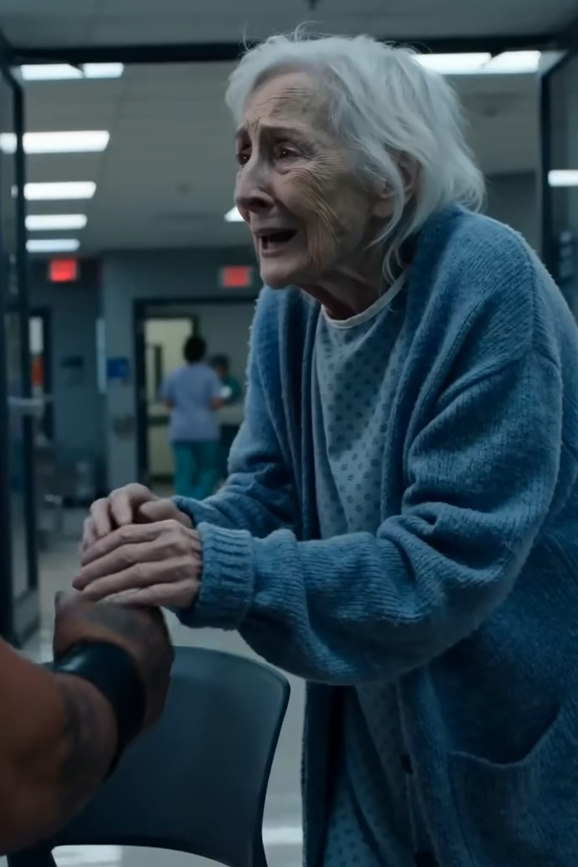
Margaret’s mouth trembled.
This time, she could not stop it.
“I couldn’t stand the thought of dying in that hospital knowing I was the last one left.”
A tear slid down her cheek.
It cut a clean line through the dust and cold mist on her skin.
“I just wanted someone to pretend.”
She swallowed.
“Just for a little while.”
Her voice broke at last.
“That I still had family.”
Brick did not know what to do with grief when it came without anger.
Anger he could hold.
Anger he could throw.
Anger had a shape.
This was different.
This was a woman standing in front of a lonely house with death in her lungs, asking the universe for one final mercy and apologizing for how she had obtained it.
Brick reached out.
His hand was huge against her shoulder.
Scarred.
Ringed.
Calloused.
Gentle.
“You got family tonight, Margaret,” he said.
Her eyes closed.
Just for a moment.
Then she nodded.
Brick looked toward the house.
“Come on.”
He took her arm.
“Let’s get you inside.”
The front porch boards complained beneath his boots.
Margaret reached into the pocket of her cardigan with shaking fingers and pulled out a key tied to a faded ribbon.
She tried to fit it into the lock.
Missed.
Tried again.
Missed again.
Brick took the key from her hand.
He did not say anything.
The lock turned with a dry scrape.
The front door opened on hinges that shrieked as though no one had crossed the threshold in years.
The smell inside was heavy.
Dust.
Old lavender.
Closed curtains.
Cold furniture.
Time.
Brick flipped the light switch.
A weak yellow lamp in the living room came on, revealing a house trapped in another decade.
Floral couches covered in plastic.
A dark wood coffee table with water rings.
A cabinet full of porcelain birds.
A clock on the wall stopped at 7:12.
Framed photographs lined nearly every surface.
A wedding photo of a young woman with bright eyes and a man in a steelworker’s suit.
A little girl missing both front teeth.
A teenage boy in a baseball uniform.
The same boy older, thinner, hollow-eyed, trying to smile.
Brick looked away.
Margaret saw that he had noticed.
“That was David,” she said.
Brick only nodded.
Her breath grew louder in the small room.
The wet click in her lungs echoed against the quiet furniture.
“My bedroom is down the hall,” she said.
“First door on the right.”
She tried to walk.
Her knees nearly folded.
Brick caught her before she hit the wall.
“Enough of that,” he muttered.
He put one arm behind her back and the other under her knees.
She weighed less than his bedroll.
“You’re very bossy for a fake grandson,” she murmured.
“Yeah.”
He carried her down the narrow hallway.
The walls were lined with more photographs.
Christmas mornings.
Birthday cakes.
A man holding a fishing rod.
A girl in a graduation gown.
A boy on a bicycle.
A family becoming smaller frame by frame.
At the first door on the right, Brick pushed the door open with his boot.
The bedroom was small and neat.
A heavy wooden bed took up most of the space, covered by a meticulously stitched patchwork quilt.
The quilt was faded but clean.
Each square seemed made from a different piece of a life.
A man’s work shirt.
A floral dress.
A child’s cotton print.
A piece of blue fabric that reminded Brick of her cardigan.
There was a nightstand with a lamp, a Bible, a tin of cough drops, and a framed photograph of Margaret and Arthur on what looked like their fortieth anniversary.
Brick lowered her onto the bed.
She made a sound that was half sigh, half surrender.
He pulled off the hospital slippers and set them carefully beside the nightstand.
Then he lifted her legs and eased them under the quilt.
The room was quiet except for her breathing.
It was worse now.
A wet, clicking rasp.
Brick stood at the side of the bed, suddenly useless.
He could face three drunk men with bottles in a bar parking lot.
He could rebuild an engine with bleeding knuckles.
He could ride all night with police lights behind him and never look back.
But he did not know how to care for a dying old woman in a bedroom that smelled like lavender and grief.
“Can I get you anything?”
The question sounded too small for him.
Margaret closed her eyes.
“A glass of water.”
“Tap?”
“Tap is fine.”
Brick walked back down the hallway.
In the kitchen, the overhead light flickered before catching.
The sink was clean and dry.
A dish towel hung folded over the oven handle.
Magnets covered the refrigerator, holding yellowed grocery lists, an old church calendar, and a child’s drawing so faded it had become mostly blue lines.
He found a glass in the cupboard.
It was one of those old heavy glasses with flowers etched into the sides.
He ran the tap until the water went cold.
For reasons he could not explain, he rinsed the glass twice before filling it.
When he returned, Margaret was staring at the ceiling.
He slid one arm behind her shoulders and held the glass to her lips.
She took two tiny sips.
A drop of water trembled on her chin.
Brick wiped it away with his thumb before he thought about it.
“Thank you, David,” she whispered.
The name struck him differently inside that room.
At the hospital, it had been a lie.
At the doorway, it had been a confession.
Now it was something else.
A role.
A gift.
A burden.
Brick set the glass on the nightstand.
He stepped back.
His job was done.
He had gotten her out.
He had brought her home.
Jackson would be waking soon.
The club would be looking for him.
The world outside this room still existed with all its noise, danger, loyalty, and rules.
Brick looked at the armchair in the corner.
Its arms were worn thin where someone had rested hands for years.
Probably Arthur.
Maybe Margaret, sitting awake after he died.
Maybe David when he was still a boy.
Brick walked over, grabbed the chair with one hand, and dragged it closer to the bed.
The legs scraped softly across the floor.
Then he sat down.
The chair groaned under him, but held.
He pulled out his phone.
There was one unread message from the club sergeant-at-arms.
Brick opened it.
Out of surgery.
Stabilized.
Docs say Crow will pull through.
Brick stared at the screen.
Crow was Jackson’s road name.
For the first time since the crash, he exhaled fully.
The breath seemed to come from somewhere below his ribs.
“He’s going to make it,” Brick muttered.
Margaret opened one eye.
“Your friend?”
“My brother.”
She studied him.
“Road captain got hit by a kid not paying attention.”
“I’m glad he’s safe,” she said.
Brick slipped the phone back into his pocket.
“So am I.”
For a while, neither of them spoke.
Rain began around 5:00 in the morning.
It tapped softly against the bedroom window, then gathered rhythm, then became a hush around the house.