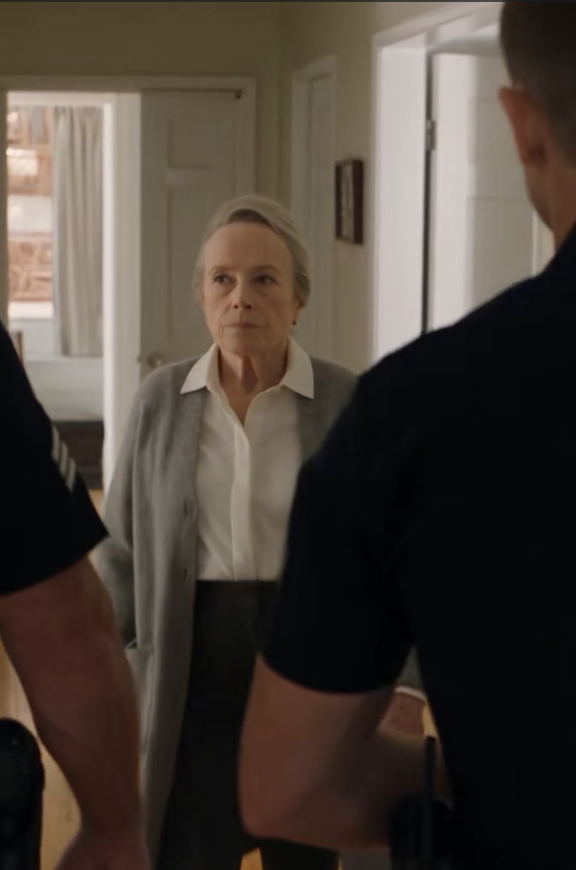
Keene said, “Thank you.”
Then another agent entered from the porch carrying a tablet.
“Special Agent Keene.”
She took it.
Her eyes moved across the screen.
Something in her face became more focused.
“What?”
The agent glanced toward the officers.
Keene stepped closer to Eleanor and lowered her voice.
“We checked department dispatch.”
“And?”
“There’s no call to this address.”
Eleanor looked toward Danner.
Danner’s jaw tightened.
Keene continued.
“No complaint. No theft report linked to the residence. No recorded supervisor authorization. Their unit was marked unavailable for administrative duty beginning forty minutes before they arrived.”
Eleanor felt no satisfaction.
Only clarity.
Danner had not made a legal mistake.
He had built a window of time in which no one was supposed to know where he was.
Keene turned.
“Sergeant Danner.”
He looked at her.
“Where is the stolen-laptop report?”
His reply came slower now.
“We got information off-book.”
“From whom?”
“Confidential source.”
“What was the source number?”
“That stays with our unit.”
“We already pulled your registered source logs.”
Danner’s silence lasted a fraction too long.
Keene’s voice hardened.
“You didn’t come here for a laptop.”
Lyle looked at him.
“Sergeant?”
Danner ignored him.
Parker’s breathing changed.
Keene stepped closer.
“What were you looking for?”
Danner looked at Eleanor.
And Eleanor saw the calculation begin again.
Not panic.
Danner was not panicking.
He was choosing.
That frightened her more.
He said, “Ask your precious former judge.”
Keene’s gaze narrowed.
Danner gave Eleanor a thin smile.
“She knows exactly what this is about.”
Eleanor held his eyes.
“No,” she said. “But I’m beginning to understand.”
Danner’s smile faded.
Keene motioned to two agents.
“Separate them.”
As they moved, Parker finally spoke.
“I want counsel.”
Keene nodded.
“You’ll have the opportunity.”
Lyle looked toward Parker, then Danner.
“Wait.”
Nobody stopped.
Lyle’s voice rose.
“Wait, I didn’t know.”
Keene looked at him.
“Know what?”
Lyle stared at Danner.
The sergeant’s face remained blank.
Lyle’s confidence collapsed so quickly Eleanor could almost see the moment instinct overran loyalty.
“You said we had consent.”
Danner turned toward him.
“No, I didn’t.”
“Yes, you did.”
“Officer, stop talking.”
“You said she’d already agreed to let us—”
“Stop talking.”
Lyle did.
But too late.
Keene looked from one to the other.
Eleanor looked at Parker.
His face had gone very pale.
He said nothing.
That silence was different from the officers’ silence when they first entered her house.
This silence had fear inside it.
Keene led Danner outside.
Before he passed Eleanor, he slowed.
For the first time since entering, he spoke only for her.
“You should’ve left it alone.”
Keene immediately stepped between them.
“What did you say?”
Danner’s eyes stayed on Eleanor.
“Nothing.”
But Eleanor had heard him clearly.
So had Parker.
And from the way the young officer looked at his sergeant, Eleanor knew he had just understood something important.
Danner had not come to discover whether Eleanor possessed evidence.
He had come because he already knew she did.
That evening, Eleanor sat at her kitchen table with a fresh cup of tea she never drank.
The federal teams had left after nearly three hours.
Her house looked intact.
That almost made it worse.
The guest-room drawer had been returned to place. Cabinet doors were closed. The picture frames Lyle had picked up were exactly where they belonged.
A stranger entering by force was easy to understand.
Authority entering politely, leaving no broken lock behind, and insisting afterward that everything had been reasonable was harder.
Eleanor had spent a career examining those distinctions.
She had never expected to feel them in her own hallway.
Mara Keene sat across from her.
“You should stay somewhere else tonight.”
“No.”
“Mrs. Vale.”
“Eleanor.”
“Eleanor, until we know what Danner was looking for—”
“I know what he was looking for.”
Keene waited.
Eleanor rose and crossed the room.
She stopped in front of the framed photograph on the desk.
Her late husband, James, stood beside her in the picture, both of them younger by fifteen years. James was laughing at something outside the frame. Eleanor had always liked that the camera had caught him before he could compose himself.
She lifted the frame.
Behind it was nothing.
Keene watched.
Eleanor put it down again.
“He thought I still had Rebecca’s packet.”
“The altered affidavits.”
“Yes.”
“We took the originals into custody.”
“I know.”
“Then why search here?”
“Because he may not know what I gave you.”
Keene leaned back.
“Or he thought you kept copies.”
Eleanor turned.
“I did.”
Keene became still.
“You told Salazar you’d surrendered everything.”
“I surrendered everything Rebecca sent me.”
“That’s not what I asked.”
Eleanor looked at her.
“When I compared the affidavits, I made notes.”
Keene exhaled slowly.
“Where are they?”
“Safe.”
“Here?”
“No.”
“Who knows they exist?”
“Until this afternoon, I thought only I did.”
Keene stood.
“What exactly is in the notes?”
“Dates. Case numbers. language changes. Names of approving supervisors. Which version appeared in which proceeding. A pattern.”
“How many cases?”
“Eleven that I could confirm.”
Keene stared at her.
“Rebecca sent three.”
“I had access to public records.”
“You kept investigating on your own?”
“I read.”
“You understand that distinction isn’t as charming to me as it is to you.”
Eleanor almost smiled.
“Rafael says similar things.”
“Where are the notes?”
Eleanor looked at James’s photograph.
Then back at Keene.
“In a safe-deposit box.”
Keene’s shoulders loosened by a fraction.
“At which bank?”
“I’ll tell Salazar.”
“Why not me?”
“Because if Danner knew enough to come here, then information is leaking.”
Keene’s expression cooled.
“You think from the Bureau?”
“I think assumptions are expensive.”
Keene studied her.
Then, unexpectedly, nodded.
“Fair.”
Eleanor sat again.
“Was Danner arrested?”
“No.”
“Why?”
“Because an unlawful entry is serious, but the larger investigation matters more. We detained and interviewed them. Their department has been notified that all three are placed on administrative leave pending review.”
“And you let Danner leave.”
“Yes.”
“You want to see what he does.”
Keene said nothing.
Eleanor understood.
She looked toward the dark window.
Danner’s words returned.
You should’ve left it alone.
Not: You should have cooperated.
Not: You made a mistake.
Left it alone.
He knew.
“Agent Keene.”
“Yes?”
“There’s something else.”
Keene waited.
“When Danner entered, he never looked surprised by the house.”
“I don’t follow.”
“The others scanned the room. Lyle looked around as if he was orienting himself. Parker watched me. Danner looked down the hallway.”
“Meaning?”
“He knew the layout.”
Keene’s eyes narrowed.
Eleanor continued.
“My home’s floor plan isn’t public.”
“Real-estate listing?”
“I’ve owned it for thirty-two years.”
Keene’s gaze moved toward the hallway.
“Contractors?”
“Of course. Repairmen. Family. Friends.”
“Any police ever been inside?”
Eleanor thought.
Then stopped.
Four months earlier.
A welfare check.
Mr. Benton across the street had fallen while gardening. Eleanor had called emergency services. Two officers arrived. They had helped him, then one came to Eleanor’s house afterward to take her statement because she had seen the fall from her kitchen.