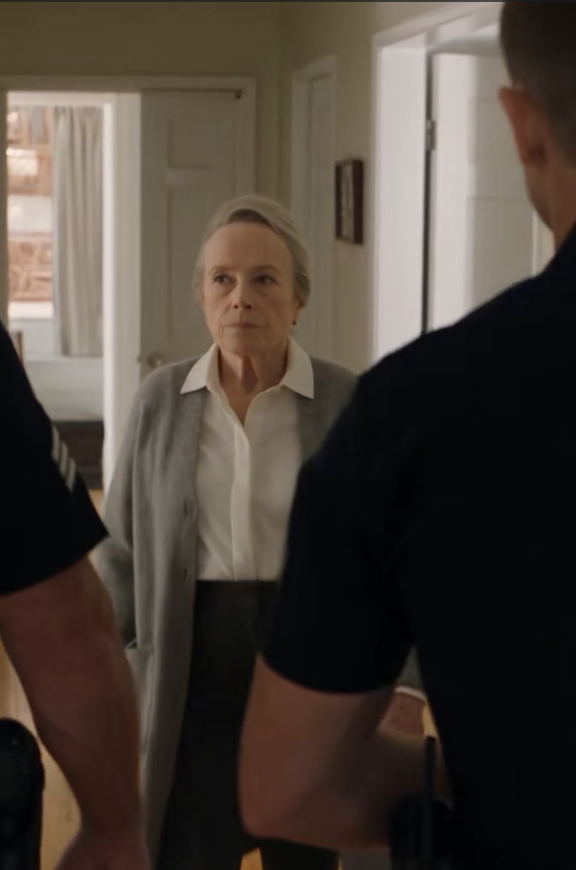
She remembered the officer’s face poorly.
But she remembered something else.
He had stood near the desk.
Looking down the hallway.
“What?” Keene asked.
Eleanor rose.
She walked toward the small drawer beneath the telephone table and removed an old notebook.
She flipped through pages.
Dates.
Repairs.
Appointments.
Numbers.
She found the entry.
May 14.
Officer statement re Benton fall — Sgt. Danner.
Keene read it.
Neither woman spoke for several seconds.
Then Keene took out her phone.
Eleanor said, “He’s been inside before.”
“Yes.”
“He knew where the back rooms were.”
“Yes.”
“And if he was here months before Rebecca contacted me…”
Keene finished it.
“Then this didn’t begin with the affidavits.”
Part III — The Pattern
Assistant Director Rafael Salazar arrived the next morning wearing the same charcoal suit Eleanor remembered from a dozen federal ceremonies and the same expression he used whenever facts had become worse overnight.
“You look terrible,” Eleanor told him.
“Good morning to you too.”
Mara Keene stood at the kitchen counter, coffee untouched.
Salazar sat across from Eleanor.
He had been a young federal prosecutor when Eleanor was still on the bench. She had once thrown out one of his cases after finding that a search exceeded the warrant’s scope.
He had thanked her six years later.
Not for the ruling.
For forcing him to learn why he had lost.
“What aren’t you telling me?” Eleanor asked.
Salazar glanced at Keene.
Keene said, “She knows about the prior visit.”
Salazar’s expression tightened.
“That was fast.”
“I keep notebooks.”
“So I’ve heard.”
Eleanor folded her hands.
“Rafael.”
He looked at her.
“What aren’t you telling me?”
Salazar leaned back.
“We reviewed Danner’s activity around the date of the welfare call.”
“And?”
“He wasn’t assigned to your neighborhood.”
Eleanor said nothing.
“He volunteered to assist after the primary officers cleared,” Salazar continued. “There was no operational reason for it.”
“Then why come here?”
“We don’t know.”
“You have a theory.”
“Yes.”
Eleanor waited.
Salazar looked toward the window before continuing.
“Rebecca Chen contacted someone else before she contacted you.”
“Who?”
“A former client.”
“Name?”
“I can’t give you that yet.”
“Why not?”
“He’s dead.”
Eleanor’s face remained still.
“When?”
“Three weeks before Rebecca mailed you the affidavits.”
Keene watched Eleanor carefully.
“What happened?”
Salazar said, “Officially? Overdose.”
“And unofficially?”
“He had complained that evidence in his case was planted during a search led by Danner’s unit.”
Eleanor sat back.
Salazar continued.
“He served fourteen months before the conviction was vacated for unrelated disclosure violations. After release, he started collecting information about the officers involved.”
“Then he contacted Rebecca.”
“Yes.”
“What did he give her?”
“We’re not sure.”
“What did Rebecca tell you?”
“She says the affidavits were all she received.”
“Do you believe her?”
“Yes.”
Eleanor caught the word choice.
“Then why are we sitting here?”
“Because Danner apparently believes there was more.”
Eleanor looked at Keene.
“The stolen laptop.”
Keene nodded.
Salazar said, “The dead man told his sister he had copied something from a police computer.”
“What?”
“He wouldn’t tell her. He said it was insurance.”
“And the laptop?”
“Never found.”
Eleanor looked toward the hallway.
Yesterday’s search rearranged itself in her mind.
They had opened drawers.
Examined photographs.
Looked at papers.
Moved toward the rear rooms.
A laptop was plausible.
But Danner had not searched like a man checking obvious places for electronics.
He had searched like a man looking for something small.
Documents.
A drive.
A key.
“What did he think Rebecca gave me?”
“That’s the question.”
Eleanor stared at Salazar.
“No. That’s your question.”
“What’s yours?”
“Why did he come to my house four months ago?”
Salazar’s mouth tightened.
“Eleanor—”
“Yesterday could have been desperation. May was preparation.”
“We agree.”
“Then he knew I mattered before Rebecca sent the documents.”
“Yes.”
“Which means either Rebecca was already under surveillance or I was.”
Salazar said nothing.
That was enough.
Eleanor’s eyes narrowed.
“You knew.”
“We had indications.”
“How long?”
“Two weeks.”
“You knew someone may have been watching me for two weeks and didn’t tell me?”
“We didn’t know who.”
“That is not an answer.”
“It’s exactly the answer.”
She stood.
Salazar did too.
“Sit down,” she said.
He blinked.
Keene looked away to hide what might have been amusement.
Salazar sat.
Eleanor remained standing.
“I spent twenty-eight years on the federal bench. I know the difference between protecting an investigation and protecting your own decisions from criticism.”
“That’s not what this is.”
“Then explain it better.”
Salazar rubbed a hand across his chin.
“We found repeated vehicle hits near your neighborhood from a license plate associated with a department pool car. No direct observation. No proof anyone watched you. We increased surveillance around your block.”
“That’s why your agents arrived so quickly.”
“Yes.”
“You were already nearby yesterday.”
“Yes.”
“How nearby?”
“Two streets.”
Eleanor stared.
“You watched them enter.”
“We saw their vehicle arrive. We couldn’t see the doorway.”
“And you waited for my text.”
“We needed to know whether the contact was voluntary.”
Eleanor understood the operational logic.
That did not mean she liked it.
“You used me.”
Salazar’s face changed.
“No.”
“You suspected Danner might come here. You put agents nearby. You waited.”
“We protected you.”
“You watched to see what he would do.”
Silence.
There it was.
Keene stepped in.
“We had no indication he would enter the house.”
“But you knew he might approach me.”
“Yes.”
Eleanor turned toward the window.
Mr. Benton was trimming dead roses across the street, unaware of federal surveillance, corrupted affidavits, or how many people had discussed this quiet block in secure conference rooms.
She said, “I want out.”
Salazar looked at her.
“Of the investigation?”
“Yes.”
Keene spoke carefully.
“You’re a witness.”
“I’ll comply with lawful requests. I’ll testify if subpoenaed. But no more informal cooperation. No more calls. No more private meetings in my kitchen.”
Salazar stood.
“Eleanor.”
“You should go.”
He did not move.
“What about your notes?”
“I’ll turn them over through counsel.”
“You don’t have counsel.”
“I know several.”
That almost made him smile.
It didn’t.
He nodded.
“All right.”
Keene gathered her things.
At the door, Salazar stopped.
“Danner knows something he shouldn’t.”
Eleanor looked at him.
“I’m aware.”
“If he contacts you—”
“I’ll call.”
“If you see anyone—”
“I’ll call.”
“If anything feels wrong—”
“Rafael.”
He stopped.
“I spent years telling frightened people that the law still mattered even when government officials failed to follow it. Yesterday, three officers entered my home without a warrant while federal agents waited two streets away to see what they would do.”
Salazar’s face tightened.
“I need a day where nobody with a badge tells me I should trust the process.”
He accepted that.
Then he left.
Keene stayed behind one moment.
“You’re right to be angry.”
Eleanor looked at her.
“I’m not angry.”
Keene raised an eyebrow.
“All right.”
“I’m disappointed.”
“That sounds worse.”
“It usually is.”
Keene reached for the door.
Eleanor said, “Agent Keene.”