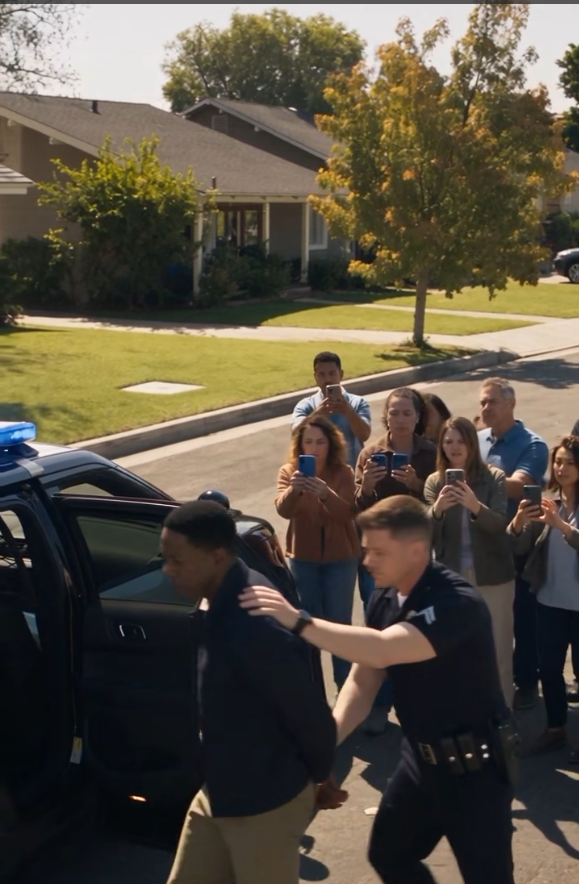
“I know that too.”
Marcus waited.
Torres looked toward the street before speaking.
“I came to tell you something before you hear it somewhere else.”
Kendra stepped closer.
“If it relates to Miller's employment record, don't.”
Torres's attention shifted to her.
“It relates to mine.”
That changed the room.
Marcus opened the door farther.
“Come in.”
Kendra immediately objected.
“Marcus.”
“She said hers.”
“That doesn't make this clean.”
“No, but leaving her on the porch in front of three news vans makes it worse.”
Torres entered.
They sat in the living room. Marcus remained in the armchair nearest the window. Kendra chose a straight-backed chair rather than the sofa, the posture of a lawyer determined not to become comfortable.
Torres remained standing.
“Sit,” Marcus said.
“I'd rather not.”
“All right.”
She took a breath.
“I recognized Officer Miller's behavior before I recognized you.”
Marcus said nothing.
Torres continued.
“He's had issues with escalation.”
Kendra lifted a hand.
“Stop.”
Torres did.
“If this is information that belongs in a personnel investigation, you cannot disclose it to Marcus.”
“I understand.”
“Then why are you here?”
Torres's mouth tightened.
“Because I supervised him.”
Kendra's expression remained neutral.
“So?”
“So yesterday wasn't the first time I told him to slow down.”
Marcus leaned back.
Kendra looked at him immediately.
He raised both hands slightly.
“I didn't ask.”
She turned back to Torres.
“What exactly do you need from him?”
Torres finally sat.
“Nothing.”
“Then what do you need to say?”
For several seconds, Torres looked at the floor.
“When I saw Mr. Reed in cuffs, I knew what was happening before I knew who he was. That's what I need to say.”
Marcus watched her.
“What was happening?”
Kendra turned sharply.
“Marcus.”
He nodded.
“Fair.”
Torres answered anyway.
“An officer had decided that compliance mattered more than the reason he was demanding it.”
Silence settled over the room.
Marcus knew the formulation.
He had used similar language in training seminars.
But Torres did not sound as though she were quoting him.
She sounded as though she had been arguing with herself.
Kendra closed the folder on her lap.
“Sergeant, if you believe you failed to document or address prior conduct, you need to report that through your department. And if the board later requests testimony, you answer there.”
“I already did.”
“This morning?”
“At five thirty.”
Marcus glanced at the clock.
Torres gave him a tired smile with no humor in it.
“I didn't sleep.”
Kendra's posture softened slightly.
“What did you report?”
Torres shook her head.
“You just told me not to tell him.”
“Good answer.”
Torres stood.
“I won't contact either of you again outside official channels.”
Marcus rose as well.
At the front door, Torres stopped.
“One thing that isn't confidential.”
Kendra waited.
Torres looked at Marcus.
“Miller's report says you repeatedly invoked your position with the board before he handcuffed you.”
Marcus did not move.
Kendra's eyes narrowed.
“He wrote that?”
Torres nodded.
Marcus recalled the exchange with exact clarity.
He had not told Miller where he worked.
He had not shown a credential.
He had not mentioned the board.
He had asked one question.
Are you sure you want to continue this?
Kendra spoke carefully.
“Sergeant, how do you know what his report says?”
“I reviewed it as his supervisor.”
“And?”
“I rejected it.”
Marcus looked at her.
Torres opened the door.
“I thought you should know why yesterday is going to get worse before it gets better.”
She left.
Kendra waited until the door closed.
Then she turned toward Marcus.
“You're still recused.”
“I know.”
“You look like you're about to drive to the office.”
“I have work.”
“Not that work.”
Marcus walked back toward the kitchen.
Kendra followed.
He stopped beside the counter.
“If he wrote that I used my position to influence him—”
“You don't get to finish that sentence.”
Marcus looked at her.
She held his gaze.
“That's exactly why recusal exists.”
He said nothing.
“You are not going to prove you're impartial by involving yourself more carefully. You're going to prove it by staying out.”
Marcus looked toward the dark tablet on the counter.
Somewhere online, millions of people had already decided what the story meant.
Powerful official gets handcuffed.
Officer discovers he's detained the wrong person.
Badge threatened.
Career over.
That was not the story Marcus had experienced.
The part that disturbed him most had happened before Miller knew anything about his job.
And if Torres was right, the part that might matter most had been written afterward.
Marcus picked up the tablet, turned it over, and left it facedown.
“Send the recusal notice.”
Kendra nodded.
“For everything?”
“For everything involving Miller.”
She studied him.
“And Richmond's reporting practices if they become part of the case?”
Marcus hesitated.
That hesitation told both of them something.
Kendra waited.
Finally Marcus said, “We'll decide that if we get there.”
“No.”
He looked up.
“We decide it now.”
“Kendra—”
“If the Miller inquiry shows a broader reporting problem, you will be personally connected to the discovery. The same conflict applies.”
Marcus knew she was right.
He disliked her more when she was right in his own kitchen.
“Fine.”
“Say it.”
He almost laughed.
“Kendra.”
“Say it, Marcus.”
He looked directly at her.
“I recuse from any board matter arising out of my detention, including any systemic review triggered by evidence discovered through that matter.”
She nodded.
“I'll put it in writing.”
Marcus walked toward the window.
Outside, another news vehicle turned onto the street.
He watched it slow.
“Do me one favor.”
Kendra picked up her folder.
“What?”
“Don't call this the Miller case.”
“What should I call it?”
Marcus looked at the cruiser-shaped empty space along the curb where he had been detained the night before.
“The Reed matter.”
Kendra raised an eyebrow.
“You want your own name on it?”
“Yes.”
“Why?”
“Because if we're going to test whether the system works when the complainant has power, we shouldn't hide that power in the file name.”
Kendra considered him.
Then she nodded once.
“The Reed matter.”
Part III — Reversal
The body-camera footage reached the certification board two days later.
Marcus did not watch it.
That became harder than he expected.
Clips appeared everywhere. Television panels froze frames from Miller's camera. Former officers analyzed positioning, commands, phrasing, and tone. Lawyers argued over reasonable suspicion. Commentators who had never met Marcus assigned motives to his pauses.
Marcus turned down every interview request.
The board issued a three-sentence statement confirming his recusal.
Richmond opened an internal investigation.
Miller remained on leave.
And Kendra stopped discussing the case with Marcus entirely.
At work, they spoke about academy accreditation, firearms-instructor renewals, legislative budget language, rural recruitment shortages, and a dispute over continuing-education hours.
They did not speak about the man who had placed Marcus in handcuffs.
The silence became almost comical.
On the fourth afternoon, Marcus walked into Kendra's office carrying a stack of budget revisions.
She did not look up.
“If that is about Reed, take it out.”
“It's about overtime reimbursements.”
“Then sit.”
Marcus dropped into the chair opposite her desk.
For ten minutes they discussed numbers.
When they finished, Kendra closed the spreadsheet.
Marcus stood.
She said, “You're doing better than I expected.”