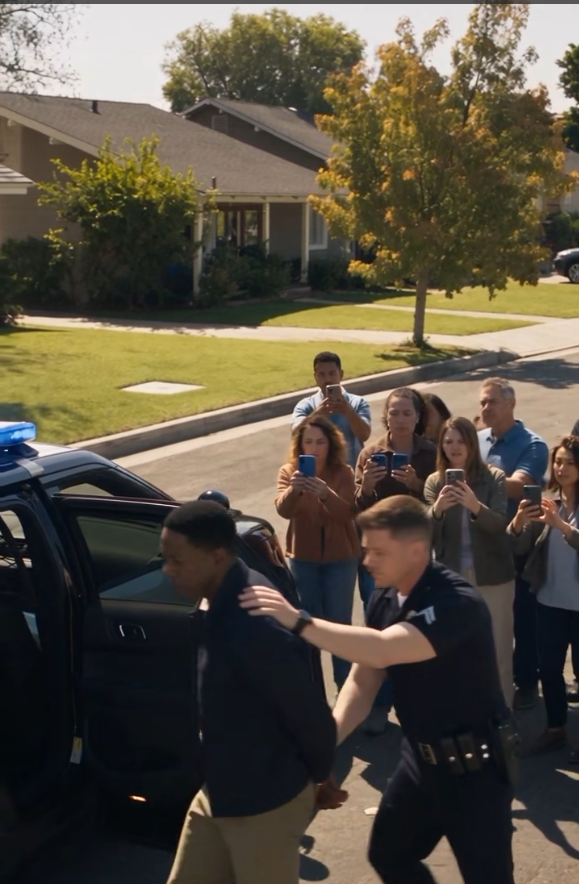
He stopped.
“At what?”
“Not asking.”
“I ask myself.”
“That doesn't violate the recusal policy.”
“I've checked.”
Kendra smiled.
Marcus reached the door.
“Is the process working?”
Her smile disappeared.
He turned.
“That's not asking what the evidence says.”
“It is asking for information about a matter from which you're recused.”
“Administrative status isn't evidence.”
“Marcus.”
He leaned against the doorframe.
“You enjoy this.”
“More than I should.”
He left.
That evening, Sergeant Torres sat in an interview room at Richmond Police headquarters with an internal-affairs investigator across from her.
A camera recorded from the ceiling.
The investigator placed a printed report between them.
“You rejected Officer Miller's first report?”
“Yes.”
“Why?”
“It contained statements inconsistent with what I heard on scene.”
“Which statements?”
Torres looked down at the document.
“He wrote that Mr. Reed repeatedly referenced his position with the Commonwealth certification board before being detained.”
“Did you hear Mr. Reed do that?”
“No.”
“Were you present before the detention?”
“No.”
“So how could you determine the statement was inaccurate?”
“I couldn't determine it was inaccurate. That's why I instructed him to verify it against body-camera footage before resubmitting.”
“Did he?”
“He changed the wording.”
The investigator slid a second page forward.
Torres read the revised line.
The detained subject made statements that Officer Miller interpreted as suggesting professional consequences if the detention continued.
The investigator asked, “Did you approve this?”
“No.”
“Why not?”
“Because interpretation is not a substitute for accurately describing what somebody said.”
The investigator sat back.
“What did Mr. Reed say?”
Torres knew the body-camera transcript almost by memory now.
“Officer, are you sure you want to continue this?”
“Anything else?”
“Not before Ms. Hayes arrived.”
The investigator tapped the report.
“Could that statement reasonably be interpreted as a threat to Officer Miller's career?”
Torres considered the question.
“It could be interpreted that way.”
The investigator waited.
Torres continued.
“If you already knew who Marcus Reed was.”
“And did Miller?”
“He says he didn't.”
“Do you believe him?”
Torres looked toward the camera mounted in the corner.
“I don't know.”
The investigator turned another page.
“Let's discuss the stop itself.”
Torres's shoulders tightened.
They went backward through the footage.
The vague call.
Miller's arrival.
Marcus identifying the SUV as his.
His license.
The request to search the vehicle.
Marcus declining.
Miller asking him to step toward the cruiser.
Marcus asking whether he was being detained.
The order to turn around.
The cuffs.
No physical resistance.
No attempt to leave.
No raised voice.
The investigator paused.
“Why was he detained?”
“Miller says he needed to complete the investigation.”
“Investigation of what?”
“A suspicious-person call.”
“What suspicious conduct had Miller personally observed?”
Torres looked down.
“None that I could identify from the footage.”
The investigator allowed the answer to sit.
Then he opened a different folder.
This one had nothing to do with Marcus Reed.
Torres recognized the cover immediately.
Her own memorandum.
Eight months earlier.
Miller had stopped a twenty-one-year-old college student after a convenience-store clerk mistakenly described him as someone who had left without paying. The student produced a receipt from another store. Miller continued questioning him for twelve minutes, then placed him in handcuffs after the young man repeatedly asked whether he was free to leave.
No force beyond the cuffing.
No arrest.
No formal complaint from the student.
Torres had reviewed Miller's camera after another officer mentioned the incident.
She had written a supervisory memorandum recommending remedial training.
The recommendation never became formal discipline.
The investigator looked at her.
“You wrote that Officer Miller showed a tendency to interpret questions about legal authority as challenges to personal authority.”
Torres nodded.
“Those were my words.”
“What happened?”
“He was counseled.”
“By you?”
“Yes.”
“Training?”
“Two hours with a field-training supervisor.”
“Was the incident reported to the state certification board?”
“No.”
“Why not?”
“It didn't meet our reporting threshold.”
The investigator slid a policy across the table.
“Whose interpretation was that?”
Torres did not answer immediately.
“Mine, initially.”
“Were you comfortable with it?”
“No.”
“Did you challenge it?”
“I asked my lieutenant.”
“And?”
“He agreed it was a performance issue rather than a certification issue.”
“Did you pursue it farther?”
“No.”
The investigator closed the folder.
“Why?”
Torres looked through the one-way glass even though she could not see what was behind it.
“Because nobody was injured. Nobody was charged. The officer received counseling. It was easy to call it handled.”
The investigator's voice stayed neutral.
“Was it handled?”
Torres thought of Marcus beside the cruiser.
“No.”
Three floors below, Miller sat in another interview room with his attorney.
He had watched his body-camera footage twice.
The first viewing made him angry.
The second made him quiet.
On video, his own voice sounded different from how he remembered it.
Sharper.
Less patient.
He had remembered Marcus as evasive. The footage showed a man answering questions in complete sentences.
He had remembered Marcus turning toward him abruptly. The camera showed Marcus moving slowly.
He had remembered the question—Are you sure you want to continue this?—as an unmistakable threat.
Without knowing Marcus's job, it sounded almost mundane.
Miller stared at the paused image.
His attorney pointed toward the monitor.
“They're going to ask why you cuffed him.”
“I know.”
“What's your answer?”
“Officer safety.”
“Based on what?”
Miller said nothing.
“Don't give me a phrase. Give me the fact.”
“He was near a vehicle that matched the location from the call.”
“His vehicle.”
“I didn't know that initially.”
“You had his license.”
Miller's jaw tightened.
His attorney leaned back.
“This gets worse if you defend every decision simply because you made it.”
Miller looked at him.
“You think I should say I screwed up.”
“I think you should decide what you actually believe before somebody puts you under oath.”
Miller pushed away from the table.
“They're going to take my certification.”
“Maybe.”
“Because he turned out to be Marcus Reed.”
“No.”
Miller looked at the screen again.
His attorney tapped the printed report.
“They may take it because this doesn't match that.”
Miller's attention moved toward the page.
The attorney continued.
“A bad detention can be a mistake. An inaccurate official report is a different problem.”
“I wrote what I believed.”
“Then be prepared to explain exactly why you believed it.”
Miller stared at Marcus's frozen image.
For the first time, he understood that the gold credential might be the least dangerous piece of evidence in the case.
The following week, Kendra received Richmond's complete mandatory disclosure packet.
She read it alone.
Miller's current incident.
Torres's memorandum from eight months earlier.
A second supervisory note from eleven months before that.
Then a third record.
Not a misconduct complaint.
A performance review.
The evaluator had written:
Officer Miller displays strong initiative but can become overly focused on gaining immediate verbal compliance during ambiguous encounters. Recommend continued emphasis on procedural articulation and de-escalation.
Kendra read the sentence twice.
Then she checked the board's reporting database.
Nothing.
She searched Miller's certification file.
Nothing.
She checked Richmond's quarterly disclosures.
Nothing.
The pattern was not hidden.
It had never reached them.
Kendra called the board's independent review chair, not Marcus.
By the next afternoon, the Reed matter had divided into two tracks.