“No.”
“Thank you.”
Torres's testimony lasted another forty minutes.
When she stepped down, she looked once toward Miller.
He did not meet her eyes.
Marcus testified next.
He entered through the public door.
The panel chair reminded him that his position with the board gave him no role in the proceeding.
Marcus answered, “Understood.”
Kendra approached the lectern.
For years they had sat beside each other during hearings.
Now she questioned him.
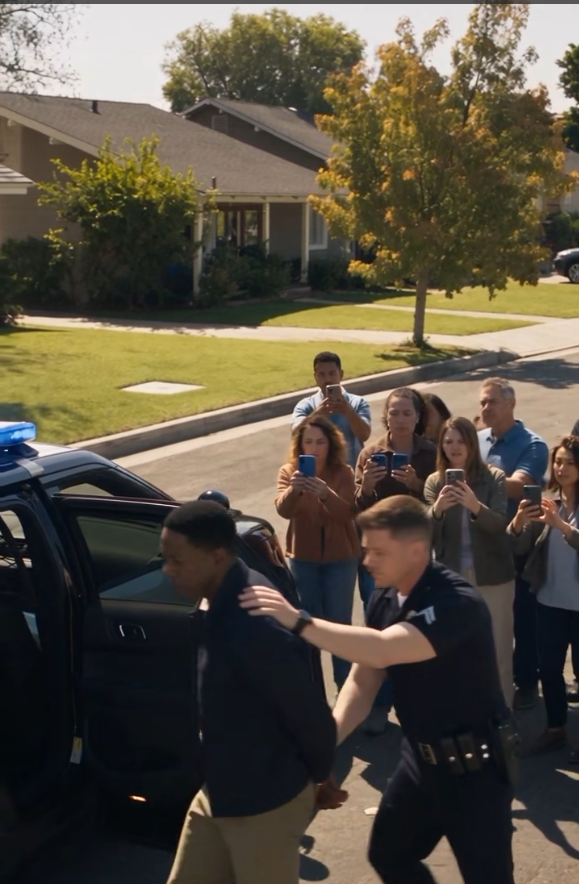
“Mr. Reed, describe what happened before Officer Miller placed you in handcuffs.”
Marcus did.
No speeches.
No conclusions.
He described the neighbor.
The SUV.
The questions.
His identification.
The request to search.
His refusal.
The detention.
Kendra asked, “Did you tell Officer Miller your occupation before being handcuffed?”
“No.”
“Did you tell him you worked for the certification board?”
“No.”
“Did you threaten to report him to the board?”
“No.”
“Did you tell him he might lose his certification?”
“No.”
“What did you say immediately before he handcuffed you?”
Marcus looked toward Miller.
Miller looked back.
“I asked, ‘Officer, are you sure you want to continue this?’”
“Why?”
Marcus considered the question.
“Because the legal basis for the detention had become unclear to me, and his behavior suggested he was making decisions faster than he was explaining them.”
“Were you trying to intimidate him?”
“No.”
“Did you expect him to know who you were?”
“No.”
“Then why phrase it that way?”
Marcus glanced toward the panel.
“Because I had spent most of my career reviewing situations in which people made a second bad decision because they felt committed to the first one.”
Kendra let that sit.
“What did you want him to do?”
“Pause.”
Nothing more.
She turned a page.
“When Ms. Hayes arrived with her credential, you told her not to interfere.”
“Yes.”
“Why?”
“I didn't know what Miller was going to do next, and I didn't want my position to become part of the encounter.”
“Yet eventually you identified what the credential represented.”
“Yes.”
“Why?”
“Because by then he had ordered her away, refused her request to call a supervisor, and stated several times that he was the person in charge.”
Kendra nodded.
“Did the treatment change once Sergeant Torres recognized you?”
“Yes.”
“How?”
“The cuffs came off.”
“Anything else?”
Marcus looked toward the table where Miller sat.
“The tone changed.”
Kendra stepped back.
“No further questions.”
Miller's attorney rose.
His cross-examination was careful.
“Mr. Reed, you are aware that officers sometimes detain individuals while investigating uncertain circumstances?”
“Yes.”
“You agree a detention does not automatically constitute misconduct?”
“Yes.”
“You agree officers may make mistakes without being unfit for certification?”
“Yes.”
“Officer Miller did not strike you?”
“No.”
“Did not threaten to strike you?”
“No.”
“Did not draw a weapon?”
“No.”
“Did not use profanity?”
“No.”
“Did you suffer a physical injury requiring treatment?”
“No.”
The attorney paused.
“You've spent fourteen years evaluating police conduct?”
“Approximately.”
“So when you asked Officer Miller, ‘Are you sure you want to continue this?’ you understood that such a statement might carry unusual weight if he knew who you were.”
“If he knew.”
“Even if he did not?”
Marcus thought about it.
“It could have sounded unusual.”
“Could it sound like a warning?”
“Yes.”
The attorney nodded.
“So Officer Miller's interpretation wasn't impossible.”
“No.”
Kendra looked toward Marcus.
He knew what she was thinking.
Do not help her.
Do not hurt Miller.
Just answer.
The attorney continued.
“If the panel concludes that Officer Miller made a poor judgment under ambiguous circumstances but honestly believed you were threatening professional consequences, would you accept that conclusion?”
Marcus looked toward the five panel members.
“I'll accept whatever conclusion the evidence supports.”
The attorney waited, perhaps hoping for more.
Marcus gave him nothing.
After Marcus was excused, he returned to the hallway.
He sat on the same bench.
Nearly two hours passed before Miller testified.
Marcus could not hear him.
Inside, Miller took the oath and adjusted the microphone.
Kendra remained at the lectern.
“Officer Miller—”
His attorney corrected her.
“Former Officer Miller.”
Kendra nodded.
“Mr. Miller. Why did you place Mr. Reed in handcuffs?”
“To control the scene while I investigated the suspicious-person call.”
“What made the scene uncontrolled?”
“He was challenging my instructions.”
“How?”
“He kept asking why he was being detained.”
“Did he refuse to provide identification?”
“No.”
“Try to leave?”
“No.”
“Refuse to step where you directed him?”
“Not exactly.”
“Raise his voice?”
“No.”
“Threaten you?”
Miller paused.
“Not directly.”
Kendra displayed his original report.
“You wrote that Mr. Reed ‘repeatedly invoked his position with the Commonwealth certification board in an apparent effort to influence lawful police action.’ Correct?”
“Yes.”
“When did he first tell you he worked for the board?”
Miller looked toward the document.
“He didn't say the words exactly.”
Kendra waited.
“When did you first learn his occupation?”
“When Sergeant Torres identified him.”
“Was that before or after you handcuffed him?”
“After.”
“Before or after Ms. Hayes displayed the credential?”
“After.”
“Before or after you told Ms. Hayes you didn't care what was in her case?”
“After.”
Kendra moved closer to the witness table.
“Then how could Mr. Reed repeatedly invoke a position you did not know he held?”
Miller looked toward his attorney.
His attorney remained still.
Miller answered, “I understood what he meant.”
“How?”
“The way he said it.”
“Which words?”
“Are you sure you want to continue this?”
“That's the statement?”
“Yes.”
“Anything else?”
“No.”
Kendra picked up the revised report.
“After Sergeant Torres rejected your first report, you changed ‘repeatedly invoked his position’ to ‘made statements that Officer Miller interpreted as suggesting professional consequences.’ Correct?”
“Yes.”
“Why?”
“Because she wanted it more precise.”
“Was it more precise?”
“Yes.”
Kendra turned toward the panel.
Then back.
“Mr. Miller, when Mr. Reed asked whether you were sure you wanted to continue, you did not know who he was.”
“Correct.”
“You did not know his occupation.”
“Correct.”
“You did not know Ms. Hayes was coming.”
“Correct.”
“You had not seen a board credential.”
“Correct.”
“So what professional consequence did you think he was suggesting?”
Miller opened his mouth.
Nothing came out.
Kendra waited.
Finally he said, “People threaten complaints all the time.”
“Did he?”
“Not in those words.”
“Did he mention your supervisor?”
“No.”
“Internal affairs?”
“No.”
“A lawsuit?”
“No.”
“The board?”
“No.”
“Your badge?”
“No.”
“Your job?”
“No.”
Kendra's voice never changed.
“Then what did he actually threaten?”
Miller stared at her.
“He challenged me.”
The answer hung in the room.
Kendra did not move.
“That's not the same thing.”
Miller's face tightened.
“I was trying to do my job.”
“I didn't ask what you were trying to do.”
His attorney stood.
“Objection. Argumentative.”
“Sustained,” the panel chair said.
Kendra nodded.
She returned to the lectern.
“Let's try a different question. When you wrote the original report, did you know by then that Mr. Reed was executive director of this board?”
“Yes.”
“And did knowing that affect how you remembered his earlier words?”
Miller looked toward the tabletop.
The hearing room remained completely quiet.
His attorney shifted slightly in his chair.
Miller could have said no.
The body-camera footage could not read his mind.
No video could prove when an interpretation formed.
No witness could testify to the instant a memory changed.