Miller knew it.
Kendra knew it.
The panel knew it.
For almost ten seconds, the only sound was ventilation moving through the ceiling.
Then Miller looked up.
“Yes.”
Kendra did not react.
“How?”
Miller rubbed his palms once against his trousers.
“When Torres said who he was, I replayed everything he'd said.”
“And?”
“It sounded different.”
“Different from how it sounded when he said it?”
“Yes.”
“Did you understand that distinction when you wrote the report?”
Miller looked toward Marcus's empty chair in the witness area.
“Yes.”
“Did you include it?”
“No.”
“Why not?”
His attorney lowered his eyes.
Miller breathed out.
“Because by then I needed what I had done to make sense.”
No one moved.
Kendra's next question came quietly.
“Even if the report didn't?”
Miller stared straight ahead.
“Yes.”
Kendra closed her folder.
“No further questions.”
Part V — The Choice
The panel recessed for lunch.
Marcus learned nothing about Miller's testimony until Kendra walked into his office after seven that evening.
The building was almost empty.
Marcus was reviewing an academy curriculum proposal that he had read three times without absorbing.
Kendra closed the door.
“The evidentiary portion is over.”
He put down the document.
“Am I allowed to ask how it went?”
“No.”
“Then why are you here?”
“Because tomorrow the panel decides whether to accept written impact statements before deliberation.”
Marcus frowned.
“Mine?”
“You're the complainant.”
“I testified.”
“Different thing.”
“What would an impact statement address?”
“The effect of the conduct and your view concerning disposition.”
Marcus leaned back.
“You want me to recommend a sanction.”
“I didn't say that.”
“It's what they want.”
“They're allowing you to.”
Marcus stood and walked toward the window.
The state-office complex was dark except for pools of light around the parking lot.
“What are the available outcomes?”
“You know them.”
“I know them generally.”
“Reprimand. Conditions. Suspension. Revocation. Or no certification action.”
Marcus nodded.
Kendra placed a blank form on his desk.
“You have until nine tomorrow morning.”
He looked at it.
“What did Miller say today?”
“No.”
“Kendra.”
“You chose recusal.”
“I know.”
“Then choose it when it's inconvenient too.”
Marcus picked up the form.
She started toward the door.
“Do you think I should submit one?”
Kendra stopped with her hand on the knob.
“That isn't a legal question.”
“No.”
She turned.
“As your friend?”
Marcus nodded.
Kendra considered him.
“I think the panel has spent six weeks hearing people describe what you experienced. You're entitled to tell them what mattered to you.”
“That's not the same as asking for punishment.”
“It doesn't have to be.”
After she left, Marcus remained at his desk.
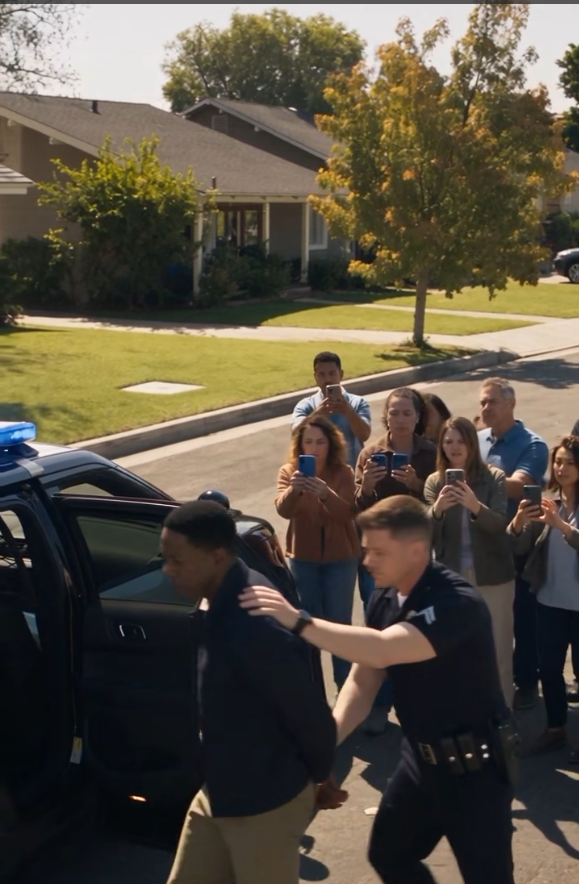
He placed the impact form beside the sidewalk photograph included in his witness packet.
The image had been taken by one of the teenagers.
Marcus stood beside the cruiser, wrists behind his back. Miller was slightly out of frame. Across the street, phones were visible in nearly every direction.
Marcus had spent much of his career believing that certification systems worked best when insulated from emotion.
Standards.
Evidence.
Findings.
Consistency.
Those things mattered.
But systems were built to govern human conduct, and human conduct always left someone standing somewhere afterward.
Sometimes beside a cruiser.
Sometimes behind a desk.
Sometimes in a hearing room explaining why a sentence in a report was not true.
Marcus took out a pen.
He began writing.
At 8:57 the next morning, Kendra handed his sealed statement to the panel.
Miller and his attorney received a copy.
Miller read it twice.
It was less than one page.
I am not asking this panel to revoke Daniel Miller's certification because I was handcuffed.
Officers make poor judgments. Training can correct some poor judgments. Supervision can correct others.
I am asking the panel not to treat my position as an aggravating factor. What happened should not matter more because the person detained happened to be me.
What concerns me most is that the encounter changed once my occupation became known, and the written account changed after the encounter in a way that made earlier conduct appear more defensible.
Certification is not a guarantee that an officer will never make a mistake. It is a public representation that the officer can be trusted with legal authority and can truthfully account for how that authority was used.
I ask the panel to decide this matter exactly as it would if I were a mechanic, teacher, warehouse worker, nurse, or unemployed resident whose name carried no institutional weight.
If the evidence supports continued certification, continue it.
If it does not, do not preserve it because the case became politically uncomfortable.
The standard should survive the identity of the complainant.
Miller finished reading.
His attorney leaned close.
“He didn't ask for revocation.”
“No.”
“That helps.”
Miller kept looking at the page.
“No, it doesn't.”
The attorney glanced at him.
“Why?”
Miller folded the statement carefully.
“Because now I can't tell myself he's doing this to me.”
The panel deliberated for nearly four hours.
Marcus stayed in his office.
Kendra stayed with staff in a conference room.
Torres waited at headquarters, working a desk assignment while her own supervisory review remained open.
At 2:18 p.m., the certification board reconvened.
The panel chair read the findings.
The first concerned the detention.
The panel found Miller lacked a sufficiently articulated basis to prolong the encounter after confirming Marcus's identity and connection to the vehicle. His decision to use handcuffs, though not accompanied by physical injury or threats, represented an unnecessary escalation.
Standing alone, the chair said, that conduct might have justified remedial conditions or a temporary suspension rather than revocation.
Miller closed his eyes briefly.
Then came the second finding.
The reporting.
The panel found that Miller's original written account materially distorted the sequence by attributing knowledge and intent to Marcus that Miller could only have formed after learning who Marcus was.
His revised report was more accurate but still failed to explain that the alleged professional “threat” was an interpretation created retrospectively.
Then the chair quoted Miller's own testimony.
Because by then I needed what I had done to make sense.
The chair looked directly at him.
“Police authority includes the power to detain, arrest, search under lawful circumstances, use reasonable force, initiate criminal process, and create official records upon which courts, prosecutors, agencies, and the public may rely. Errors in judgment can occur within that system. Deliberate distortion of the record compromises the system's ability to identify and correct those errors.”
Miller stared at the table.
The chair continued.
The panel had voted four to one.
Daniel Miller's Commonwealth law-enforcement certification was revoked.
Effective immediately.
He could petition for eligibility review after the statutory waiting period, but no reinstatement would be automatic.
There were no cameras inside the room other than the official hearing feed.
No crowd.
No neighbors.
No shouting.
Miller listened to the rest of the order without visible reaction.
When it ended, he stood.
His attorney gathered their files.
Kendra remained at the staff table.
Miller looked at her.
“Is Reed here?”
“No.”
“Did he know before we walked in?”
“No.”
Miller nodded slowly.
Then he left.
The story could have ended there.
It did not.
The systemic review remained.
And it was harder.