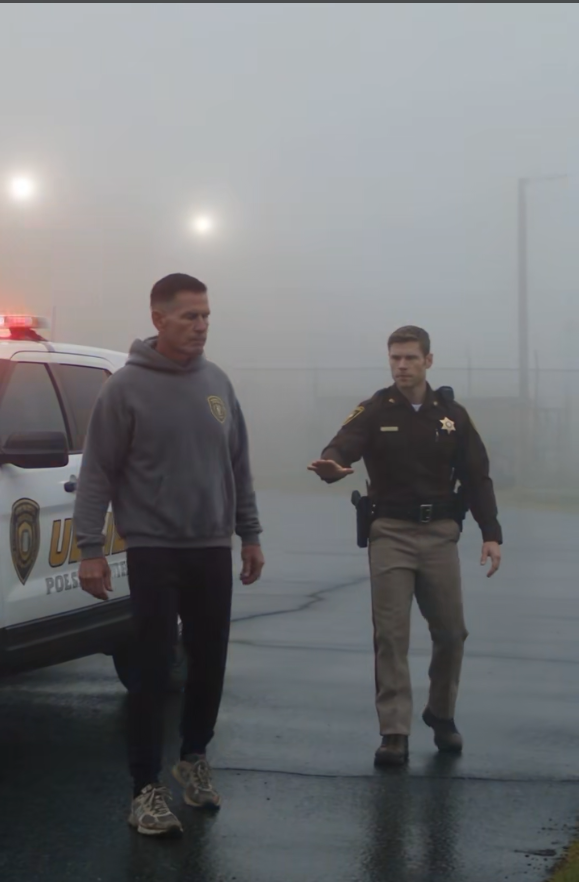
“This isn't about embarrassing the sheriff's department,” I said.
“I know.”
“Do you?”
Her eyes stayed on mine.
“Yes, sir.”
I nodded toward the chair.
She sat.
“If Lawson had stopped me, asked questions, even detained me briefly while he verified identity, we'd have nothing to discuss. But dispatch explicitly offered to contact installation law enforcement, and he refused.”
Mercer wrote something.
“He also confiscated your notebook.”
“Yes.”
“MPs recovered it?”
“No.”
Her pen stopped.
“What?”
“It wasn't returned.”
“Could still be in his vehicle.”
“Could be.”
She looked up.
“You think that's important?”
“I don't know yet.”
That became the phrase of the morning.
I don't know yet.
Good commanders learn to respect it.
Certainty is seductive. Especially after humiliation.
By nine, Lieutenant Colonel Rachel Kim from the staff judge advocate's office had arrived.
She listened without interrupting while I described the encounter.
When I finished, she asked, “At any point did you physically resist?”
“No.”
“Did you threaten him with your rank?”
“No.”
“Did you order military personnel to detain or interfere with him?”
“No.”
“Did he explain the basis for arrest?”
“He said trespassing, then suspicious activity.”
“Were you on military property?”
“Not when he approached me.”
Kim looked at Mercer.
Mercer nodded.
“We pulled the survey map. General Henderson was on the county easement.”
Kim closed her folder.
“Then we have two separate issues. One is the encounter itself. The other is whether the county has a broader pattern of stops involving installation personnel near that boundary.”
I leaned back.
“Why would you say that?”
Kim hesitated.
That was unusual for her.
“Because this isn't the first complaint.”
The room changed.
Mercer stopped writing.
“How many?” I asked.
“I'm not sure.”
“Rachel.”
“Sir, over the past year, legal assistance received several informal reports from soldiers about interactions with county deputies near the north annex and housing corridor.”
“What kind of interactions?”
“Vehicle stops. Pedestrian questioning. Searches.”
“Lawful?”
“Some may have been.”
“And the others?”
“They were never formally pursued.”
“Why?”
Kim chose her words carefully.
“Junior soldiers often don't file complaints when the matter ends without charges.”
I looked at Mercer.
“How many did you know about?”
“None.”
Kim said, “They came through separate channels. Legal assistance. Equal opportunity. A unit commander in one case. They weren't connected.”
“Until now.”
“No, sir.”
Rain ran in thin sheets down the window.
I thought of Lawson's first questions.
Casing the place?
Stealing copper?
Not who are you.
Not do you need help.
Not did someone report you.
He had started with a story already written.
“Find every complaint connected to that corridor for the last two years,” I said.
Kim nodded.
Mercer said, “That will get attention.”
“Good.”
“From the county.”
“Also good.”
She looked at me for another second.
“You're certain you want to widen this?”
I turned my wrist over.
The cuff mark had darkened.
“This stopped being personal the moment Rachel said there were other complaints.”
By Monday morning we had eleven.
Eleven documented interactions involving soldiers, civilian employees, or military family members along the northern boundary and adjacent county roads.
Not all were improper.
That mattered.
One soldier had been speeding twenty-two miles over the limit. Another had an expired registration. A civilian contractor had crossed a clearly posted restricted access area while taking a shortcut.
Those did not concern me.
Four others did.
A specialist walking home from a late shift had been detained for forty-three minutes because he “did not appear to belong in the area.”
A sergeant had been ordered out of her vehicle after stopping on the shoulder to take a phone call.
A civilian network technician had been searched after photographing damaged utility infrastructure he had been assigned to inspect.
And six months earlier, a young private named Luis Ortega had been handcuffed near almost the exact location where Lawson stopped me.
No charges.
No citation.
No formal arrest record.
Just a notation in an internal legal assistance memo: soldier reports aggressive county contact; declined complaint.
I had Ortega brought to headquarters Monday afternoon.
He entered my office looking as if he expected a court-martial.
“Relax, Private.”
“Yes, sir.”
He sat on the edge of the chair.
He was twenty-one. Maybe twenty-two.
“I'm not investigating you.”
“Yes, sir.”
“You had an encounter with a county deputy near North Service Road in March.”
His eyes dropped.
“Yes, sir.”
“Deputy Lawson?”
He looked up sharply.
That was my answer before he spoke.
“Yes, sir.”
“What happened?”
Ortega rubbed one thumb across the side of his index finger.
“I was coming back from the gas station.”
“On foot?”
“Yes, sir. My car was in the shop. He stopped and asked where I was going.”
“And?”
“I said base housing.”
“He ask for ID?”
“Yes, sir.”
“You had it?”
“Yes.”
“Military?”
“And state.”
“What happened next?”
A pause.
“He said military ID didn't prove I lived there.”
I kept my voice level.
“What did he do?”
“Put me against the car. Searched me.”
“Why?”
“He said I matched a description.”
“What description?”
“He looked at the carpet.
“Private.”
“He never told me.”
“Were you arrested?”
“No, sir.”
“Cited?”
“No.”
“How long were you detained?”
“I don't know. Half hour. Maybe longer.”
“Did he handcuff you?”
“Yes, sir.”
“Why didn't you file a complaint?”
His face tightened, not dramatically. Just enough.
“My squad leader told me I could.”
“But?”
Ortega looked toward the window.
“I didn't think anything would happen.”
“Why not?”
He gave a tiny shrug.
“I was a private.”
The sentence sat between us.
Not angry.
Not accusing.
Just factual.
I had heard variations of it during three decades of command.
I'm only a private.
I'm only a spouse.
I'm only a civilian.
I didn't think anyone would care.
I looked at him.
“Did Lawson say anything else?”
Ortega hesitated.
“He asked if I was really in the Army.”
“Why?”
“I don't know.”
“Exact words if you remember.”
Another pause.
“He looked at my ID and said, ‘They let anybody in now.’”
I felt Mercer shift beside the bookcase.
I did not.
“Thank you, Private.”
Ortega stood.
At the door I stopped him.
“One more thing.”
“Yes, sir?”
“What would you have wanted your chain of command to do differently?”
He thought about that longer than any other question.
“Believe me before it happened to somebody important.”
Then he left.
Mercer closed the door.
Neither of us spoke for several seconds.
Finally she said, “That one hurt.”
“It should.”
Sheriff Thomas Warren arrived at 1500.
He was sixty, broad through the shoulders, with silver at his temples and the practiced calm of someone who had spent years in elected office without losing the habits of a patrol officer.
He brought his undersheriff and county counsel.
I brought Mercer and Kim.
No press.
No photographers.
No one in the room benefited from theater.
Warren began.
“General, first, I want to apologize for what happened Saturday.”
“I appreciate that.”
“Deputy Lawson exercised poor judgment.”
“That appears clear.”
“He has been placed on administrative duty while we review the incident.”
“Good.”
Warren folded his hands.
“I'd like to keep this from damaging a relationship both our communities rely on.”
“So would I.”
Something eased in his face.