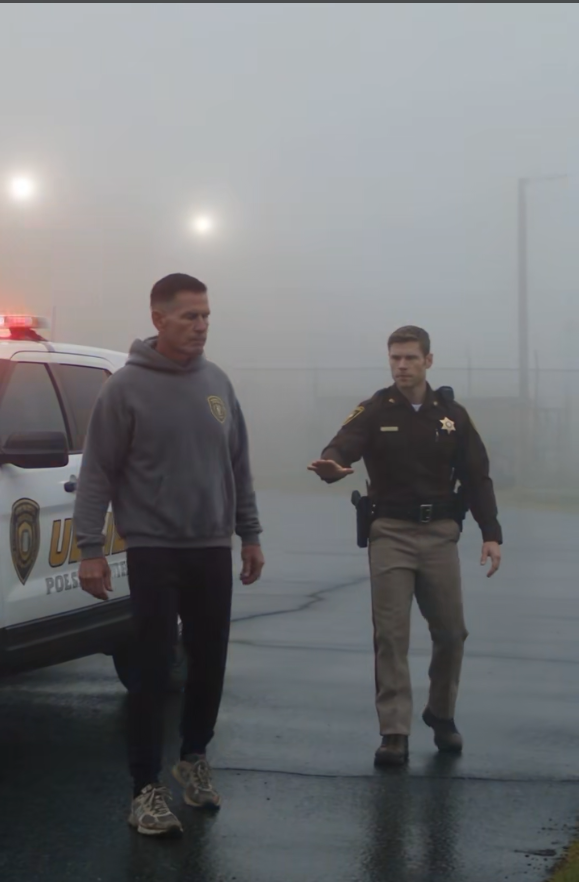
Then I placed the Ortega memo on the table.
“This is why that won't be enough.”
Warren read the first page.
His expression didn't change much.
Professionals in difficult jobs learn not to perform surprise.
“Where did you get this?”
“My legal office.”
“This was never filed with us.”
“I know.”
“That matters.”
“It does.”
I set down another summary.
“And these?”
He read.
The undersheriff leaned closer.
Warren looked at me.
“What are you asking for?”
“A joint review of contacts involving military-affiliated personnel along the installation boundary for two years.”
County counsel immediately spoke.
“That raises privacy and jurisdictional issues.”
Kim answered.
“We can structure it appropriately.”
Warren never looked away from me.
“You believe my department is targeting soldiers?”
“I didn't say that.”
“What do you believe?”
“I believe I don't have enough information yet.”
He sat back.
“That sounds careful.”
“It is.”
“You're a general.”
“Yes.”
“You know how this works. If we announce a joint review, people will assume guilt before we establish facts.”
I thought about Ortega sitting in the chair that morning.
“They already assumed guilt,” I said. “That's how we got here.”
The room became very quiet.
Warren looked down at the papers again.
Finally he nodded once.
“I'll cooperate.”
His county counsel turned toward him.
“Sheriff—”
“I said I'll cooperate.”
Then he looked at me.
“But I expect the same standard applied to your people. No selective evidence. No using my deputy as a symbol before we know what happened.”
“Agreed.”
He rose.
At the door, he stopped.
“General.”
“Yes?”
“Brad Lawson's father was a deputy here for twenty-eight years.”
I said nothing.
“Good cop. Died when Brad was nineteen.”
“Why are you telling me?”
“Because everybody has context.”
I looked at him.
“Context isn't immunity.”
“No.”
Warren opened the door.
“But it can matter when you decide what justice looks like.”
Part III — The Missing Notebook
The security notebook disappeared.
At first, nobody used that word.
Lawson said he had placed it on the front passenger seat of his cruiser.
The military police officers who met him said they never saw it.
His body-camera footage showed him taking it from my pocket.
It showed him flipping through the pages.
Then, for nearly four minutes, his camera went black.
Not powered off.
Obstructed.
County policy allowed officers to cover the camera when changing clothes, using a restroom, or discussing protected information.
None of those circumstances applied.
When the video returned, Lawson was standing beside the cruiser talking to dispatch.
The notebook never appeared again.
Colonel Mercer found me watching the video Tuesday evening.
“Again?” she asked.
“Third time.”
“You're not going to find new pixels.”
“No.”
She set a sandwich on my desk.
“I've noticed generals also require food.”
“So I've been told.”
She looked at the frozen image on my monitor.
Lawson's hand was partially visible at the bottom of the frame.
“You think he destroyed it.”
“I think I don't know.”
“Still using that line?”
“It's served me well.”
She sat across from me.
“Security wants to know what was in the notebook.”
“Mostly infrastructure deficiencies.”
“Anything classified?”
“No.”
“Sensitive?”
“Yes.”
“How sensitive?”
I rubbed my forehead.
“Gate weaknesses. Camera blind spots. Sensor obstruction. Patrol timing observations.”
Mercer went still.
“Patrol timing?”
“Approximate.”
“That notebook can't stay missing.”
“I know.”
She glanced at the screen.
“Could Lawson understand what those notes meant?”
“Enough to know they mattered.”
“Then why take it?”
“Maybe he didn't.”
She frowned.
“You think somebody else did?”
“I think we're getting ahead of evidence.”
She unwrapped half the sandwich and pushed it toward me.
“Eat while being disciplined.”
I took it.
Mercer had served with me years earlier when we were both colonels. She was one of the few people who could tell me I was being stubborn without phrasing it as a compliment.
After a minute she said, “You know what people are saying.”
“Which people?”
“Your staff.”
“That narrows it to several hundred.”
“They think you're going soft on Lawson.”
I looked at her.
“Because I haven't demanded his badge?”
“Because he put you in cuffs and you're acting like an inspector general.”
“I am acting like a commander.”
“Those two jobs overlap more than anyone admits.”
I took a bite.
She waited.
“What do you think?” I asked.
“I think what he did to Ortega matters more than what he did to you.”
“So do I.”
“And I think if that notebook leaked, we have a security problem larger than misconduct.”
“So do I.”
“Then why do I get the sense there's something you're not saying?”
I set the sandwich down.
Because there was.
“The citizen report.”
“What about it?”
“I listened to the dispatch recording.”
“And?”
“The caller said a man was photographing the fence.”
“You weren't.”
“No.”
“They could have mistaken the notebook.”
“The caller said he had a backpack.”
“You didn't.”
“Correct.”
Mercer leaned forward.
“So the call wasn't about you.”
“Maybe.”
“Or it was fabricated.”
“Maybe.”
“Do we have the number?”
“Blocked.”
“Voice?”
“Male. Short call. No name.”
Mercer looked at the monitor.
“This gets stranger.”
“Yes.”
I opened another file.
“Security pulled incident reports for Sector Four.”
She read the top page.
Three times in eight months, communications equipment near the northern annex had experienced unexplained service disruptions.
Nothing catastrophic.
Short outages.
A damaged exterior junction box.
A severed fiber conduit initially blamed on road work.
A motion sensor that had failed because moisture entered its housing.
Individually, routine problems.
Together, not quite a pattern.
But patterns often begin as things reasonable people dismiss.
Mercer looked up.
“You think somebody's probing the perimeter.”
“I think somebody may have noticed the same weaknesses I did.”
“And called county dispatch to put a deputy on you?”
“That would require knowing I was there.”
“Did anyone know?”
I thought.
My aide knew I often ran early.
Security knew I planned to inspect the annex before Monday.
Mercer knew.
No one had my exact schedule.
Except—
“Alpha Checkpoint.”
“What?”
“I told the duty officer Friday evening I'd leave my Jeep near the secondary access lot before dawn.”
Mercer stood.
“I'll get the access logs.”
“No.”
She stopped.
“If this is internal, don't alert anyone yet.”
Her eyes narrowed.
“You seriously think someone inside—”
“I seriously think we don't know.”
There it was again.
But this time the phrase felt less like discipline and more like warning.
The access logs produced one anomaly.
At 04:51 Saturday morning, a civilian maintenance credential had been used at a service entrance near the northern annex.
Authorized hours began at 06:00.
The credential belonged to a subcontractor named Northwest Systems Maintenance.
The individual assigned that credential was not scheduled to work.
Security verified that by noon Wednesday.
The contractor himself was in Oregon attending his daughter's wedding.
His badge had been cloned.
That changed everything.
I called Sheriff Warren personally.
He arrived within an hour.
When I explained, he stopped looking like an elected official defending his department.
He looked like a cop.
“You think Saturday's caller was connected.”
“We don't know.”
“But you think it.”
“I think we have unauthorized access ninety minutes before I'm stopped near the same sector.”
“Did they get inside?”
“Credential opened an outer service gate. Interior access was denied.”