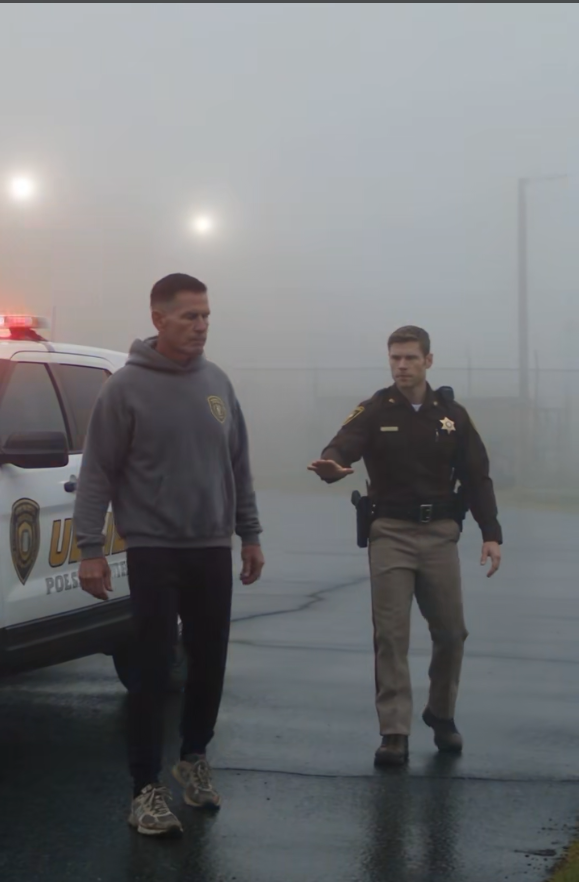
Warren looked at Mercer.
“Cameras?”
“Fog and vegetation obscured one. Another had been offline intermittently.”
He exhaled through his nose.
“Exactly the vulnerabilities you were checking.”
“Yes.”
He turned back to me.
“And your notes vanish.”
“Yes.”
For several seconds nobody spoke.
Then Warren said, “Lawson.”
“What about him?”
“He'd been working that corridor overtime for months.”
Mercer looked sharply at him.
“You didn't mention that.”
“I didn't know it mattered.”
I said, “Why was he assigned there?”
“He volunteered for traffic and property patrols around the north county roads. We have theft complaints out there. Scrap metal. Vehicle break-ins.”
“Did he file reports?”
“Some.”
“How often was he near the installation boundary?”
Warren looked uncomfortable.
“I'll find out.”
“And the anonymous calls?”
“What about them?”
“Pull every one tied to his stops.”
Warren's eyes settled on me.
“You think he manufactured probable cause.”
“I think we're done assuming this is one bad morning.”
Lawson asked to meet me Thursday.
His attorney objected.
Lawson insisted.
Sheriff Warren called first.
“He says he'll only talk to you.”
“That's not how an investigation works.”
“I told him.”
“And?”
“He said there's something you need to know before internal affairs interviews him again.”
“Is his lawyer present?”
“Will be.”
“Then Kim will be present too.”
The meeting took place in a neutral conference room at county headquarters.
Lawson looked different without the tactical vest.
Smaller, somehow.
Not physically.
Institutionally.
A badge, radio, armor, duty belt—those things create silhouette as much as authority.
He sat beside an attorney in a dark suit.
Kim sat beside me.
Lawson looked at my wrists first.
The marks had faded to yellow.
“I didn't steal your notebook,” he said.
No greeting.
His attorney touched his arm.
“Brad.”
“I didn't.”
I folded my hands.
“Then tell investigators what happened to it.”
“I did.”
“You said you left it in your cruiser.”
“I did.”
“Your camera was blocked for four minutes.”
“I leaned against the car.”
“Conveniently.”
His eyes flashed.
For a second I saw the deputy from Saturday.
Then it disappeared.
“You think I set you up.”
“I think you're responsible for your own decisions.”
“That isn't what I asked.”
“No. I don't know who set up what.”
Lawson stared at the table.
His attorney said, “Deputy Lawson requested this meeting because he believes certain information may be relevant to installation security.”
Kim's pen stopped.
Lawson swallowed.
“About two months ago, I started getting calls.”
“Anonymous?”
“Yes.”
“What kind?”
“Suspicious people near the fence. Vehicles parked where they shouldn't be. Copper theft. Photography.”
“Were the calls real?”
He looked at me.
“Some.”
“Meaning?”
“I'd get there and find somebody.”
“Military personnel?”
“A few.”
“Like Private Ortega?”
Lawson looked away.
“Yes.”
“Was there a call before you detained him?”
A pause.
“Yes.”
“Do you still have a record of it?”
“Dispatch might.”
Warren had already checked.
They didn't.
The call came through the nonemergency administrative line and was entered manually by a dispatcher who no longer remembered it.
I asked, “What did the callers sound like?”
“Usually a man.”
“Same voice?”
“I thought so.”
“Why didn't you report that?”
“Why would I? People call police.”
“Did he ever give you information that turned out to be accurate?”
“Yes.”
“What?”
Lawson rubbed his thumb along the table's edge.
“Someone cutting fencing. A stolen utility trailer. Two guys stripping wire from an abandoned structure.”
That mattered.
A source who was right often enough could train an officer to trust him.
“Did the caller ever talk to you directly?”
Lawson nodded.
“My department number was publicly listed.”
His attorney glanced at him.
“This is the part you hadn't previously disclosed.”
“Yes.”
I waited.
Lawson looked at me.
“He called me after the Ortega stop.”
“What did he say?”
“Said the Army wouldn't do anything because it protected its own.”
I felt Kim shift beside me.
“And?”
“He said people around the base lied constantly about who they were.”
“Did you believe him?”
“At the time.”
“At the time?”
Lawson's jaw tightened.
“Saturday morning, dispatch sent me because of an anonymous suspicious-person call.”
“There was no mention of that in your initial report.”
“I know.”
“Why?”
“Because after the MPs showed up, I knew how it looked.”
I let that sit.
“You omitted evidence because it made you look bad?”
“I omitted it because I panicked.”
“That's not better.”
“I know.”
He looked directly at me for the first time.
“After they took you back to base, I found an envelope under my windshield wiper.”
Kim leaned forward.
“What envelope?”
“Plain white. No name.”
“What was inside?”
He reached into the folder in front of his attorney.
The attorney stopped him.
“It's been photographed and provided to county investigators.”
Lawson slid a clear evidence sleeve across the table.
Inside was a single sheet of paper.
Three typed lines.
YOU FINALLY FOUND SOMEONE IMPORTANT.
NOW THEY'LL LOOK AT YOU INSTEAD OF THE FENCE.
THANK YOU.
For the first time since Saturday, anger gave way to something colder.
Not fear.
Recognition.
I had spent enough years around adversaries to know manipulation when I saw it.
Lawson had not been the architect.
He had been used.
That did not absolve him.
In some ways, it made his choices more important.
Someone had studied him well enough to know exactly which weakness to exploit.
Certainty.
Pride.
Suspicion.
The need to be right.
“Why didn't you turn this over immediately?” I asked.
Lawson's face hardened with shame.
“Because by then everybody already thought I was an idiot.”
Kim said, “So you withheld evidence in an active security matter?”
“I didn't know it was a security matter.”
I looked at him.
“You knew enough to hide it.”
He looked back at me.
“Yes.”
The room was still.
Then he said something I did not expect.
“General, the person doing this knew me.”
“How?”
“They knew what I'd do.”
Part IV — Reckoning
The investigation split into two tracks.
County internal affairs handled Lawson's conduct.
Federal and military investigators handled the installation security breach.
I removed myself from direct investigative control where my own arrest created a conflict. That irritated some people who wanted decisive action and reassured others who feared I would turn institutional power into personal retaliation.
Both groups misunderstood the same thing.
Command is not the freedom to do anything.
It is the obligation to know when you should not.
I continued receiving briefings.
The anonymous caller had contacted the sheriff's department seventeen times in nine months.
Eleven calls resulted in deputy responses.
Eight involved Lawson.
Three involved other deputies.
The calls had two characteristics.
First, most were credible enough to generate a response.
Second, several directed police attention toward ordinary people while minor security incidents occurred elsewhere along the northern perimeter.
A distracted patrol.
A searched vehicle.
A detained pedestrian.
Meanwhile, a camera cable was cut fifty yards away.
A gate alarm tripped.
A communications junction box was opened.
None of the incidents had produced major damage.
That was what worried me.
Professionals do not always begin by stealing secrets.
Sometimes they begin by measuring response.
How long until someone notices?
Who gets called?
Which agency responds?
What assumptions do people make?
Where does jurisdiction create friction?