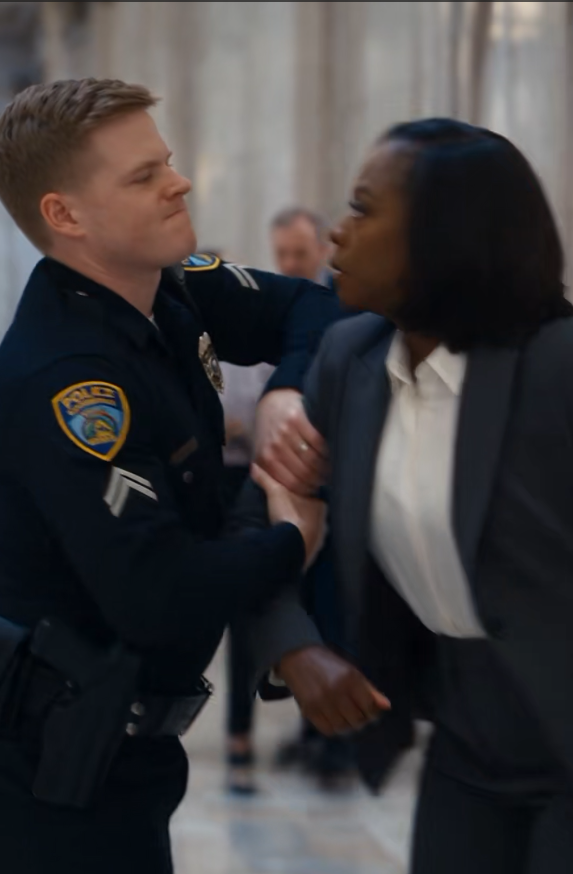
“Because people complain to me. Or to a clerk. Or to a lawyer. Then they go home.”
“What kinds of incidents?”
“He’s rough with people.”
“Define rough.”
“Grabs arms. Crowds them. Talks down to them.”
“Has he struck anyone before?”
“Not that I know.”
“Threatened arrest?”
“Yes.”
“For what?”
“‘Failure to follow lawful orders.’”
I sat across from him.
“How many times?”
Thomas shook his head.
“I don’t know.”
“More than three?”
“Yes.”
“More than ten?”
He looked away.
That was the answer.
“Why didn’t you report it?”
His face tightened.
“I did.”
I stopped.
“To whom?”
“My supervisor.”
“When?”
“Three months ago.”
“What happened?”
“Nothing I could see.”
“Do you have it in writing?”
He hesitated.
“Yes.”
I leaned back.
That changed everything.
Not because it proved Miller had violated policy before.
But because it meant the department had notice.
“Where?”
“Email.”
“Preserve it.”
“I already forwarded it to Internal Affairs.”
“Good.”
I stood.
Thomas remained seated.
“Judge.”
I stopped at the door.
“There’s more.”
I turned.
He reached into a desk drawer and took out a small spiral notebook.
The cover was bent.
“I started writing things down.”
“When?”
“After the second complaint.”
He handed it to me.
I did not open it.
“This needs to go to Internal Affairs.”
“It will.”
“Not me.”
“I know.”
“Then why show me?”
“Because you need to understand what they’re going to say.”
I looked at him.
“What are they going to say?”
“That this was one bad morning.”
He tapped the notebook.
“It wasn’t.”
By ten, the courthouse administrator had issued a building-wide instruction requiring all staff to route media inquiries to communications.
By eleven, the police union released a statement.
It acknowledged that “a regrettable physical interaction” had occurred.
It emphasized that Miller had been “attempting to locate a noncompliant defendant.”
It cited “conflicting accounts regarding resistance.”
It asked the public not to prejudge.
No mention of the dispatch description.
No mention of Thomas.
No mention of the fact that Miller had addressed me as “Black coat.”
At noon, I was eating half a turkey sandwich at my desk when Chief Judge Ellis came in.
He closed the door.
“You’ve seen the statement?”
“Yes.”
“What do you think?”
“I think every noun was negotiated.”
He sat.
“The county wants you not to comment.”
“I wasn’t planning to.”
“Good.”
“Does the county want Miller not to comment?”
Ellis sighed.
“The union is speaking for him.”
“Convenient.”
He folded his hands.
“There is another complication.”
I waited.
“The Reynolds case.”
“What about it?”
“She was arrested yesterday afternoon.”
I stared at him.
“For failure to appear?”
“No. She showed up.”
“Then why?”
“A probation warrant from another matter.”
I sat back.
“That means the media will find her.”
“They already have.”
I understood immediately.
If Maya Reynolds became a public face in the story, people would compare us.
Judge.
Defendant.
Respectable.
Unrespectable.
Correct victim.
Incorrect victim.
The whole conversation could become about whether Miller’s conduct was wrong because he did it to me instead of whether it was wrong.
I hated the shape of that trap before anyone had set it.
Ellis saw it too.
“Be careful.”
“With what?”
“With being drawn into public comparison.”
“I won’t be.”
“I know.”
He stood.
Then he paused.
“I’ve known Reeves thirty years.”
“That sounds ominous.”
“He’s not reckless.”
“Neither was Miller, apparently. He was certain.”
Ellis frowned.
“That’s not fair.”
“No. It isn’t.”
He looked at me for a long moment.
“You’re angry.”
“Yes.”
“That can be useful.”
“I know.”
“It can also make every compromise look like corruption.”
“I know that too.”
He nodded.
Then he left.
That afternoon, Captain Ruiz called.
“We found the camera issue.”
“Meaning?”
“The corridor camera was offline because the network switch on that floor failed at 7:14 a.m.”
“Accident?”
“Yes.”
“Confirmed?”
“Yes.”
I felt an unexpected release.
Part of me had been waiting for a darker explanation.
“What about witnesses?”
“Consistent.”
“How consistent?”
“Very.”
“Any support for Miller’s claim that I struck him?”
“No witness has described that.”
I let the words settle.
“Any footage elsewhere?”
“The elevator bank camera catches part of the interaction through the glass reflection.”
I sat straighter.
“How much?”
“Not much. No audio. Oblique angle.”
“What does it show?”
“Miller stopping you. Physical contact. Your briefcase falling.”
“The strike?”
“Partially. His arm movement is visible. Your head movement is visible.”
“Enough?”
“For the administrative investigation, combined with witnesses, yes.”
“For criminal?”
She paused.
“That decision belongs to the prosecutor.”
Of course.
I had spent half my career telling clients that evidence strong enough for one process might not be strong enough for another.
Now the distinctions felt less elegant.
“What else?”
Ruiz hesitated.
“We reviewed prior complaints.”
Thomas’s notebook.
“How many?”
“Formal or informal?”
“Both.”
“Five documented concerns in eight months.”
I closed my eyes.
“Nature?”
“Two for unnecessary physical handling. Two for discourteous conduct. One for improper detention.”
“Outcomes?”
“Counseling. No sustained misconduct.”
“Why?”
“Insufficient evidence. No video. Conflicting statements.”
“And Thomas’s report?”
“It was routed to his supervisor.”
“What happened?”
“Nothing documented.”
I opened my eyes.
“Nothing?”
“Not that we’ve found.”
“Who was the supervisor?”
“Lieutenant James Cole.”
I knew the name.
Not personally.
Miller’s chain of command.
Ruiz continued.
“There’s another fact.”
“What?”
“Miller had been advised six weeks ago to reduce direct physical intervention unless necessary.”
“That sounds more serious than counseling.”
“It was verbal.”
“Documented?”
“Briefly.”
“Why was he advised?”
“Three incidents in two weeks.”
I stood and walked to the window.
Rain had stopped.
The city beyond the courthouse looked washed out and flat.
“What are you telling me, Captain?”
“I’m telling you we’re no longer examining only what happened Tuesday.”
I turned.
“What are you examining?”
“Whether the department had enough information to intervene earlier.”
There it was.
The story had changed.
Not from officer versus judge.
From incident to pattern.
That evening, Maya Reynolds appeared on television.
I did not watch live.
Andrea sent me the clip.
Maya was twenty-seven, tall, slim, long braids over one shoulder. She stood outside the county detention center in a tan coat.
Exactly as dispatch had described her.
A reporter asked what she thought about being mistaken for a judge.
Maya looked at him.
Then she said, “I think the judge got mistaken for me.”
The reporter tried to clarify.
Maya didn’t let him.
“No. Don’t do that. She wasn’t mistaken for a judge. She was mistaken for me. And apparently that made it okay to put hands on her until somebody said she was important.”
I watched the clip twice.
Then a third time.
Not because she had defended me.
Because she had stated the problem more cleanly than anyone else had.
The next morning, I asked Andrea for Maya’s case file.
She looked at me over her glasses.
“You’re conflicted now.”
“I know.”
“You can’t touch her case.”
“I know.”
“Then why?”
“I want to know what happened Tuesday.”
Andrea hesitated.
Then slid the administrative movement sheet toward me.
Maya had checked in at pretrial services at 8:41 a.m.