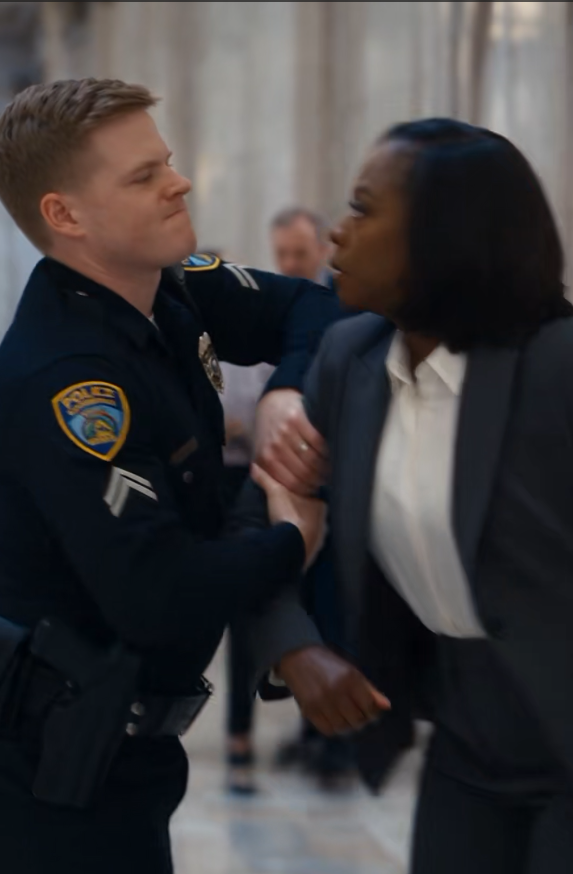
She had signed a log.
A clerk directed her to 4B.
She went to the third floor by mistake.
At 8:52, 4B asked for a courthouse officer to locate her.
At 8:57, Officer Miller acknowledged the radio call.
At 9:02, he stopped me.
At 9:05, Thomas arrived.
At 9:08, Maya Reynolds entered courtroom 4B.
She had not been fleeing.
She had not been hiding.
She had been lost.
That detail was almost too ordinary to bear.
The dangerous defendant trying to escape had been a confused twenty-seven-year-old woman in the wrong stairwell.
The whole event had grown from an assumption piled on another assumption.
The following Monday, Internal Affairs requested a second interview.
This time, the union attorney was not present.
Neither was Chief Reeves.
Only Ruiz and an investigator named David Chen.
Ruiz placed a thick file on the table.
“We’re near completion.”
“Near?”
“There’s one issue.”
“What?”
“Officer Miller has changed part of his statement.”
I sat back.
“How?”
“He now says he did not hear the physical description from dispatch.”
“But he acknowledged the call.”
“He says he acknowledged before the description finished due to radio overlap.”
“Is there overlap?”
“No.”
“Then why say it?”
Ruiz didn’t answer.
Chen slid a transcript toward me.
Miller’s statement was typed.
I read the relevant paragraph.
I believed the subject matched the general description provided over dispatch. Due to radio interference, I did not hear all identifying details.
I looked up.
“That’s false.”
“We believe the recording contradicts it.”
“Believe?”
“We have to phrase findings precisely.”
I pushed the transcript back.
“What does he say about the slap?”
“He continues to describe it as a defensive distraction strike after you made contact with his wrist.”
“That is not what happened.”
“I know your statement.”
“No. I’m saying the sequence matters. He reached for me.”
Ruiz nodded.
“We have three witnesses who describe that.”
“Then why are we still using his language?”
“We’re not. We’re documenting it.”
I studied her.
She looked exhausted.
“Captain, what do you think happened?”
She paused.
It was the first time I had asked her personally.
The first time she allowed herself to answer.
“I think Officer Miller decided who you were before he reached you.”
I said nothing.
She continued.
“I think every action after that was interpreted through his first conclusion. Your denial became deception. Your legal knowledge became defiance. Your attempt to pull away became resistance.”
Chen looked toward her.
Ruiz didn’t stop.
“And I think when you knocked his hand away, he reacted to losing control of the encounter.”
The room felt smaller.
“That’s what I think,” she said. “The report will say what we can establish.”
I nodded.
“That’s fair.”
She closed the file.
“One more question.”
“Yes?”
“If disciplinary charges are sustained, there may be a hearing. Would you testify?”
I did not answer immediately.
I had spent a week hoping the evidence would speak for itself.
But evidence never speaks.
People speak for it.
“Yes,” I said.
Part IV — Reckoning
The findings came on a Thursday.
The department sustained four charges against Bradley Miller.
Improper detention.
Excessive force.
Conduct unbecoming.
Untruthfulness during an administrative investigation.
The fifth finding was broader.
Supervisory failure.
Lieutenant James Cole had received prior concerns and had not initiated a formal performance review.
Chief Reeves requested Miller’s termination.
The union appealed.
That appeal was how the case moved from investigation into spectacle.
The hearing was scheduled for January.
By then, the bruise on my face had faded.
The effect of it had not.
People treated me differently in the courthouse.
Some became overly careful.
Officers I had known for years greeted me with a stiffness that had not existed before.
Attorneys asked if I was “doing okay” in lowered voices.
Defendants looked at me longer.
One woman standing for sentencing said, “I saw you on TV.”
I told her, “We’re here about your case.”
But I understood what she meant.
The incident had changed the distance between us.
Before, I had been the judge.
After, I was also someone who had been stopped, disbelieved, grabbed, and accused of resistance.
That did not make me better at my job.
It made some things harder to ignore.
In December, a defense attorney challenged an officer’s testimony in a suppression hearing.
The officer said he had smelled marijuana before opening a car door.
Body camera footage showed he mentioned the smell only after searching.
Before November, I would still have examined the discrepancy.
Now I heard the structure of certainty differently.
The language.
The sequence.
The small sentence that appeared after the fact and made everything before it seem reasonable.
I suppressed the evidence.
Not because of Miller.
Because the record required it.
But when I issued the ruling, I knew I had become more disciplined about separating an officer’s confidence from proof.
That was uncomfortable to admit.
So was the reverse.
Sometimes an officer was right.
Sometimes a defendant lied.
Sometimes force was lawful.
The lesson was not that authority was always wrong.
The lesson was that certainty deserved evidence.
In early January, Thomas asked to see me.
He came to chambers carrying the same battered notebook.
“I got subpoenaed.”
“So did I.”
He nodded.
“I’m retiring.”
I looked at him.
“When?”
“End of the month.”
“Because of this?”
“No.”
He smiled slightly.
“Because my knees are sixty-eight and my wife has been threatening divorce if I miss another spring.”
“You’re not married.”
“Exactly. She’s very committed to the threat.”
I laughed despite myself.
Then his expression changed.
“I stayed too long.”
“At the courthouse?”
“In some ways.”
He sat across from me.
“When you work somewhere long enough, you learn which problems become paperwork and which problems disappear.”
“That sounds bleak.”
“It’s practical until it isn’t.”
He looked at the notebook.
“I wrote things down. I told a supervisor. Then I went back to work.”
“You did more than most.”
“Not enough.”
“That’s easy to say after.”
“Yes.”
He met my eyes.
“That’s why I’m saying it now.”
I understood.
He wasn’t asking absolution.
He was naming his part.
That required something I respected more than self-punishment.
Accuracy.
The termination hearing began on a Monday morning in a county administrative building six blocks from the courthouse.
I entered through the front doors.
Public entrance.
No private elevator.
No robe.
Charcoal suit again, though not the same one.
I chose it deliberately.
The hearing officer was a retired judge named Evelyn Park.
She sat at the center of a long table.
Department counsel on one side.
Union counsel on the other.
Miller sat beside his attorney.
It was the first time I had seen him since the hallway.
He looked thinner.
His face had lost the flushed certainty I remembered.
For a moment, neither of us looked away.
Then his attorney spoke to him.
He turned.
I sat in the witness area.
The department presented the radio recording.
Dispatch.
Description.
Acknowledgment.
Then the elevator reflection footage.
It was grainy.
There I was.
A dark figure in a suit.
Miller approaching.
A stop.
Movement.
His arm.
My head.
My briefcase falling.