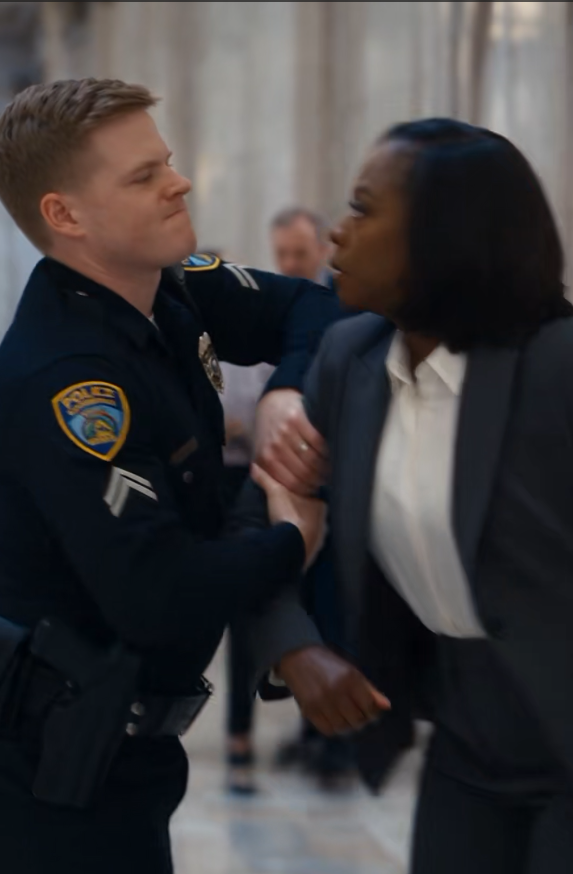
Watching it was worse than remembering.
Memory contains intention.
Video does not.
It showed only bodies.
That made it harder to argue with.
Thomas testified first.
He described Miller’s prior behavior.
The comments.
The earlier complaints.
His email to a supervisor.
Union counsel attacked the notebook.
“You began documenting Officer Miller because you disliked him?”
“No.”
“You had disagreements?”
“I’ve had disagreements with everyone in that courthouse.”
A few people smiled.
Counsel did not.
“You used the phrase ‘rough with defendants.’ That’s subjective, isn’t it?”
“Yes.”
“You’re not a use-of-force instructor.”
“No.”
“You’re not a police officer.”
“No.”
“So you’re giving personal impressions.”
“I’m giving what I saw.”
“Which is your interpretation.”
Thomas leaned toward the microphone.
“I know the difference between moving someone and hurting them because you can.”
Counsel objected.
Park sustained.
Thomas sat back.
But the sentence had landed.
When my turn came, I swore the oath.
Department counsel, Maria Benton, began simply.
“State your name.”
“Josephine Caldwell.”
“Occupation?”
“Superior Court judge.”
“How long?”
“Six years.”
“Prior occupation?”
“Public defender. Fifteen years.”
She walked me through the morning.
Slowly.
Miller’s attorney objected twice.
Once to characterization.
Once to hearsay.
Park ruled.
Then came cross-examination.
Union counsel’s name was Gregory Sloan.
He was skilled.
Quiet.
He did not need aggression.
“Judge Caldwell, you agree Officer Miller had been dispatched to locate a defendant?”
“Yes.”
“You agree that defendant had not appeared in court when expected?”
“She had not yet appeared.”
“So yes?”
“Yes.”
“You did not identify yourself with physical identification when requested.”
“No.”
“You told him verbally you were a judge.”
“Yes.”
“But you did not produce ID.”
“No.”
“You attempted to walk past him.”
“Yes.”
“He put a hand on your arm.”
“Yes.”
“You pulled away.”
“Yes.”
“You then struck his wrist.”
“I knocked his hand away when he reached for me again.”
“So you made physical contact.”
“Yes.”
He paused.
That was the first trap.
Not a lie.
A frame.
“And immediately after that contact, Officer Miller struck you.”
“Yes.”
“So from his perspective—”
“Objection.”
Benton stood.
“Calls for speculation.”
“Sustained.”
Sloan nodded.
“Judge Caldwell, did Officer Miller know you were a judge at that point?”
“I told him.”
“That wasn’t my question. Did he know?”
“I can’t know what he believed.”
“Exactly.”
He walked two steps.
“He believed you were Maya Reynolds.”
“He said I was.”
“And because he believed that, he treated you as a person he had been ordered to locate.”
I looked at him.
“No.”
He paused.
“No?”
“He treated me as a person he had already decided was lying.”
Sloan’s expression barely changed.
“You refused identification.”
“I declined to hand over ID after telling him who I was and asking why I was being detained.”
“You refused a police directive.”
“I questioned its basis.”
“You pulled away from him.”
“Yes.”
“You knocked his hand aside.”
“Yes.”
“Yet you characterize his response as wholly unprovoked.”
“I did not use that phrase.”
He glanced at his notes.
“No, you didn’t.”
Then he looked up.
“Judge, you are trained to argue.”
“I’m trained to listen too.”
“Fifteen years as a public defender?”
“Yes.”
“You have cross-examined hundreds of police officers?”
“Yes.”
“Challenged their credibility?”
“When appropriate.”
“Accused officers of improper searches?”
“When supported by evidence.”
“Excessive force?”
“Yes.”
“False testimony?”
“Yes.”
“So you came into this encounter with strong views about police authority.”
I understood what he was doing.
Building bias backward.
“I came into the encounter trying to get to work.”
A ripple moved through the room.
Park looked up.
Sloan paused.
Then continued.
“You were angry.”
“After he grabbed me, yes.”
“You were confrontational.”
“No.”
“You refused.”
“Yes.”
“You challenged.”
“Yes.”
“You physically redirected his hand.”
“Yes.”
“Those actions escalated the encounter.”
I looked directly at him.
“No. His decision escalated the encounter.”
“What decision?”
“To make my identity fit his assumption.”
Sloan stopped.
Benton watched me.
Park wrote something.
Sloan changed direction.
“You believe race played a role.”
“Yes.”
“You cannot read Officer Miller’s mind.”
“No.”
“You don’t know whether he is racist.”
“I did not call him racist.”
“You said race played a role.”
“Yes.”
“Based on what?”
I could have said the phrase.
You people.
I could have said his identification of me despite the description.
I could have said the speed with which he dismissed my title.
Instead I answered carefully.
“Based on what he knew and what he ignored.”
Sloan waited.
I continued.
“He had a description of a twenty-seven-year-old Black woman, five-foot-nine, long braids, tan coat. I matched one feature.”
Sloan’s jaw moved.
“That feature being race.”
“Yes.”
He looked toward his client.
Then back to me.
“No further questions.”
I stepped down.
Miller testified the following day.
I did not have to attend.
I went anyway.
His voice was different from the hallway.
Measured.
Controlled.
He said courthouse duty required quick decisions.
He said defendants sometimes lied about identity.
He said judges occasionally moved through public areas without robes.
He admitted hearing part of dispatch.
He denied hearing all details.
He insisted he believed I was Maya Reynolds.
He said he became suspicious when I refused ID.
Then Benton asked the question that changed the hearing.
“Officer Miller, when Judge Caldwell told you she was Judge Caldwell, what did you do to verify that?”
He hesitated.
“I requested identification.”
“Did you radio dispatch?”
“No.”
“Did you call courtroom 6A?”
“No.”
“Did you ask a bailiff?”
“No.”
“Did you check the courthouse directory?”
“No.”
“Did you ask her where her courtroom was?”
“She said sixth floor.”
“Did you know judges have chambers on six?”
“Yes.”
“So what did you do to test whether her statement was true?”
Miller looked toward his attorney.
Then back.
“I ordered her to identify herself.”
Benton nodded.
“Meaning give you ID.”
“Yes.”
“And when she did not?”
“I detained her.”
“Before determining whether she was telling the truth.”
“She was noncompliant.”
“That wasn’t my question.”
Miller’s face changed.
Only slightly.
But I saw the hallway again.
That same irritation with being questioned.
Benton repeated herself.
“Did you detain her before determining whether her statement was true?”
“Yes.”
“And when she asked the legal basis?”
“I believed she was the defendant.”
“Because?”
“She matched the description.”
Benton lifted a sheet of paper.
“Twenty-seven?”
Silence.
“Five-nine?”
Silence.
“Long braids?”
Silence.
“Tan coat?”
His attorney objected.
“Argumentative.”
Park overruled.
Benton lowered the paper.
“Officer, what did she match?”
Miller stared ahead.
“She was a Black female in the area.”
There it was.
No drama.
No shouting.
Just the sentence.
The entire room seemed to understand that something had ended.
Part V — Final Confrontation
Three days later, the hearing reached its final stage.
Closing arguments were scheduled for morning.
I expected to listen and leave.
Then Maria Benton called me at 7:10 a.m.
“There’s a development.”
“What kind?”
“Miller wants to submit a supplemental statement.”
“Why?”
“He says there’s context he didn’t provide.”
“What context?”
“He alleges his supervisor pressured him to increase courthouse stops because leadership was worried about missed appearances.”
I sat on the edge of my bed.
“Cole?”