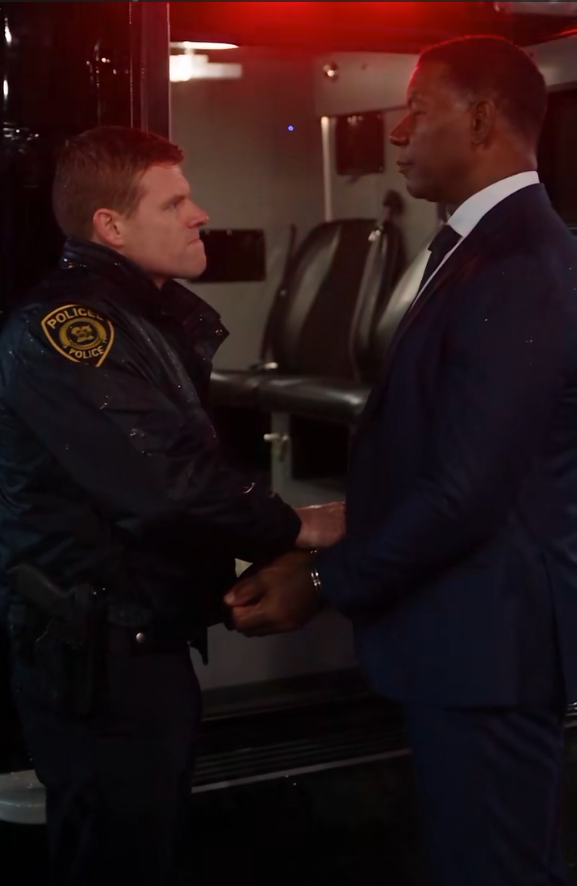
David rubbed neither wrist.
He simply brought his hands to his sides.
Miller came around the desk.
“Mr. Harrison—Agent Harrison—”
“Special Agent Harrison is fine.”
“I apologize.”
David looked at him.
“Were you on scene?”
“No.”
“Then don’t apologize for something you didn’t do.”
Miller stopped.
David nodded toward his property.
“Where is my firearm?”
Jenkins answered.
“In evidence intake.”
“Has anyone handled it besides you?”
“No.”
“My secure device?”
“Evidence tray.”
“My Tahoe?”
Silence.
David looked at Higgins.
The rookie answered.
“Tow was requested, but I don’t think it arrived before we left.”
Miller swore under his breath.
David turned to him.
“Cancel it. No civilian tow operator approaches that vehicle. Send a unit to secure the location and tell them not to enter, move, photograph, or inventory the interior.”
Miller was already reaching for the radio.
David added, “And Sergeant?”
Miller looked up.
“Do not broadcast the nature of the vehicle or my position over open radio.”
“Understood.”
Jenkins shifted.
“This is getting ridiculous.”
Miller stared at him.
“No. It got ridiculous about forty minutes ago.”
The secure line rang again.
This time, David held out his hand.
Miller passed him the receiver.
“Harrison.”
A voice spoke.
David listened.
“I’m fine.”
Another pause.
“No. No emergency response.”
Jenkins looked at Miller.
David continued.
“Send one liaison. That’s all. The vehicle needs a secure recovery team if local officers touched the communications system.”
He listened again.
“No injuries requiring treatment.”
He glanced at his wrists.
“Minor abrasions.”
Another pause.
“I said I’m fine.”
He hung up.
Jenkins stared at him.
“Who was that?”
David met his eyes.
“You don’t need to know.”
And for the first time all night, Jenkins had no answer.
Part II — Pressure
The station changed after the second phone call.
No alarms sounded.
No agents burst through the doors.
No convoy arrived with flashing lights.
The transformation was quieter than that.
And because it was quiet, it frightened Jenkins more.
Sergeant Miller closed the side entrance.
A patrol officer who had been eating from a vending machine was told to remain in the report room.
The evidence technician was instructed not to touch the firearm Jenkins had logged.
Dispatch was told that the Tahoe on Georgetown Pike was not to be moved until federal personnel arrived.
Every order was delivered in a calm voice.
Every calm instruction made the mistake look larger.
David stood beside the desk while Miller found a clean towel.
“You can dry off in my office.”
“I’m fine here.”
“You’re soaked.”
David looked down at his shirt.
“That’s true.”
Miller pointed.
“Office.”
David went.
Not because Miller outranked him.
Because he was tired enough to recognize kindness when it appeared.
The office was cramped, with two chairs, a metal filing cabinet, a framed photograph of Miller’s family, and an old retirement plaque from someone David did not know.
He dried his hair and face.
When he rolled his sleeves back, the marks from the cuffs were clearer.
The left wrist had opened in two places.
Nothing serious.
He had worked through worse.
But he knew enough about investigations to understand that “nothing serious” was not the same as “nothing important.”
He left the marks untouched.
Evidence mattered.
There was a knock.
Higgins stood in the doorway.
“Can I come in?”
David gestured toward the second chair.
The rookie remained standing.
Up close, he looked younger than David had first thought. Twenty-four, maybe twenty-five.
His wet hair was flattened against his forehead.
“Sir, I should have stopped it.”
David folded the towel.
“Could you have?”
Higgins looked down.
“I could’ve done more.”
“That’s a different question.”
Higgins nodded.
David studied him.
“What did you see before the arrest?”
“The vehicle.”
“What about it?”
“Government plates. Reinforced doors. Communications equipment. Your credential looked real.”
“You’ve seen a Secret Service credential before?”
“No.”
“Then how did you know?”
“I didn’t. It just didn’t look like something printed in a basement.”
David almost smiled.
Almost.
Higgins continued.
“You were calm.”
“Calm people can lie.”
“I know.”
“What else?”
Higgins hesitated.
“You told him exactly where your ID was before moving.”
“Yes.”
“You told him about the firearm.”
“Yes.”
“You kept asking him to verify you.”
David nodded.
“That should have mattered.”
“It did to me.”
“Not enough.”
The words landed harder than David intended.
Higgins absorbed them.
“No, sir.”
David leaned back.
“That doesn’t mean you should have tackled your partner on the shoulder of the road.”
“I know.”
“Do you?”
Higgins looked at him.
David’s voice stayed level.
“The worst thing you can do after seeing one officer misuse authority is decide the solution is another officer acting without judgment.”
Higgins was silent.
“You had options,” David said. “Call your supervisor. Verify independently. Slow the stop down. Document your objection clearly. Use the radio if necessary.”
“I thought he’d calm down.”
“That was your mistake.”
Higgins frowned.
David looked toward the open doorway where Jenkins stood somewhere out of sight.
“You were waiting for his personality to solve a problem his personality created.”
Higgins nodded slowly.
“Yes, sir.”
A voice came from the hall.
“Bradley. Conference room.”
Miller.
Higgins stepped aside.
Jenkins walked past without looking in.
His face was rigid.
David stood.
Higgins said, “Are they going to arrest him?”
David looked at him.
“I don’t know.”
“You don’t?”
“No.”
Higgins seemed surprised.
David picked up his credential case from the desk where Miller had returned it.
“My job is not deciding what happens to Officer Jenkins.”
“But you’re the person he arrested.”
“That makes me a witness.”
Higgins considered that.
David walked toward the conference room.
“Tonight, learn the difference.”
Lieutenant Karen Ellis arrived twelve minutes later.
She wore civilian clothes beneath a raincoat and carried the expression of someone who had been awakened by a phone call she already knew would ruin the rest of her night.
Miller met her in the corridor.
David remained in the report room, close enough to hear voices but not words.
He used Miller’s office phone to make one call.
His wife answered on the fourth ring.
“David?”
He heard sleep and immediate concern in her voice.
“Hey.”
“You’re not home.”
“I know.”
“What happened?”
“Traffic stop.”
There was a pause.
“You’re calling from a police station.”
He looked at the wall.
“Yes.”
“Were you in an accident?”
“No.”
“Are you hurt?”
“No.”
A second pause.
She knew him too well.
“How hurt?”
He smiled tiredly.
“Two scratches.”
“David.”
“I’m fine.”
“What happened?”
He looked through the office window.
Jenkins sat alone at a table in the conference room while Lieutenant Ellis spoke to Miller outside.
“I got stopped. The officer didn’t believe my credentials.”
Silence.
Then: “He arrested you?”
“For a little while.”
Her voice changed.
“David.”
“I’m already out of cuffs.”
“That is not the reassuring sentence you think it is.”
He rubbed his forehead.
“I know.”
“Are you coming home?”
“Eventually.”
“Eventually tonight?”
“I don’t know.”
She sighed.
Not dramatically.
Just the sound of a woman who had spent many years married to a man whose work made ordinary timelines unreliable.