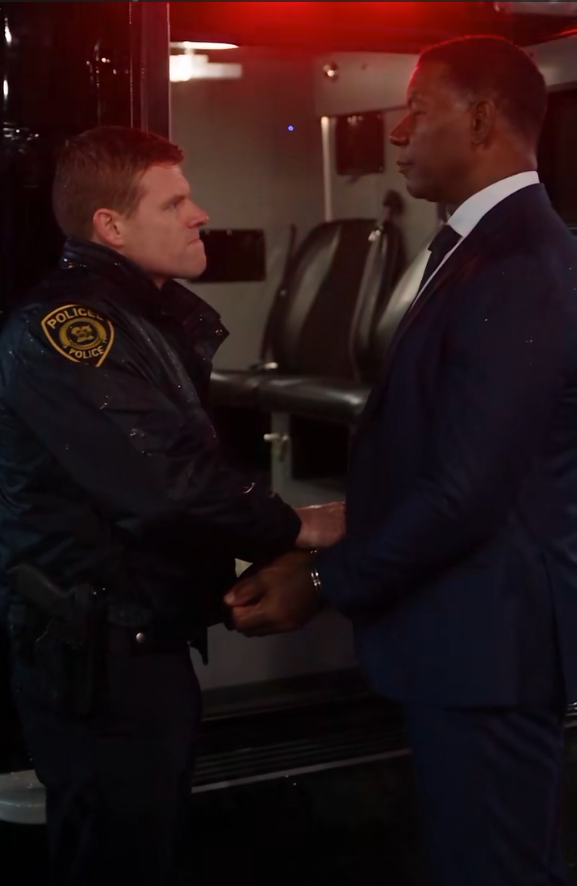
“Call me when you’re leaving.”
“I will.”
“And have somebody look at the scratches.”
“They’re scratches.”
“David.”
“Okay.”
“You’re lying.”
“About what?”
“You’re not going to have anybody look at them.”
He glanced at the blood drying near his wrist.
“I’ll clean them.”
“That was not what I said.”
He smiled despite himself.
“Go back to sleep.”
“I wasn’t asleep after seeing the time.”
He looked at the clock.
2:17 a.m.
“I’m sorry.”
“Just come home.”
“I will.”
He hung up.
For a few seconds, he sat alone.
That was when the fatigue returned.
Not all at once.
It settled behind his eyes and in the weight of his shoulders.
He wanted no investigation.
No meetings.
No calls to headquarters.
No official inquiry.
No news.
No explanation of why the Special Agent in Charge of the Presidential Protection Division had spent part of his night handcuffed in a county patrol car because a young officer refused to verify an ID.
He wanted his Tahoe.
He wanted his service weapon.
He wanted home.
But David had spent too much of his career understanding consequences to believe wanting simplicity made a problem simple.
A knock sounded.
Lieutenant Ellis stood there.
“Special Agent Harrison?”
David rose.
“David is fine.”
“Karen Ellis.”
They shook hands.
She looked at his wrists.
Her mouth tightened.
“Can we talk?”
“Of course.”
They went into the report room.
Ellis closed the door.
“I reviewed Sergeant Miller’s preliminary account.”
“That was fast.”
“He writes fast when he’s angry.”
David sat opposite her.
She remained standing.
“I need your statement.”
“You’ll have it.”
“I also need to know whether there are any immediate federal security concerns.”
“The vehicle.”
“We have two officers securing it.”
“Have they approached?”
“They’re parked fifty yards back.”
“Good.”
“A federal recovery team is on the way.”
“Yes.”
She nodded.
“Anything else?”
“My secure device was handled.”
“By Jenkins?”
“Yes.”
“Unlocked?”
“No.”
“Any chance information was exposed?”
“Very low.”
“But not zero.”
“Nothing involving the protectee’s immediate movements is stored openly on that device.”
Ellis exhaled.
“Good.”
David watched her.
“You’re trying to determine how bad this is.”
“I’m trying not to underestimate it.”
“That’s wise.”
She sat.
“What happened?”
David gave her the stop from beginning to end.
He did not dramatize.
He did not speculate about Jenkins’s motive.
He described the cruiser’s approach.
The stated lane violation.
His identification.
The request for verification.
The firearm.
The cuffs.
The phrase stop resisting.
The search of the Tahoe.
The transport.
The property handling.
Ellis took notes.
When he finished, she asked, “Did you refuse a lawful command?”
“No.”
“Raise your voice?”
“No.”
“Attempt to leave?”
“No.”
“Physically resist?”
“No.”
“Threaten Officer Jenkins?”
“No.”
“Tell him what would happen to him if he arrested you?”
“No.”
Ellis looked up.
“Did you identify your rank or title beyond saying you were a federal agent?”
“I told him my position when asked at the station. On the road, I identified myself as a sworn federal agent.”
“Why not say who you were more explicitly?”
David’s gaze hardened slightly.
“I gave him federal credentials.”
“That’s fair.”
“No, Lieutenant. It’s more than fair.”
Ellis held his gaze.
David continued.
“A twenty-year-old probationary agent and the head of my division should receive the same response to valid credentials.”
She nodded once.
“You’re right.”
David looked at her notebook.
“If your concern is whether I could have ended this sooner by making myself sound important, the answer is possibly.”
“That wasn’t what I meant.”
“I know.”
Ellis was quiet.
David added, “But it matters.”
“Yes.”
She closed the notebook.
“What do you want to happen?”
David’s answer came immediately.
“I want a factual investigation.”
“That’s all?”
“Yes.”
“No recommendation?”
“No.”
“You’re not angry?”
David looked toward the darkened hallway.
“That’s irrelevant.”
“It may be relevant to your complaint.”
“I haven’t made a complaint.”
Ellis blinked.
“You haven’t?”
“No.”
“You intend to?”
“I intend to give you a statement.”
She leaned back.
“Most people in your position would have called an attorney before talking to us.”
“Most people in my position aren’t required to make decisions while tired.”
“Meaning?”
“Meaning I know enough not to decide tonight what I want tomorrow.”
Ellis regarded him for a long moment.
“You’ve done this before.”
“Been arrested by local police?”
“No. Sat on the other side of a bad institutional night.”
David looked at his hands.
“Yes.”
A phone rang outside.
Ellis stood.
“That will probably be your people.”
“They’re not my people.”
She stopped.
David looked up.
“They’re federal employees coming to secure government equipment. That distinction matters too.”
For the first time, Ellis smiled faintly.
“I can see why people find you difficult.”
“So can my wife.”
She opened the door.
“Stay here.”
David raised an eyebrow.
Ellis corrected herself.
“Please.”
“Better.”
The federal liaison was Special Agent Marcus Hale.
David knew him well enough to trust him and not well enough to enjoy seeing him at three in the morning.
Hale entered wearing a dark field jacket, rain on his shoulders.
He looked at David.
Then at David’s wrists.
Then at Jenkins, who was still visible through the conference room window.
“Boss.”
“Hale.”
“You okay?”
“Yes.”
“That answer has already been identified as unreliable.”
“My wife called you?”
“No. I’ve worked for you six years.”
David stood.
“Vehicle?”
“Recovery team has it. Local tow never touched it.”
“Console?”
“One door was opened by Officer Jenkins. No secure compartment breach. We’ll inspect everything.”
“Weapon?”
Miller appeared carrying a sealed evidence box.
“We never processed it beyond intake.”
Hale accepted it only after checking the chain-of-custody form.
David watched.
Miller noticed.
“Trying to do this right from here forward.”
David nodded.
“That’s all anyone can do.”
Hale looked at him.
“Headquarters wants you examined.”
“No.”
“David.”
“No.”
“You were restrained.”
“I’m aware.”
“The abrasions need documentation.”
“They’re documented.”
Hale looked at Miller.
Miller raised both hands.
“I am staying out of this one.”
David sighed.
“Fine.”
Hale nodded toward a small first-aid room.
“Two minutes.”
“This is why I don’t like you.”
“You’ve told me.”
The medic cleaned the cuts.
No stitches.
No serious swelling.
Minor superficial injury.
Exactly as David had said.
Yet the photographs looked worse than he expected.
Two dark red rings against brown skin.
A small tear near the left wrist.
He looked at the image on the medic’s phone and felt something settle in him.
Not anger.
Something colder.
Documentation.
The mark would fade.
The decisions that caused it would not.
Part III — Reversal
By four-thirty in the morning, the immediate security concern had been contained.
David’s Tahoe was secured at a federal facility.
His service weapon was returned after chain-of-custody verification.
His communications device showed no unauthorized access.
Nothing sensitive had been compromised.
That should have reduced the incident.
Instead it stripped away Jenkins’s best possible defense.
There had been no hidden threat.
No counterfeit credential.
No unauthorized weapon.
No security breach caused by David.
Only a traffic stop that had gone wrong because one officer refused to slow down.